College of Pharmacy, Rady Faculty of Health Sciences, University of Manitoba, Winnipeg, Canada.
Manitoba Centre for Health Policy, Max Ray College of Medicine, Rady Faculty of Health Sciences, University of Manitoba, Winnipeg, Canada.
PLoS One. 2019 Aug 29;14(8):e0221921. doi: 10.1371/journal.pone.0221921. eCollection 2019.
Prenatal antibiotic exposure induces changes in infants' gut microbiota composition and is suggested as a possible contributor in the development of autism spectrum disorders (ASD). In this study, we examined the association between prenatal antibiotic exposure and the risk of ASD.
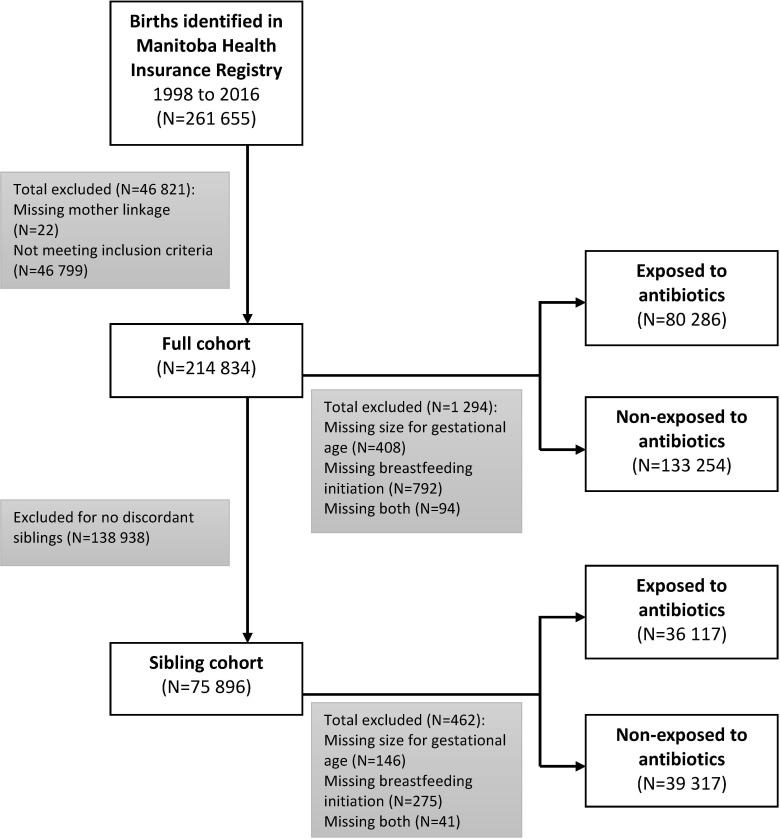
This was a population-based cohort study utilizing the Manitoba Population Research Data Repository. The cohort included 214 834 children born in Manitoba, Canada between April 1, 1998 and March 31, 2016. Exposure was defined as having filled one or more antibiotic prescription during pregnancy. The outcome was autism spectrum disorder diagnosis. Multivariable Cox proportional hazards regression was used to estimate the risk of developing ASD in the overall cohort and in a sibling cohort.
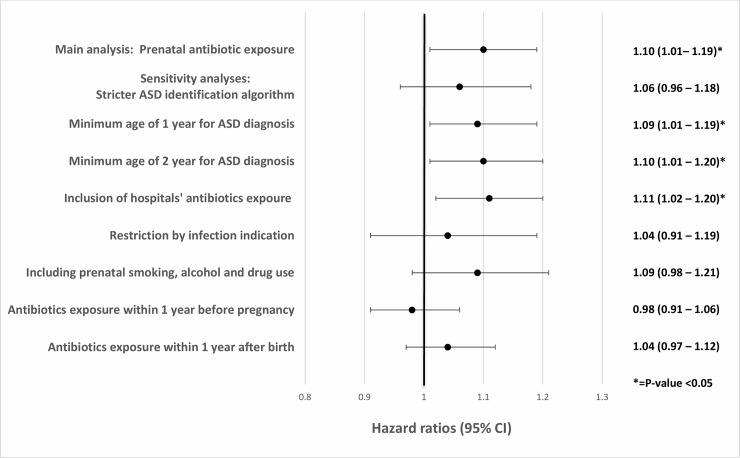
Of all subjects, 80 750 (37.6%) were exposed to antibiotics prenatally. During follow-up, 2965 children received an ASD diagnosis. Compared to children who were not exposed to antibiotics prenatally, those who were exposed had a higher risk of ASD: (adjusted HR 1.10 [95% CI 1.01, 1.19]). The association was observed in those exposed to antibiotics in the second or third trimester (HR 1.11 [95% CI 1.01, 1.23] and 1.17 [95% CI 1.06, 1.30], respectively). In the siblings' cohort, ASD risk estimate remained unchanged (adjusted HR 1.08 [95% CI 0.90, 1.30], although it was not statistically significant.
Prenatal antibiotic exposure is associated with a small increase in the risk of ASD. Given the potential of residual confounding beyond what it was controlled through our study design and because of possible confounding by indication, such a small risk increase in the population is not expected to be clinically significant.
产前抗生素暴露会改变婴儿肠道微生物群的组成,并被认为是自闭症谱系障碍(ASD)发展的一个可能因素。在这项研究中,我们研究了产前抗生素暴露与 ASD 风险之间的关系。
这是一项基于人群的队列研究,利用了马尼托巴人口研究数据资源库。该队列包括 1998 年 4 月 1 日至 2016 年 3 月 31 日期间在加拿大马尼托巴省出生的 214834 名儿童。暴露定义为在怀孕期间服用一种或多种抗生素。结果是自闭症谱系障碍的诊断。多变量 Cox 比例风险回归用于估计整个队列和同胞队列中 ASD 的发病风险。
在所有受试者中,有 80750 人(37.6%)在产前接受了抗生素治疗。在随访期间,有 2965 名儿童被诊断为 ASD。与未接受产前抗生素治疗的儿童相比,接受抗生素治疗的儿童患 ASD 的风险更高:(调整后的 HR 为 1.10 [95%CI 1.01,1.19])。这种关联在第二或第三孕期接受抗生素治疗的儿童中更为明显(HR 分别为 1.11 [95%CI 1.01,1.23]和 1.17 [95%CI 1.06,1.30])。在同胞队列中,ASD 风险估计值保持不变(调整后的 HR 为 1.08 [95%CI 0.90,1.30],尽管没有统计学意义。
产前抗生素暴露与 ASD 风险略有增加相关。鉴于我们的研究设计所控制的潜在残余混杂因素,以及可能存在的指示性混杂因素,这种人群中微小的风险增加预计不会具有临床意义。