Nottingham BBSRC Wheat Research Centre, School of Biosciences, University of Nottingham, Loughborough, Leicestershire, UK.
LGC Biosearch Technologies, Hoddesdon, Hertfordshire, UK.
Plant Biotechnol J. 2020 Mar;18(3):743-755. doi: 10.1111/pbi.13241. Epub 2019 Sep 30.
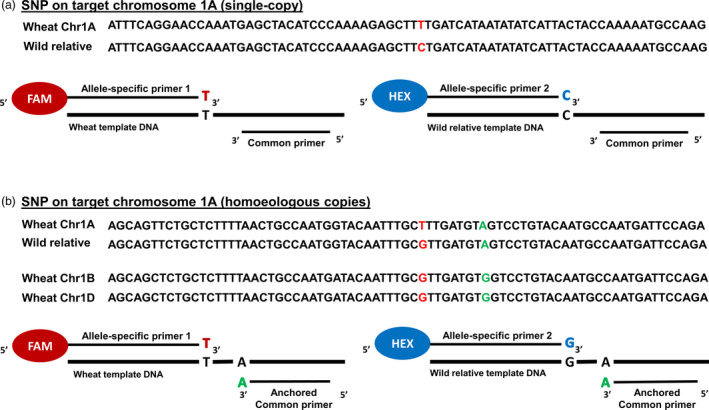
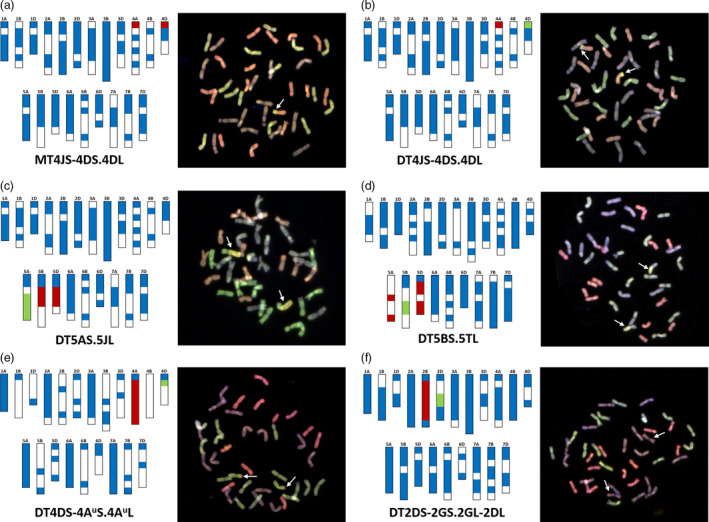
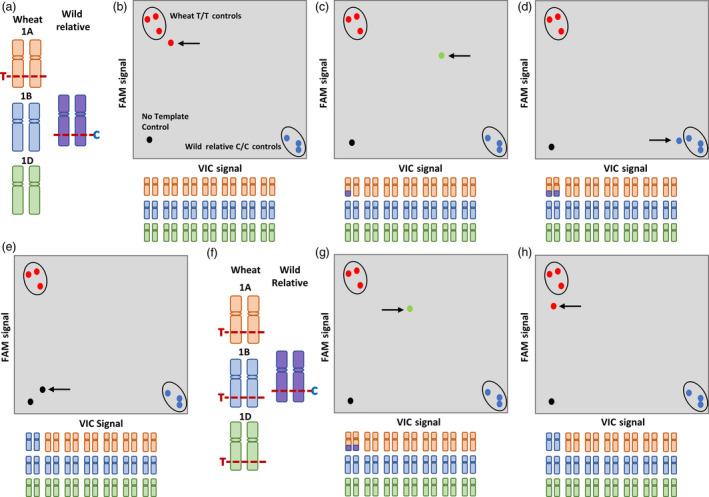
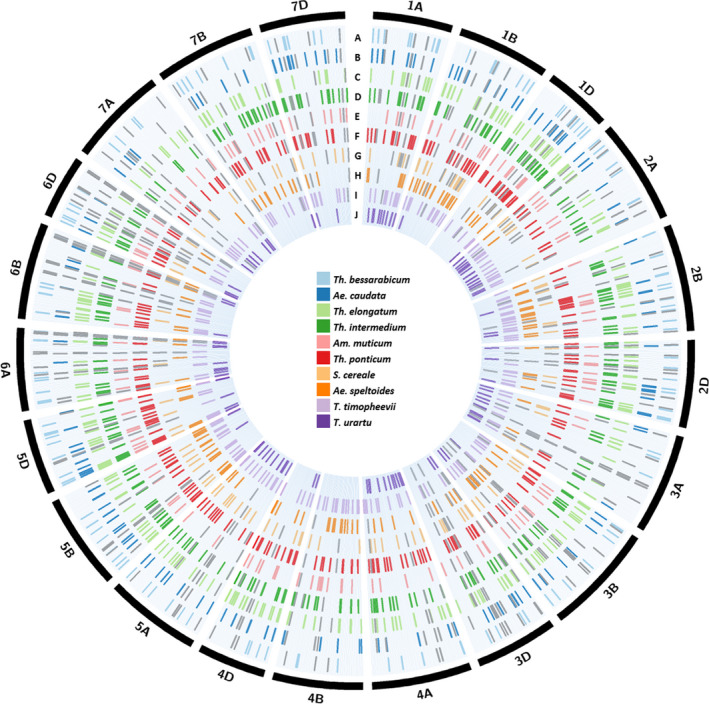
For future food security, it is important that wheat, one of the most widely consumed crops in the world, can survive the threat of abiotic and biotic stresses. New genetic variation is currently being introduced into wheat through introgressions from its wild relatives. For trait discovery, it is necessary that each introgression is homozygous and hence stable. Breeding programmes rely on efficient genotyping platforms for marker-assisted selection (MAS). Recently, single nucleotide polymorphism (SNP)-based markers have been made available on high-throughput Axiom SNP genotyping arrays. However, these arrays are inflexible in their design and sample numbers, making their use unsuitable for long-term MAS. SNPs can potentially be converted into Kompetitive allele-specific PCR (KASP™) assays that are comparatively cost-effective and efficient for low-density genotyping of introgression lines. However, due to the polyploid nature of wheat, KASP assays for homoeologous SNPs can have difficulty in distinguishing between heterozygous and homozygous hybrid lines in a backcross population. To identify co-dominant SNPs, that can differentiate between heterozygotes and homozygotes, we PCR-amplified and sequenced genomic DNA from potential single-copy regions of the wheat genome and compared them to orthologous copies from different wild relatives. A panel of 620 chromosome-specific KASP assays have been developed that allow rapid detection of wild relative segments and provide information on their homozygosity and site of introgression in the wheat genome. A set of 90 chromosome-nonspecific assays was also produced that can be used for genotyping introgression lines. These multipurpose KASP assays represent a powerful tool for wheat breeders worldwide.
为了未来的粮食安全,作为世界上消费最广泛的作物之一,小麦必须能够抵御非生物和生物胁迫,这一点至关重要。目前,通过从其野生亲缘植物中导入,新的遗传变异正在被引入小麦。为了发现性状,每个导入系必须是纯合的,因此是稳定的。育种计划依赖于高效的基因分型平台进行标记辅助选择(MAS)。最近,基于单核苷酸多态性(SNP)的标记已经在高通量 Axiom SNP 基因分型阵列上可用。然而,这些阵列在其设计和样本数量上缺乏灵活性,使得它们不适合长期的 MAS。SNP 可以潜在地转化为 Kompetitive allele-specific PCR (KASP™) 测定法,该测定法具有成本效益高且效率高的特点,非常适合用于导入系的低密度基因分型。然而,由于小麦的多倍体性质,KASP 测定法对于同源 SNP 可能难以区分回交群体中的杂合和纯合杂种系。为了鉴定能够区分杂合体和纯合体的共显性 SNP,我们从小麦基因组的潜在单拷贝区域中扩增和测序了基因组 DNA,并将其与来自不同野生亲缘植物的同源拷贝进行了比较。已经开发了 620 个染色体特异性 KASP 测定法,可快速检测野生亲缘片段,并提供有关其在小麦基因组中的纯合性和导入位置的信息。还产生了一组 90 个染色体非特异性测定法,可用于对导入系进行基因分型。这些多用途的 KASP 测定法代表了全球小麦育种者的强大工具。