Kang Seung Joo, Park Boram, Shin Cheol Min
Department of Internal Medicine, Seoul National University Hospital Healthcare System Gangnam Center, Seoul 06236, Korea.
Department of Public Health Science, Seoul National University, Seoul 08826, Korea.
J Clin Med. 2019 Aug 28;8(9):1324. doi: 10.3390/jcm8091324.
Previous studies on the effect of eradication on functional dyspepsia (FD) are conflicting. We performed a comprehensive meta-analysis on this issue according to region and prevalence of .
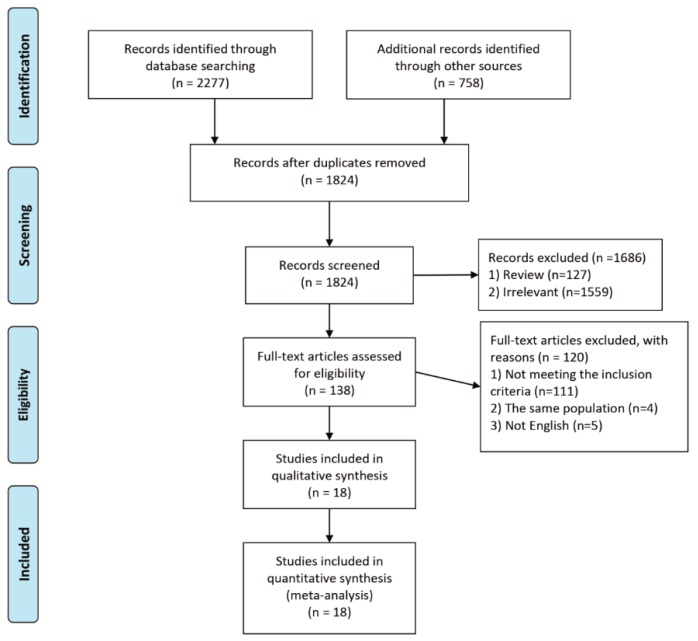
Randomized controlled trials (RCTs) evaluating the effect of eradication of on functional dyspepsia up to December 2018 were searched through PubMed, EMBASE, and the Cochrane Library. Subgroup analyses by the outcome measure, region, and prevalence of were performed. All data were analyzed with Review Manager 5.3.
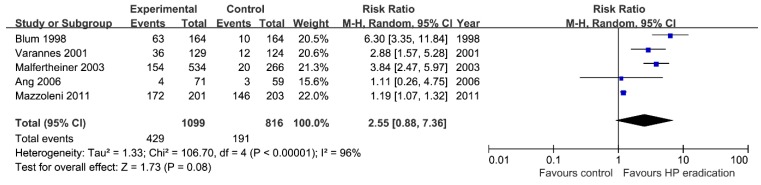
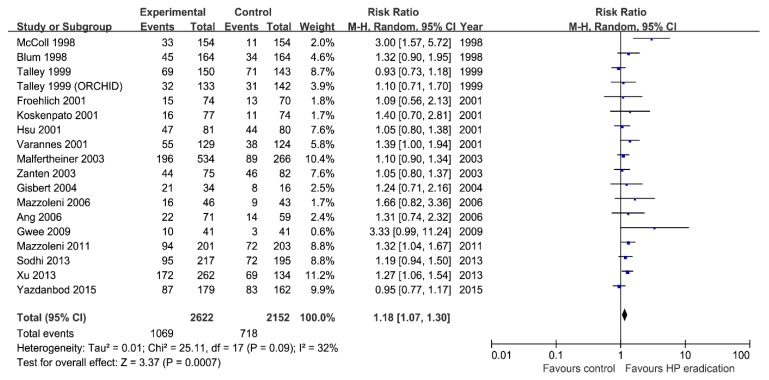
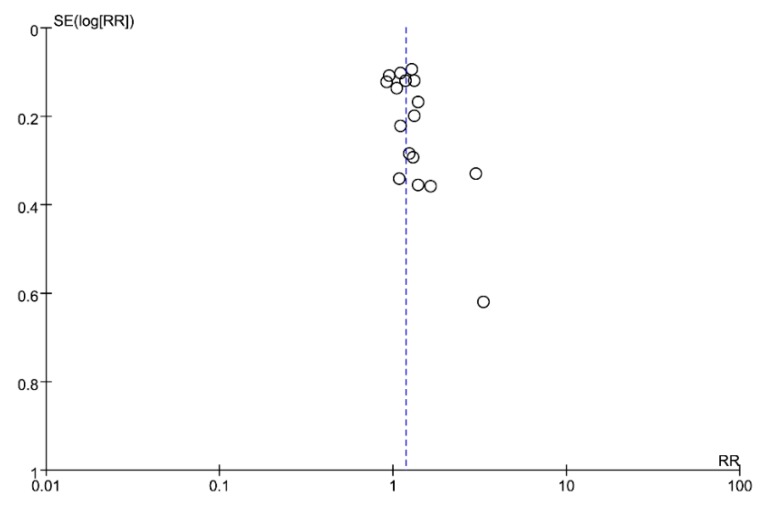
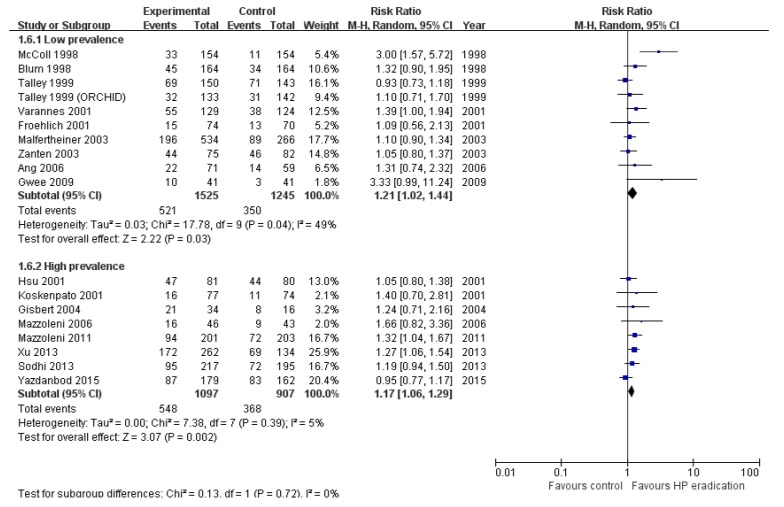
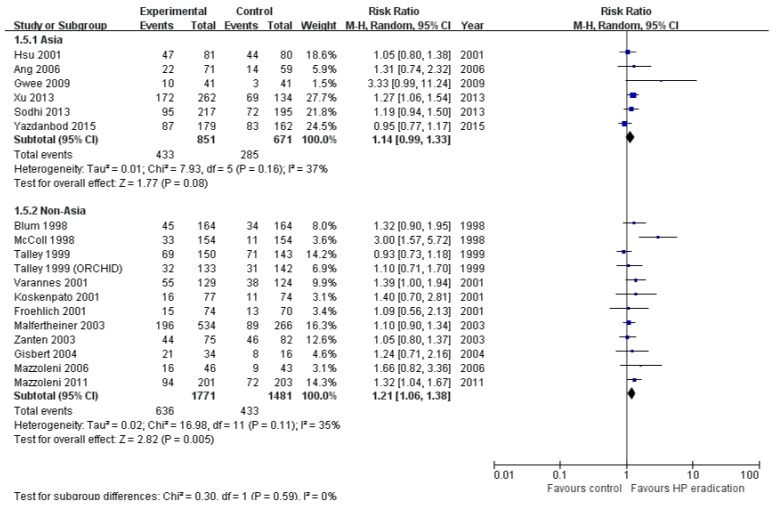
Eighteen RCTs were included in our meta-analysis. Overall, the eradication group showed significant improvement of symptoms compared with the control group (risk ratio (RR) = 1.18; 95% confidence interval (CI): 1.07-1.30, < 0.01). There was moderate heterogeneity among studies ( = 34%) and the number needed to treat (NNT) was 15.0. eradication improved dyspeptic symptoms both in low (<50%) and high (≥50%) prevalence regions (RR = 1.21 and 1.17; 95% CI: 1.02-1.44 and 1.06-1.29, = 49% and 5%, respectively.) In the analysis of studies from Asia, however, the effect of eradication on improvement of dyspepsia was not significant (RR = 1.14; 95% CI: 0.99-1.33, = 0.08, = 37%).
Overall, eradication provides significant improvement of symptoms in functional dyspepsia patients regardless of prevalence. However, in the analysis of studies from Asia, the eradication did not significantly improve dyspeptic symptoms. In this region, eradication for dyspepsia can be individualized.
既往关于根除[某种因素]对功能性消化不良(FD)影响的研究结果相互矛盾。我们根据[某种因素]的地区分布和流行率,对该问题进行了一项全面的荟萃分析。
通过PubMed、EMBASE和Cochrane图书馆检索截至2018年12月评估根除[某种因素]对功能性消化不良影响的随机对照试验(RCT)。按结局指标、地区和[某种因素]流行率进行亚组分析。所有数据均使用Review Manager 5.3进行分析。
18项RCT纳入我们的荟萃分析。总体而言,与对照组相比,根除[某种因素]组症状有显著改善(风险比(RR)=1.18;95%置信区间(CI):1.07 - 1.30,P<0.01)。研究间存在中度异质性(I² = 34%),治疗所需人数(NNT)为15.0。在[某种因素]流行率低(<50%)和高(≥50%)的地区,根除[某种因素]均改善了消化不良症状(RR分别为1.21和1.17;95%CI:1.02 - 1.44和1.06 - 1.29,I²分别为49%和5%)。然而,在对来自亚洲的研究分析中,根除[某种因素]对改善消化不良的效果不显著(RR = 1.14;95%CI:0.99 - 1.33,P = 0.08,I² = 37%)。
总体而言,无论[某种因素]流行率如何,根除[某种因素]均可显著改善功能性消化不良患者的症状。然而,在对来自亚洲的研究分析中,根除[某种因素]并未显著改善消化不良症状。在该地区,消化不良的根除治疗可个体化。