Department of Medicine Huddinge, Center for Infectious Medicine, Karolinska Institutet, Karolinska University Hospital, Stockholm, Sweden.
Programme in Emerging Infectious Diseases, DUKE-NUS Medical School, Singapore, Singapore.
Nat Commun. 2019 Aug 29;10(1):3897. doi: 10.1038/s41467-019-11878-3.
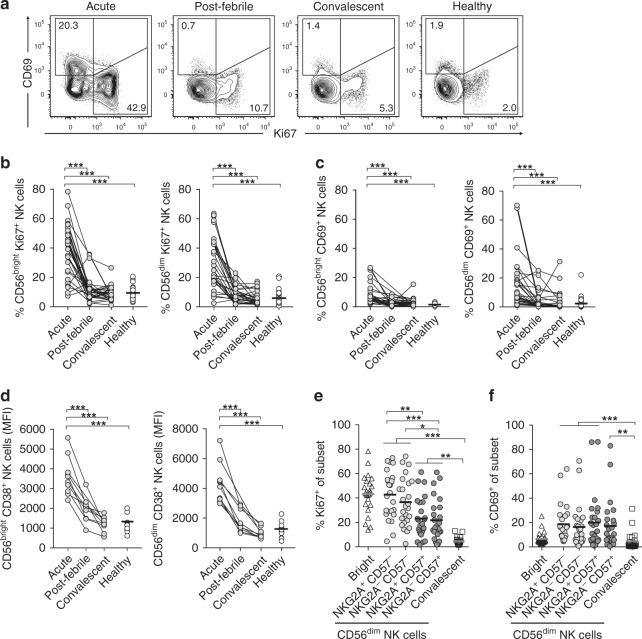
Despite animal models showing that natural killer (NK) cells are important players in the early defense against many viral infections, the NK cell response is poorly understood in humans. Here we analyze the phenotype, temporal dynamics, regulation and trafficking of NK cells in a patient cohort with acute dengue virus infection. NK cells are robustly activated and proliferate during the first week after symptom debut. Increased IL-18 levels in plasma and in induced skin blisters of DENV-infected patients, as well as concomitant signaling downstream of the IL-18R, suggests an IL-18-dependent mechanism in driving the proliferative NK cell response. Responding NK cells have a less mature phenotype and a distinct chemokine-receptor imprint indicative of skin-homing. A corresponding NK cell subset can be localized to skin early during acute infection. These data provide evidence of an IL-18-driven NK cell proliferation and priming for skin-homing during an acute viral infection in humans.
尽管动物模型表明自然杀伤 (NK) 细胞在早期抵御许多病毒感染中起着重要作用,但人类对 NK 细胞反应的了解甚少。在这里,我们分析了一组急性登革热病毒感染患者的 NK 细胞表型、时间动态、调节和迁移。在症状出现后的第一周内,NK 细胞被强烈激活并增殖。血浆中升高的 IL-18 水平和 DENV 感染患者诱导性皮肤水疱中升高的 IL-18 水平,以及下游伴随的 IL-18R 信号转导,提示在驱动增殖性 NK 细胞反应中存在 IL-18 依赖性机制。反应性 NK 细胞具有更不成熟的表型和独特的趋化因子受体印记,表明其具有皮肤归巢特性。在急性感染期间,相应的 NK 细胞亚群可以早期定位于皮肤。这些数据提供了证据,表明在人类急性病毒感染中,存在由 IL-18 驱动的 NK 细胞增殖和皮肤归巢的初始阶段。