Guerrouahen Bella S, Sidahmed Heba, Al Sulaiti Asma, Al Khulaifi Moza, Cugno Chiara
Sidra Medicine, Member of Qatar Foundation, Doha, Qatar.
Stem Cells Int. 2019 Aug 5;2019:7219297. doi: 10.1155/2019/7219297. eCollection 2019.
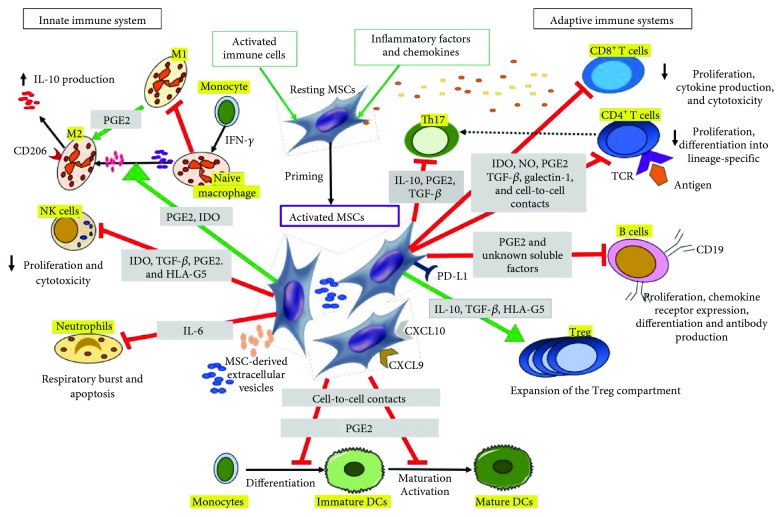
Mesenchymal stromal cells (MSCs), formerly known as mesenchymal stem cells, are nonhematopoietic multipotent cells and are emerging worldwide as the most clinically used and promising source for allogeneic cell therapy. MSCs, initially obtained from bone marrow, can be derived from several other tissues, such as adipose tissue, placenta, and umbilical cord. Diversity in tissue sourcing and manufacturing procedures has significant effects on MSC products. However, in 2006, a minimal set of standard criteria has been issued by the International Society of Cellular Therapy for defining derived MSCs. These include adherence to plastic in conventional culture conditions, particular phenotype, and multilineage differentiation capacity . Moreover, MSCs have trophic capabilities, a high self-renewal ability, and immunomodulatory characteristics. Thus, immunosuppressive treatment with MSCs has been proposed as a potential therapeutic alternative for conditions in which the immune system cells influence outcomes, such as inflammatory and autoimmune diseases. The precise mechanism by which MSCs affect functions of most immune effector cells is not completely understood but involves direct contact with immune cells, soluble mediators, and local microenvironmental factors. Recently, it has been shown that their homeostatic resting state requires activation, which can be achieved with various cytokines, including interferon-. In the present review, we focus on the suppressive effect that MSCs exert on the immune system and highlight the significance of preconditioning and its use in preclinical studies. We discuss the clinical aspects of using MSCs as an immunomodulatory treatment. Finally, we comment on the risk of interfering with the immune system in regard to cancer formation and development.
间充质基质细胞(MSCs),以前被称为间充质干细胞,是一种非造血多能细胞,正在成为全球范围内临床应用最广泛且最具前景的异基因细胞治疗来源。MSCs最初从骨髓中获取,现在也可以从其他几种组织中获得,如脂肪组织、胎盘和脐带。组织来源和生产程序的多样性对MSCs产品有显著影响。然而,2006年,国际细胞治疗协会发布了一套最低标准,用于定义衍生的MSCs。这些标准包括在传统培养条件下贴壁生长、特定的表型以及多向分化能力。此外,MSCs具有营养支持能力、高度的自我更新能力和免疫调节特性。因此,对于免疫系统细胞影响疾病转归的情况,如炎症性疾病和自身免疫性疾病,采用MSCs进行免疫抑制治疗已被提议作为一种潜在的治疗选择。MSCs影响大多数免疫效应细胞功能的确切机制尚未完全明了,但涉及与免疫细胞的直接接触、可溶性介质和局部微环境因素。最近的研究表明,它们的稳态静息状态需要激活,这可以通过多种细胞因子实现,包括干扰素-。在本综述中,我们重点关注MSCs对免疫系统的抑制作用,并强调预处理的重要性及其在临床前研究中的应用。我们讨论了将MSCs用作免疫调节治疗的临床方面。最后,我们就干扰免疫系统对癌症形成和发展的风险进行了评论。