Department of Global Health and Biomedical Sciences, School of Life Science and Bioengineering, Nelson Mandela African Institution of Science and Technology, Arusha, Tanzania.
College of Veterinary Medicine and Biomedical Sciences, Sokoine University of Agriculture, Morogoro, Tanzania.
Biomed Res Int. 2019 Jul 29;2019:3768948. doi: 10.1155/2019/3768948. eCollection 2019.
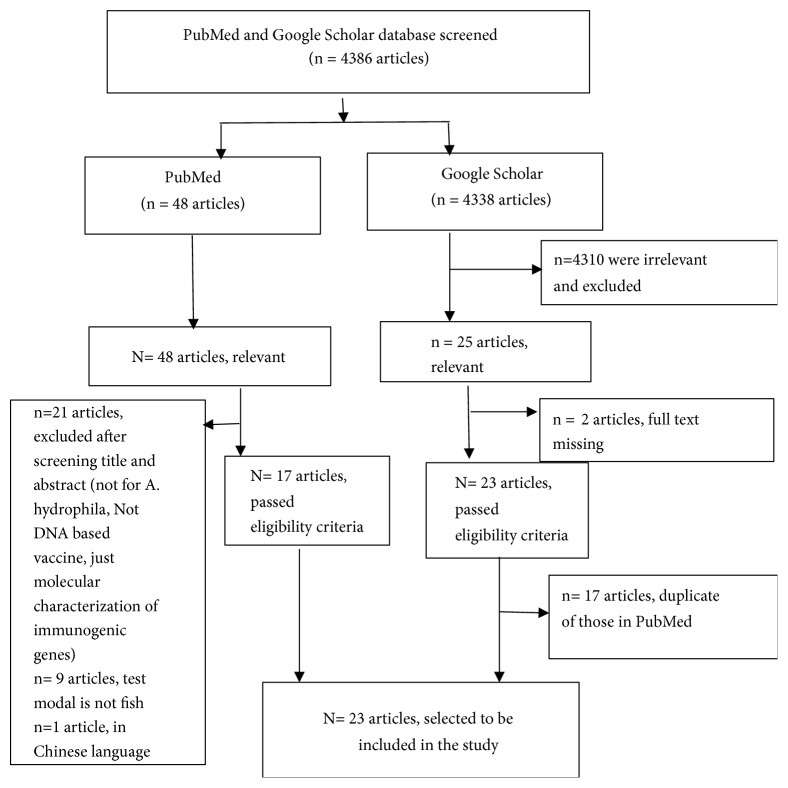
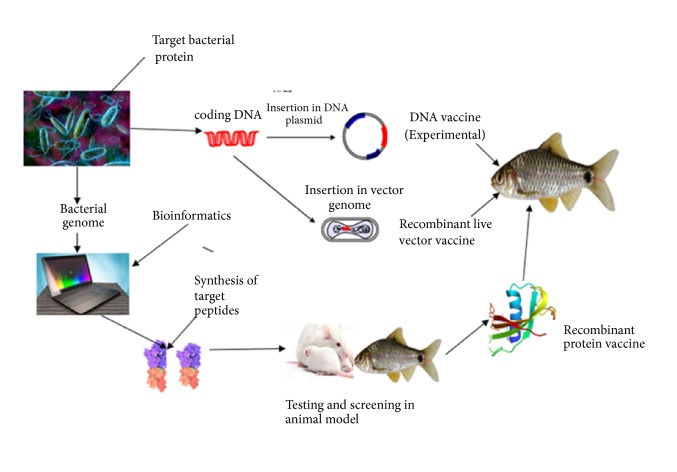
This systematic review describes what "the cutting edge vaccines for are". The focus is on types of high tech biotechnological based vaccines, target gene or antigen in developing these vaccines, and challenge model fish species used in vaccines efficacy testing. Vaccines delivery methods, immune response, and their efficacy, adjuvant or carrier systems used, and the overall experimental setup or design of the vaccines under investigation are also described. The search for the original papers published between 2009 and 2018 was conducted in June of 2018, using the PubMed and Google scholar electronic database. Twenty-three (23/4386) studies were included in the final assembly using PRISMA guidelines (Protocol not registered). Recombinant protein vaccines were the highly experimented type of the modern biotechnological based vaccines identified in the selected studies (16/23; 70%). Outer membrane proteins (OMPs) of different -barrels were shown to be a potential antigenic entity for vaccines (57%). Intraperitoneal route with conventional carries or adjuvants was the highly applied delivery system while very few studies used herbal based vaccine adjuvants and nanomaterial as a vaccine carrier. Variation was observed in terms of protection levels in the selected studies. The experimental designs partly contributed to the observed variation. Therefore, recombinant vaccines that use new carrier system technologies and delivered through oral route in feeds would have been of great value for use in the prevention and control of infections in fish. Despite the usefulness as academic tools to identify what is important in pathogenicity of the etiological agent to the host fish, these vaccines are only economically viable in very high-value animals. Therefore, if vaccination is a good option for group, then simple autogenous vaccines based on accurate typing and evidence-based definition of the epidemiological unit for their use would be the most viable approach in terms of both efficacy and economic feasibility especially in low and middle-income countries (LMIC).
这篇系统综述描述了“用于 的尖端疫苗是什么”。重点介绍了基于高科技生物技术的疫苗类型、开发这些疫苗的靶基因或抗原,以及用于疫苗功效测试的挑战模式鱼类物种。还描述了疫苗的传递方法、免疫反应及其功效、佐剂或载体系统的使用,以及正在研究的疫苗的整体实验设置或设计。2018 年 6 月,使用 PubMed 和 Google Scholar 电子数据库,对 2009 年至 2018 年期间发表的原始论文进行了搜索。根据 PRISMA 指南(未注册的方案),有 23 项(23/4386)研究最终被纳入综述。在所选择的研究中,重组蛋白疫苗是经过高度实验验证的现代基于生物技术的疫苗类型(16/23;70%)。不同桶状的外膜蛋白(OMPs)被证明是 疫苗的潜在抗原实体(57%)。腹腔内途径与常规载体或佐剂一起使用是高度应用的传递系统,而很少有研究使用草药疫苗佐剂和纳米材料作为疫苗载体。在所选择的研究中观察到保护水平的变化。实验设计在一定程度上导致了观察到的变化。因此,使用新型载体系统技术并通过饲料中的口服途径递送的重组疫苗将对鱼类 感染的预防和控制具有重要价值。尽管作为识别病原体对宿主鱼类致病性的重要因素的学术工具很有用,但这些疫苗仅在非常高价值的动物中具有经济可行性。因此,如果疫苗接种是 群体的一个好选择,那么基于准确分型和基于证据的用于它们的流行病学单位定义的简单自体疫苗将是最可行的方法,无论是在疗效还是经济可行性方面,特别是在低收入和中等收入国家(LMIC)。