Khunti Kamlesh, Chen Hungta, Cid-Ruzafa Javier, Fenici Peter, Gomes Marilia B, Hammar Niklas, Ji Linong, Kosiborod Mikhail, Pocock Stuart, Shestakova Marina V, Shimomura Iichiro, Tang Fengming, Watada Hirotaka, Nicolucci Antonio
University of Leicester, Leicester, UK.
AstraZeneca, Gaithersburg, Maryland.
Diabetes Obes Metab. 2020 Jan;22(1):66-78. doi: 10.1111/dom.13866. Epub 2019 Oct 1.
To assess glycaemic control and factors associated with poor glycaemic control at initiation of second-line therapy in the DISCOVER programme.
DISCOVER (NCT02322762 and NCT02226822) comprises two similar prospective observational studies of 15 992 people with type 2 diabetes (T2D) initiating second-line glucose-lowering therapy in 38 countries across six regions (Africa, Americas, South-East Asia, Eastern Mediterranean, Europe and Western Pacific). Data were collected using a standardized case report form. Glycated haemoglobin (HbA1c) levels were measured according to standard clinical practice in each country, and factors associated with poor glycaemic control (HbA1c >8.0%) were evaluated using hierarchical regression models.
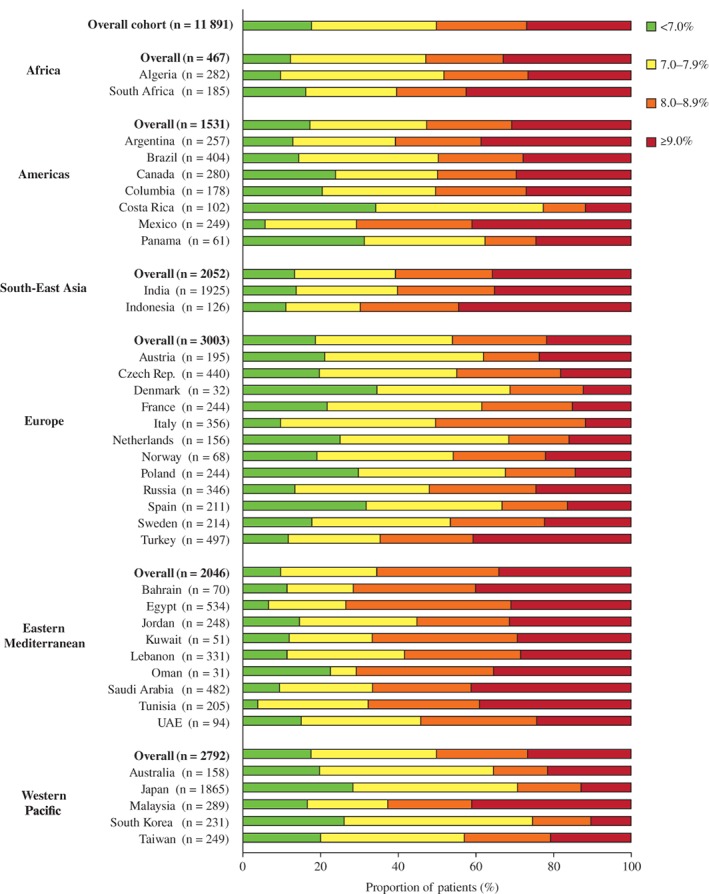
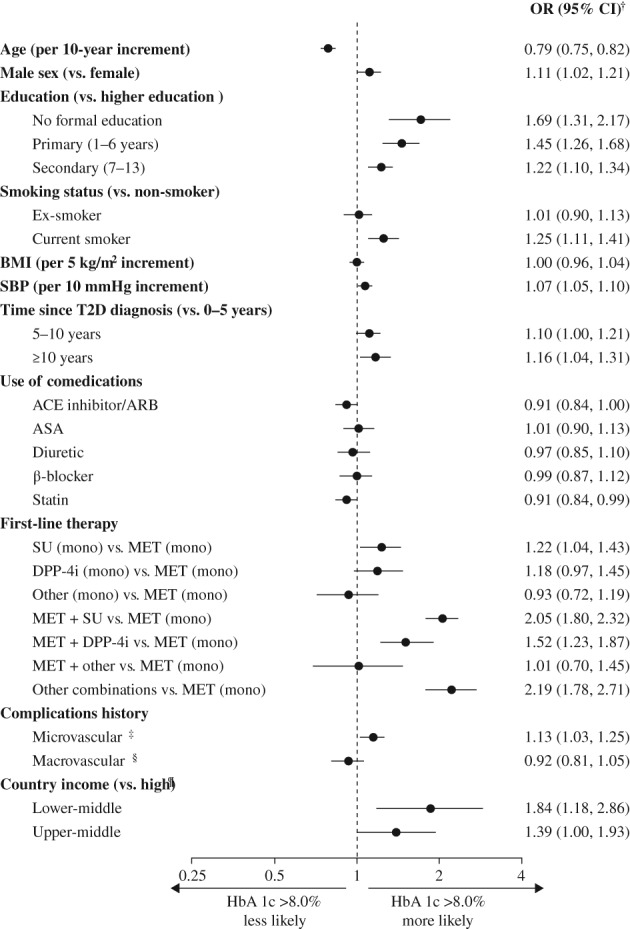
HbA1c levels were available for 80.9% of patients (across-region range [ARR] 57.5%-97.5%); 92.2% (ARR 59.2%-99.1%) of patients had either HbA1c or fasting plasma glucose levels available. The mean HbA1c was 8.3% (ARR 7.9%-8.7%). In total, 26.7% of patients had an HbA1c level ≥9.0%, with the highest proportions in South-East Asia (35.6%). Factors associated with having HbA1c >8.0% at initiation of second-line therapy included low education level, low country income, and longer time since T2D diagnosis.
The poor levels of glycaemic control at initiation of second-line therapy suggest that intensification of glucose-lowering treatment is delayed in many patients with T2D. In some countries, HbA1c levels are not routinely measured. These findings highlight an urgent need for interventions to improve monitoring and management of glycaemic control worldwide, particularly in lower-middle- and upper-middle-income countries.
评估“发现”(DISCOVER)项目中二线治疗起始时的血糖控制情况以及与血糖控制不佳相关的因素。
“发现”项目(NCT02322762和NCT02226822)包括两项类似的前瞻性观察性研究,涉及15992例2型糖尿病(T2D)患者,他们在六个地区(非洲、美洲、东南亚、东地中海、欧洲和西太平洋)的38个国家开始二线降糖治疗。数据通过标准化病例报告表收集。每个国家根据标准临床实践测量糖化血红蛋白(HbA1c)水平,并使用分层回归模型评估与血糖控制不佳(HbA1c>8.0%)相关的因素。
80.9%的患者有HbA1c水平数据(跨地区范围[ARR]57.5%-97.5%);92.2%(ARR 59.2%-99.1%)的患者有HbA1c或空腹血糖水平数据。HbA1c的平均水平为8.3%(ARR 7.9%-8.7%)。总共有26.7%的患者HbA1c水平≥9.0%,其中东南亚地区的比例最高(35.6%)。二线治疗起始时HbA1c>8.0%的相关因素包括教育水平低、国家收入低以及T2D诊断后的时间较长。
二线治疗起始时血糖控制水平不佳表明,许多T2D患者的降糖治疗强化延迟。在一些国家,HbA1c水平并非常规测量。这些发现凸显了迫切需要采取干预措施,以改善全球范围内血糖控制的监测和管理,特别是在中低收入和中高收入国家。