Department of Medicine, Diabetes Unit, Rio de Janeiro State University, Rio de Janeiro, Brazil.
Saint Luke's Mid America Heart Institute, Kansas City, MO, United States.
Front Endocrinol (Lausanne). 2022 Apr 22;13:831676. doi: 10.3389/fendo.2022.831676. eCollection 2022.
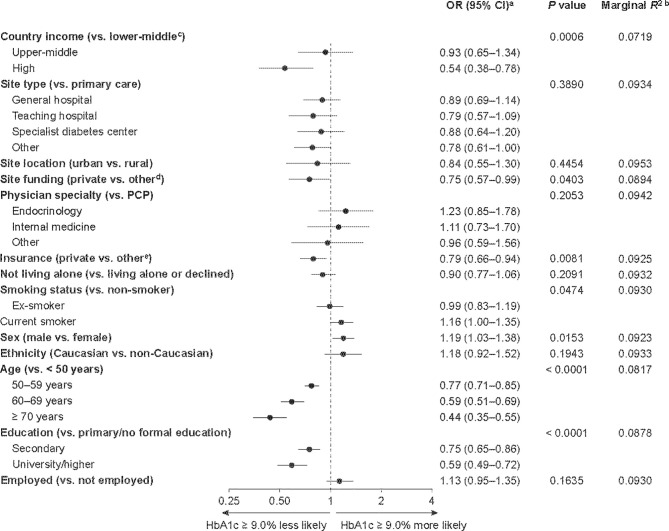
DISCOVER is a 3-year observational study program of 15,983 people with type 2 diabetes initiating second-line glucose-lowering therapy in 38 countries. We investigated the association between socioeconomic status and both the availability of a baseline glycated hemoglobin (HbA1c) measurement and poor glycemic control (HbA1c level ≥ 9.0%) in participants enrolled in DISCOVER. Factors associated with a lack of baseline HbA1c measurement or an HbA1c level ≥ 9.0% were assessed using three-level hierarchical logistic models. Overall, 19.1% of participants did not have a baseline HbA1c measurement recorded. Lower-middle country income (vs. high) and primary/no formal education (vs. university education) were independently associated with a reduced likelihood of having a baseline HbA1c measurement (odds ratio [95% confidence interval]: 0.11 [0.03-0.49] and 0.81 [0.66-0.98], respectively. Of the participants with an available HbA1c measurement, 26.9% had an HbA1c level ≥ 9.0%; 68.7% of these individuals were from lower- or upper-middle-income countries. Factors associated with an increased likelihood of poor glycemic control included low country income, treatment at a site with public and/or governmental funding (vs. private funding) and having public or no health insurance (vs. private). A substantial proportion of DISCOVER participants did not have an HbA1c measurement; more than one-quarter of these participants had poorly controlled type 2 diabetes. Both individual- and country-level socioeconomic factors are associated with the quality of care regarding glycemic control. Awareness of these factors could help improve the management of patients with type 2 diabetes.
DISCOVER 是一项为期 3 年的观察性研究项目,共纳入 38 个国家的 15983 例 2 型糖尿病患者,这些患者正在接受二线降糖治疗。我们研究了社会经济地位与 DISCOVER 参与者的基线糖化血红蛋白(HbA1c)测量值和较差的血糖控制(HbA1c 水平≥9.0%)之间的关联。使用三级层次逻辑模型评估了与缺乏基线 HbA1c 测量值或 HbA1c 水平≥9.0%相关的因素。总体而言,19.1%的参与者未记录基线 HbA1c 测量值。中低收入国家(vs. 高收入国家)和小学/无正规教育(vs. 大学教育)与基线 HbA1c 测量值较低的可能性独立相关(比值比[95%置信区间]:0.11[0.03-0.49]和 0.81[0.66-0.98])。在有可用 HbA1c 测量值的参与者中,26.9%的患者 HbA1c 水平≥9.0%;其中 68.7%的参与者来自中低收入或高收入国家。与较差的血糖控制可能性增加相关的因素包括低国家收入、在有公共和/或政府资助(vs. 私人资助)的治疗点进行治疗以及有公共或无健康保险(vs. 私人保险)。相当一部分 DISCOVER 参与者没有 HbA1c 测量值;其中超过四分之一的患者患有 2 型糖尿病控制不佳。个体和国家层面的社会经济因素都与血糖控制的护理质量有关。了解这些因素可能有助于改善 2 型糖尿病患者的管理。