Di Domenico Enea Gino, Cavallo Ilaria, Capitanio Bruno, Ascenzioni Fiorentina, Pimpinelli Fulvia, Morrone Aldo, Ensoli Fabrizio
Clinical Pathology and Microbiology, San Gallicano Dermatologic Institute, IRCCS, 00144 Rome, Italy.
Division of Dermatology, San Gallicano Dermatologic Institute, IRCCS, 00144 Rome, Italy.
Microorganisms. 2019 Aug 29;7(9):301. doi: 10.3390/microorganisms7090301.
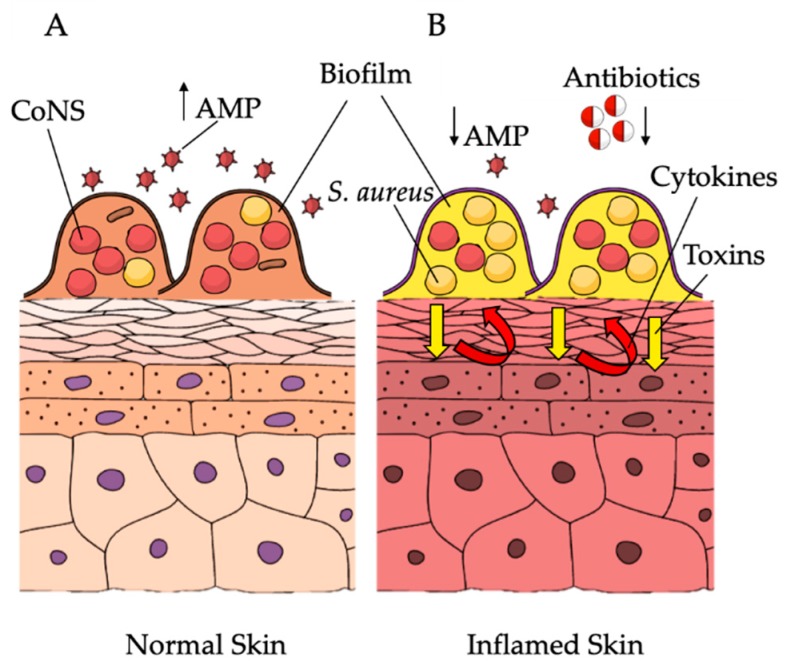
Biofilm is the dominant mode of growth of the skin microbiota, which promotes adhesion and persistence in the cutaneous microenvironment, thus contributing to the epidermal barrier function and local immune modulation. In turn, the local immune microenvironment plays a part in shaping the skin microbiota composition. Atopic dermatitis (AD) is an immune disorder characterized by a marked dysbiosis, with a sharp decline of microbial diversity. During AD flares biofilm-growing emerges as the major colonizer in the skin lesions, in strict association with disease severity. The chronic production of inflammatory cytokines in the skin of AD individuals concurs at supporting biofilm overgrowth at the expense of other microbial commensals, subverting the composition of the healthy skin microbiome. The close relationship between the host and microbial biofilm resident in the skin has profound implications on human health, making skin microbiota an attractive target for the therapeutic management of different skin disorders.
生物膜是皮肤微生物群的主要生长模式,它促进了在皮肤微环境中的黏附和持久性,从而有助于表皮屏障功能和局部免疫调节。反过来,局部免疫微环境在塑造皮肤微生物群组成方面发挥作用。特应性皮炎(AD)是一种以明显的生态失调为特征的免疫紊乱疾病,微生物多样性急剧下降。在AD发作期间,生物膜生长成为皮肤病变中的主要定植菌,与疾病严重程度密切相关。AD患者皮肤中炎症细胞因子的持续产生有助于支持生物膜过度生长,而牺牲其他共生微生物,从而破坏健康皮肤微生物群的组成。宿主与皮肤中驻留的微生物生物膜之间的密切关系对人类健康具有深远影响,使皮肤微生物群成为治疗不同皮肤疾病的有吸引力的靶点。