Sato-Boku Aiji, Nagano Keiji, Hasegawa Yoshiaki, Kamimura Yuji, Sento Yoshiki, So MinHye, Kako Eisuke, Okuda Masahiro, Tachi Naoko, Ito Hidekazu, Adachi Yushi, Sobue Kazuya
Department of Anesthesiology, Aichi Gakuin University School of Dentistry, 2-11 Suemori-dori, Chikusa-ku, Nagoya, 464-8651, Japan.
Department of Oral microbiology, School of Dentistry Health Sciences University of Hokkaido 757 Kanazawa, Ishikari-Tobetsu, Hokkaido, 061-0293, Japan.
BMC Anesthesiol. 2019 Aug 31;19(1):168. doi: 10.1186/s12871-019-0839-y.
Nasotracheal intubation can potentially result in microbial contamination from the upper respiratory tract to the lower respiratory tracts. However, an ideal nasotracheal disinfection method is yet to be determined. Therefore, we compared the disinfection effects between benzalkonium chloride and povidone iodine in nasotracheal intubation.
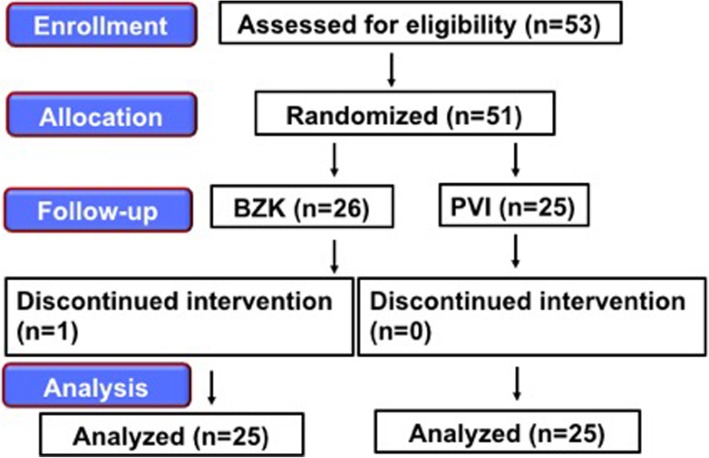
Overall, this study enrolled 53 patients aged 20-70 years who were classified into classes 1 and 2 as per American Society of Anesthesiologists-physical status and were scheduled to undergo general anesthesia with NTI. Patients who did not give consent (n = 2) and who has an allergy for BZK or PVI were excluded from the study. The patients were randomly divided into two groups on the basis of the disinfection method: BZK (n = 26, one patient was discontinued intervention) and PVI (n = 25). 50 patients were assessed finally. The subjects' nasal cavities were swabbed both before (A) and after disinfection (B), and the internal surface of the endotracheal tube was swabbed after extubation (C). The swabs were cultured on Brain heart infusion agar and Mannitol salt agar. The number of bacteria per swab was determined and the rates of change in bacterial count (B/A, C/B) were calculated. The growth inhibitory activity of the disinfectants on Staphylococcus aureus were also investigated in vitro.
Although the initial disinfection effects (B/A) were inferior for benzalkonium chloride compared with those for povidone iodine, the effects were sustained for benzalkonium chloride (C/B). In the in vitro growth inhibitory assay against S. aureus, benzalkonium chloride showed higher inhibitory activity than povidone iodine.
Although both disinfectants were inactivated or diffused/diluted over time, benzalkonium chloride maintained the threshold concentration and displayed antimicrobial effects longer than povidone iodine; therefore, benzalkonium chloride appeared to show a better sustained effect. Benzalkonium chloride can be used for creating a hygienic nasotracheal intubation environment with sustained sterilizing effects.
UMIN-CTR (Registration No. UMIN000029645 ). Registered 21 Oct 2017.
经鼻气管插管可能会导致微生物从上呼吸道污染至下呼吸道。然而,理想的经鼻消毒方法尚未确定。因此,我们比较了苯扎氯铵和聚维酮碘在经鼻气管插管中的消毒效果。
本研究共纳入53例年龄在20至70岁之间的患者,根据美国麻醉医师协会身体状况分级为1级和2级,计划接受经鼻气管插管全身麻醉。未给予同意的患者(n = 2)以及对苯扎氯铵或聚维酮碘过敏的患者被排除在研究之外。根据消毒方法将患者随机分为两组:苯扎氯铵组(n = 26,1例患者停止干预)和聚维酮碘组(n = 25)。最终评估了50例患者。在消毒前(A)和消毒后(B)对受试者的鼻腔进行擦拭,并在拔管后对内气管导管的内表面进行擦拭(C)。将拭子接种在脑心浸液琼脂和甘露醇盐琼脂上进行培养。确定每个拭子上的细菌数量,并计算细菌计数的变化率(B/A,C/B)。还在体外研究了消毒剂对金黄色葡萄球菌的生长抑制活性。
虽然与聚维酮碘相比,苯扎氯铵的初始消毒效果(B/A)较差,但苯扎氯铵的效果持续存在(C/B)。在针对金黄色葡萄球菌的体外生长抑制试验中,苯扎氯铵显示出比聚维酮碘更高的抑制活性。
虽然两种消毒剂都会随着时间而失活或扩散/稀释,但苯扎氯铵能维持阈值浓度并比聚维酮碘更长时间地发挥抗菌作用;因此,苯扎氯铵似乎显示出更好的持续效果。苯扎氯铵可用于创造具有持续杀菌效果的卫生经鼻气管插管环境。
UMIN-CTR(注册号UMIN000029645)。2017年10月21日注册。