Centers for Disease Control and Prevention, Atlanta, USA.
PHI/CDC Global Health Fellowship and ASPPH/CDC Allen Rosenfield Global Health Fellowship, Atlanta, USA.
Vaccine. 2019 Oct 3;37 Suppl 1(Suppl 1):A6-A13. doi: 10.1016/j.vaccine.2019.04.024. Epub 2019 Aug 27.
Rabies is a neglected zoonotic disease with a global burden of approximately 59,000 human deaths a year. Once clinical symptoms appear, rabies is almost invariably fatal; however, with timely and appropriate post-exposure prophylaxis (PEP) consisting of wound washing, vaccine, and in some cases rabies immunoglobulin (RIG), the disease is almost entirely preventable. Access to PEP is limited in many countries, and when available, is often very expensive.
We distributed a standardized assessment tool electronically to a convenience sample of 25 low- and middle-income countries in Asia and Africa to collect information on rabies PEP procurement, forecasting, distribution, monitoring and reporting. Information was collected from national rabies focal points, focal points at the World Health Organization (WHO) country offices, and others involved in procurement, logistics and distribution of PEP. Because RIG was limited in availability or unavailable in many countries, the assessment focused on vaccine. Data were collected between January 2017 and May 2018.
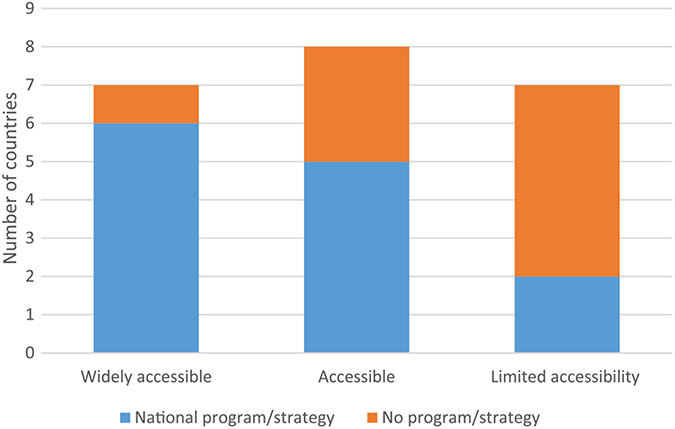
We received responses from key informants in 23 countries: 11 countries in Asia and 12 countries in Africa. In 9 of 23 (39%) countries, rabies vaccine was provided for free in the public sector and was consistently available. In 10 (43%) countries, all or some patients were required to pay for the vaccine in the public sector, with the cost of a single dose ranging from US$ 6.60 to US$ 20/dose. The primary reason for the high cost of the vaccine for patients was a lack of funding at the central level to subsidize vaccine costs. In the remaining 4 (17%) countries, vaccine was provided for free but was often unavailable so patients were required to purchase it instead. The majority of countries used the intramuscular route for vaccine administration and only 5 countries exclusively used the dose-sparing intradermal (ID) route. Half (11/22; 50%) of all countries assessed had a standardized distribution system for PEP, separate from the systems used for routine childhood vaccines, and almost half used separate storage facilities at both central and health facility levels. Approximately half (9/22; 41%) of all countries assessed reported having regular weekly, monthly or quarterly reporting on rabies vaccination.
While all countries in our assessment had rabies vaccines available in the public sector to some extent, barriers to access include the high cost of the vaccine to the government as well as to patients. Countries should be encouraged to use ID administration as this would provide access to rabies vaccine for many more people with the same number of vaccine vials. In addition, standardized monitoring and reporting of vaccine utilization should be encouraged, in order to improve data on PEP needs.

狂犬病是一种被忽视的动物源性传染病,每年约有 59000 人死于这种病。一旦出现临床症状,狂犬病几乎总是致命的;然而,通过及时、适当的暴露后预防措施(PEP),包括伤口清洗、疫苗接种,在某些情况下还包括狂犬病免疫球蛋白(RIG),这种疾病几乎是完全可以预防的。许多国家的 PEP 供应都受到限制,而在供应的国家,PEP 通常非常昂贵。
我们向亚洲和非洲的 25 个低收入和中等收入国家的便利样本发送了一份标准化评估工具,以收集有关狂犬病 PEP 采购、预测、分发、监测和报告的信息。信息是从国家狂犬病联络点、世界卫生组织(WHO)国家办事处的联络点以及参与 PEP 采购、后勤和分发的其他人员处收集的。由于 RIG 在许多国家的供应有限或不可用,因此评估主要集中在疫苗上。数据收集于 2017 年 1 月至 2018 年 5 月。
我们收到了 23 个国家的主要信息来源的回复:11 个亚洲国家和 12 个非洲国家。在 23 个国家中的 9 个(39%)国家,狂犬病疫苗在公共部门免费提供,且始终有供应。在 10 个(43%)国家中,所有或部分患者都需要在公共部门支付疫苗费用,单剂费用从 6.60 美元到 20 美元不等。造成患者疫苗费用高的主要原因是中央一级缺乏资金来补贴疫苗成本。在其余 4 个(17%)国家,疫苗免费提供,但往往供应不足,因此患者需要购买。大多数国家使用肌肉内途径接种疫苗,只有 5 个国家专门使用节省剂量的皮内(ID)途径。评估的所有国家中有一半(11/22;50%)有一个独立于常规儿童疫苗使用系统的 PEP 标准化分配系统,近一半(9/22;41%)在中央和卫生设施两级使用单独的储存设施。大约一半(9/22;41%)评估的所有国家报告说,对狂犬病疫苗接种情况进行了定期的每周、每月或每季度报告。
虽然我们评估的所有国家在某种程度上都有公共部门的狂犬病疫苗供应,但获取疫苗的障碍包括政府和患者对疫苗费用的高昂。应鼓励各国使用 ID 给药,因为这将使更多的人能够获得狂犬病疫苗,而疫苗瓶数相同。此外,应鼓励对疫苗使用情况进行标准化监测和报告,以改善关于 PEP 需求的数据。