Division of Geriatric Psychiatry, New York State Psychiatric Institute, New York, New York, USA.
Department of Psychiatry, Columbia University Medical Center, New York, New York, USA.
BMJ Open. 2019 Aug 30;9(8):e028536. doi: 10.1136/bmjopen-2018-028536.
Mild cognitive impairment (MCI) is common in older adults and represents a high-risk group for progression to Alzheimer's disease (AD). Medication trials in MCI have generally failed, but new discoveries with brain plasticity in ageing have led to the study of cognitive training as a potential treatment to improve cognitive abilities. Computerised cognitive training (CCT) involves computerised cognitive exercises that target specific cognitive abilities and neural networks to potentially improve cognitive functioning through neuroplasticity.
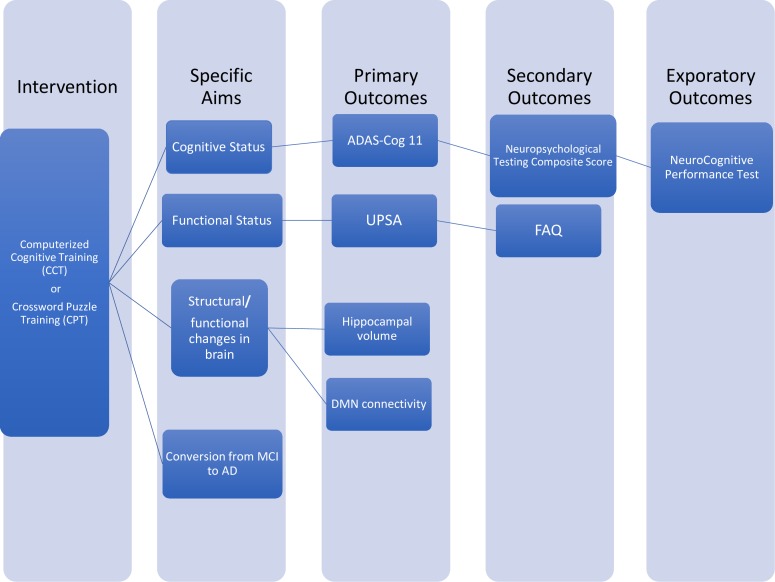
In a two-site study (New York State Psychiatric Institute/Columbia University Medical Center and Duke University Medical Center), we will randomise 100 patients with MCI (Wechsler Memory Scale-III Logical Memory II score 0-11; Folstein Mini Mental State Examination ≥23) to home-based CCT (suite of exercises: memory, matching, spatial recognition, processing speed) or a home-based active control condition (computerised crossword puzzle training (CPT)) with 12 weeks of intensive training followed by regular booster sessions up to 78 weeks. All patients will receive standard neuropsychological and functional assessments in clinic as well as structural/functional brain MRI scans at study entry and endpoint. We will test if CCT, versus CPT, leads to improved cognitive functioning, transfers to functional ability and tasks of everyday life and impacts hippocampal volume changes and changes in the default mode network of the brain measured by resting-state functional MRI.
The study will be conducted following ethics approval and written informed consent will be obtained from all subjects. Study results will be disseminated via publication, clinicaltrials.gov, media and conference presentations. This will be the first controlled long-term trial to evaluate the effects of home-based CCT versus computerised CPT on cognitive abilities and functional measures and neural outcomes as determined by MRI indices in patients with MCI. Positive results from trial may support further development of home-based CCT.
ClinicalTrials.gov identifier (NCT03205709).
轻度认知障碍(MCI)在老年人中很常见,是发展为阿尔茨海默病(AD)的高风险群体。在 MCI 中的药物试验一般都失败了,但随着衰老过程中大脑可塑性的新发现,认知训练作为一种提高认知能力的潜在治疗方法已经开始研究。计算机化认知训练(CCT)涉及针对特定认知能力和神经网络的计算机化认知练习,通过神经可塑性来潜在地改善认知功能。
在一项两站点研究(纽约州立精神研究所/哥伦比亚大学医学中心和杜克大学医学中心)中,我们将随机分配 100 名 MCI 患者(韦氏记忆量表-III 逻辑记忆 II 得分 0-11;Folstein 简易精神状态检查≥23)到家庭为基础的 CCT(记忆、匹配、空间识别、处理速度)或家庭为基础的主动对照条件(计算机化填字游戏训练(CPT)),进行 12 周的强化训练,然后进行长达 78 周的定期强化训练。所有患者将在诊所接受标准神经心理学和功能评估,以及结构/功能大脑 MRI 扫描,在研究入组和终点时进行。我们将测试 CCT 是否优于 CPT,是否能提高认知功能、转移到功能能力和日常生活任务中,并是否能影响海马体积变化和静息状态功能 MRI 测量的大脑默认模式网络的变化。
该研究将在获得伦理批准后进行,并将从所有受试者获得书面知情同意。研究结果将通过发表、clinicaltrials.gov、媒体和会议报告进行传播。这将是第一个评估家庭为基础的 CCT 与计算机化 CPT 对认知能力和功能测量以及 MCI 患者 MRI 指标确定的神经结果的对照长期试验。试验的积极结果可能会支持进一步开发家庭为基础的 CCT。
ClinicalTrials.gov 标识符(NCT03205709)。