Division of Hematopathology, Mayo Clinic College of Medicine, Rochester, MN, USA.
Biomedical statistics and informatics, Mayo Clinic College of Medicine, Rochester, MN, USA.
Mod Pathol. 2020 Mar;33(3):334-343. doi: 10.1038/s41379-019-0359-9. Epub 2019 Aug 30.
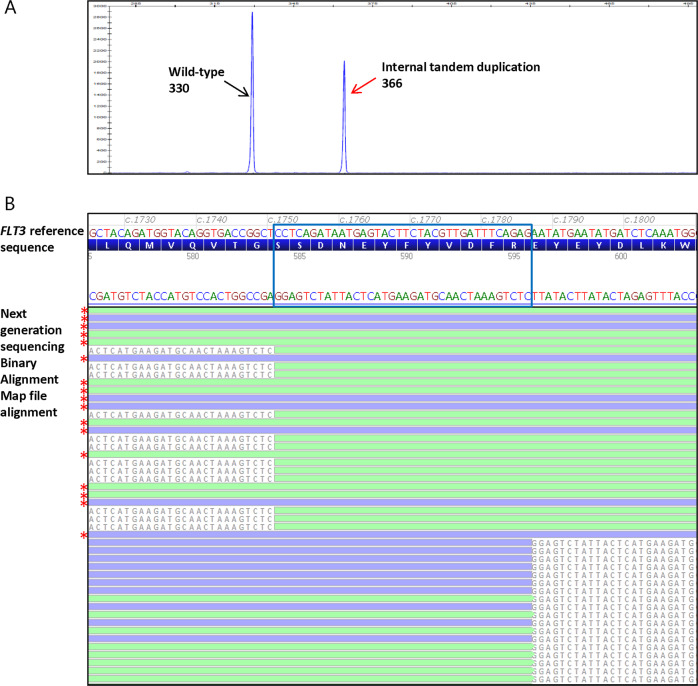
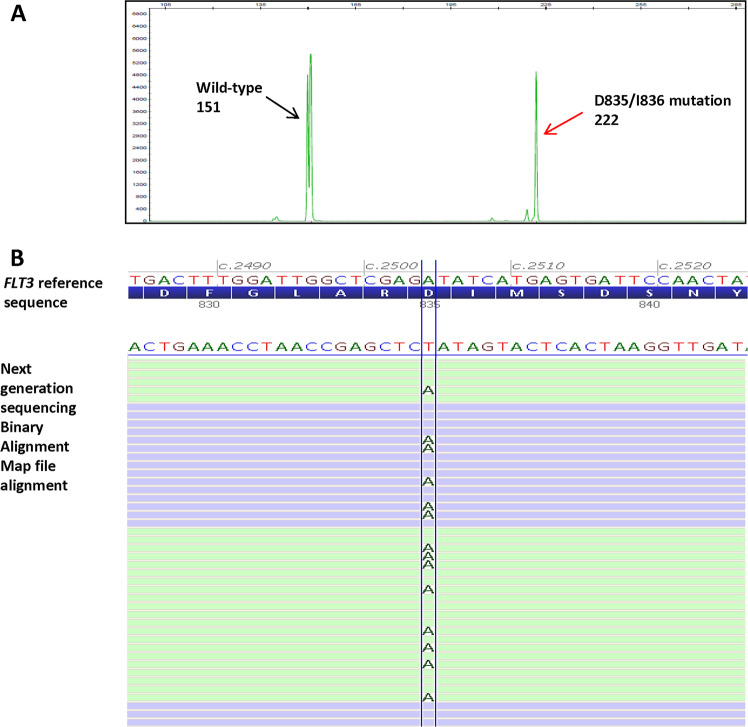
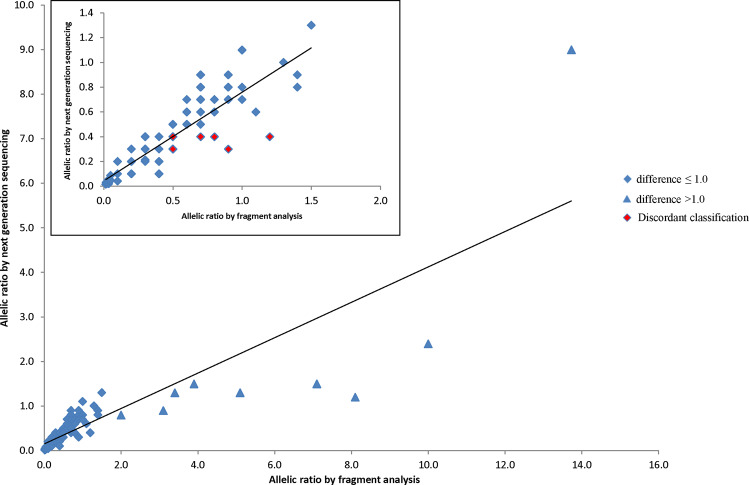
FLT3-internal tandem duplication occurs in 20-30% of acute myeloid leukemia and confers an adverse prognosis with its allelic ratio being a key risk stratifier. The US Food and Drug Administration recently approved FLT3 inhibitors midostaurin and gilteritinib in FLT3 mutation-positive acute myeloid leukemia. Historically, FLT3 was tested by fragment analysis, which has become the standard method endorsed by international guidelines. However, next generation sequencing is increasingly used at acute myeloid leukemia diagnosis given its ability to simultaneously evaluate multiple clinically informative markers. As FLT3-internal tandem duplication detection was known to be challenging by next generation sequencing and the results carry profound prognostic and therapeutic implications, it is important to thoroughly examine its performance in FLT3-internal tandem duplication detection and allelic ratio classification. In a comparative study with fragment analysis, we retrospectively reviewed our experience using a custom-designed, hybridization capture-based, targeted next generation sequencing panel. Among 7902 cases, FLT3-internal tandem duplication was detected in 335 with variable sizes (3-231 bp) and insertion sites. Fragment analysis was also performed in 402 cases, demonstrating 100% concordance in FLT3-internal tandem duplication detection. In 136 dual-tested, positive cases, 128/136 (94%) exhibited concordant high/low allelic ratio classifications. The remaining 6% showed borderline low allelic ratio by next generation sequencing. The two methods were concordant in FLT3-tyrosine kinase domain mutation detection at the hotspot D835/I836 targeted by fragment analysis. Furthermore, seven mutations which may benefit from FLT3 inhibitor therapy were detected by next generation sequencing, in regions not covered by fragment analysis. Our study demonstrates that using a hybridization capture-based chemistry and optimized bioinformatics pipeline, next generation sequencing can reliably detect FLT3-internal tandem duplication and classify its allelic ratio for acute myeloid leukemia risk stratification. Next generation sequencing also exhibits superior comprehensiveness in FLT3 mutation detection and may further improve personalized, targeted therapy in acute myeloid leukemia.
FLT3 内部串联重复发生在 20-30%的急性髓系白血病中,并伴有不良预后,其等位基因比是关键的风险分层因素。美国食品和药物管理局最近批准了 FLT3 突变阳性的急性髓系白血病的 FLT3 抑制剂米哚妥林和吉特替尼。历史上,FLT3 通过片段分析进行测试,该方法已成为国际指南认可的标准方法。然而,鉴于其能够同时评估多个具有临床意义的标志物,下一代测序在急性髓系白血病诊断中的应用越来越广泛。由于下一代测序检测 FLT3 内部串联重复存在挑战性,且结果具有深远的预后和治疗意义,因此彻底检查其在 FLT3 内部串联重复检测和等位基因比分类中的性能非常重要。在与片段分析的对比研究中,我们回顾性地审查了使用定制设计的、基于杂交捕获的靶向下一代测序面板的经验。在 7902 例病例中,检测到 335 例具有不同大小(3-231bp)和插入部位的 FLT3 内部串联重复。还对 402 例进行了片段分析,在 FLT3 内部串联重复检测方面显示出 100%的一致性。在 136 例双重检测阳性病例中,128/136(94%)表现出一致的高/低等位基因比分类。其余 6%的病例通过下一代测序显示出边界低值。在片段分析靶向的热点 D835/I836 处,两种方法在 FLT3 酪氨酸激酶结构域突变检测方面一致。此外,通过下一代测序在片段分析未覆盖的区域检测到 7 种可能受益于 FLT3 抑制剂治疗的突变。我们的研究表明,使用基于杂交捕获的化学方法和优化的生物信息学管道,下一代测序可以可靠地检测 FLT3 内部串联重复,并对其等位基因比进行分类,用于急性髓系白血病的风险分层。下一代测序在 FLT3 突变检测方面也具有更高的全面性,可能进一步改善急性髓系白血病的个性化、靶向治疗。