Department of Orthopedic Surgery, Amsterdam University Medical Center, Meibergdreef 9, 1105 AZ, Amsterdam, The Netherlands.
Coronel Institute of Occupational Health, Amsterdam University Medical Center, Meibergdreef 9, 1105 AZ, Amsterdam, The Netherlands.
Knee Surg Sports Traumatol Arthrosc. 2020 Sep;28(9):2905-2916. doi: 10.1007/s00167-019-05667-0. Epub 2019 Aug 30.
It is not yet known if unicompartmental knee arthroplasty (UKA) patients are more likely to return to work sooner or have improved ability to work (i.e., workability) than total knee arthroplasty (TKA) patients. The following questions were addressed: patients were assessed to determine: (1) whether they returned to work sooner following UKA compared to TKA; (2) whether UKA patients had better WORQ function scores compared to TKA patients; and (3) if UKA patients have higher workability scores and greater satisfaction regarding workability than TKA patients.
A multicenter retrospective cohort study was performed that included patients at least 2 years after having undergone either UKA or TKA surgery and on the condition that patients had been in work in the 2 years prior to surgery. Time period between stopping work and returning to work was assessed; the WORQ scores (0 = worst-100 = best) and the Work Ability Index (WAI = 0-10) and reported satisfaction with work ability.
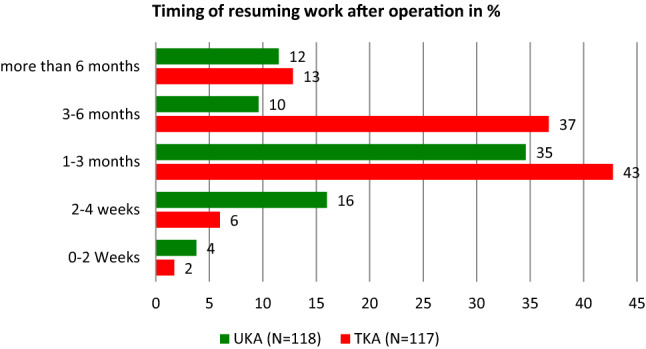
UKA patients (n = 157, median 60 years, 51% male) were compared to TKA patients (n = 167, median 60 years, 49% male) (n.s.). Of the 157 UKA patients, 115 (73%) returned to work within 2 years compared to 121 (72%) of TKA patients (n.s.). More UKA patients return to work within 3 months (73% versus 48%) (p < 0.01). WORQ scores improved similarly in both groups. The WAI was also comparable between the groups. Dissatisfaction with workability was comparable (UKA 15% versus TKA 18% (n.s.).
TKA and UKA patients have similar WORQ, WAI, and satisfaction scores. However, in this study population, UKA patients to return to work after surgery significantly sooner than TKA patients, which improves their quality of life and allows them to participate actively in society. This information can help health care providers and patients weigh-up the pros and cons and choose the best treatment and timing for patients in the working population.
III.
目前尚不清楚单髁膝关节置换术(UKA)患者是否比全膝关节置换术(TKA)患者更早重返工作岗位或具有更好的工作能力(即工作能力)。提出了以下问题:评估患者以确定:(1)与 TKA 相比,UKA 后患者更早重返工作岗位;(2)UKA 患者的 WORQ 功能评分是否优于 TKA 患者;以及(3)与 TKA 患者相比,UKA 患者的工作能力评分更高,对工作能力的满意度更高。
进行了一项多中心回顾性队列研究,纳入了至少在接受 UKA 或 TKA 手术后 2 年且在手术前 2 年内有工作的患者。评估了停止工作和重返工作之间的时间间隔;WORQ 评分(0=最差-100=最佳)和工作能力指数(WAI=0-10)以及对工作能力的满意度。
将 UKA 患者(n=157,中位数 60 岁,51%为男性)与 TKA 患者(n=167,中位数 60 岁,49%为男性)进行比较(n.s.)。在 157 名 UKA 患者中,115 名(73%)在 2 年内重返工作岗位,而 121 名(72%)TKA 患者(n.s.)重返工作岗位。更多的 UKA 患者在 3 个月内重返工作岗位(73%与 48%)(p<0.01)。两组 WORQ 评分均有类似改善。两组之间的 WAI 也相似。对工作能力的不满相似(UKA 为 15%,TKA 为 18%(n.s.)。
TKA 和 UKA 患者的 WORQ、WAI 和满意度评分相似。然而,在本研究人群中,UKA 患者术后重返工作岗位的时间明显早于 TKA 患者,这提高了他们的生活质量,使他们能够积极参与社会。这些信息可以帮助医疗保健提供者和患者权衡利弊,并为工作人群中的患者选择最佳的治疗方案和时间。
III。