Aging Research Center, Department of Neurobiology, Care Sciences and Society, Karolinska Institutet and Stockholm University, Stockholm, Sweden.
Department of Geriatrics, Catholic University of Rome, Rome, Italy.
Aging Clin Exp Res. 2020 Jun;32(6):1007-1016. doi: 10.1007/s40520-019-01297-1. Epub 2019 Aug 30.
Cognitive and physical deficits independently raise the risk for negative events in older adults. Less is known about whether their co-occurrence constitutes a distinct risk profile. This study quantifies the association between cognitive impairment, no dementia (CIND), slow walking speed (WS) and their combination and disability and mortality.
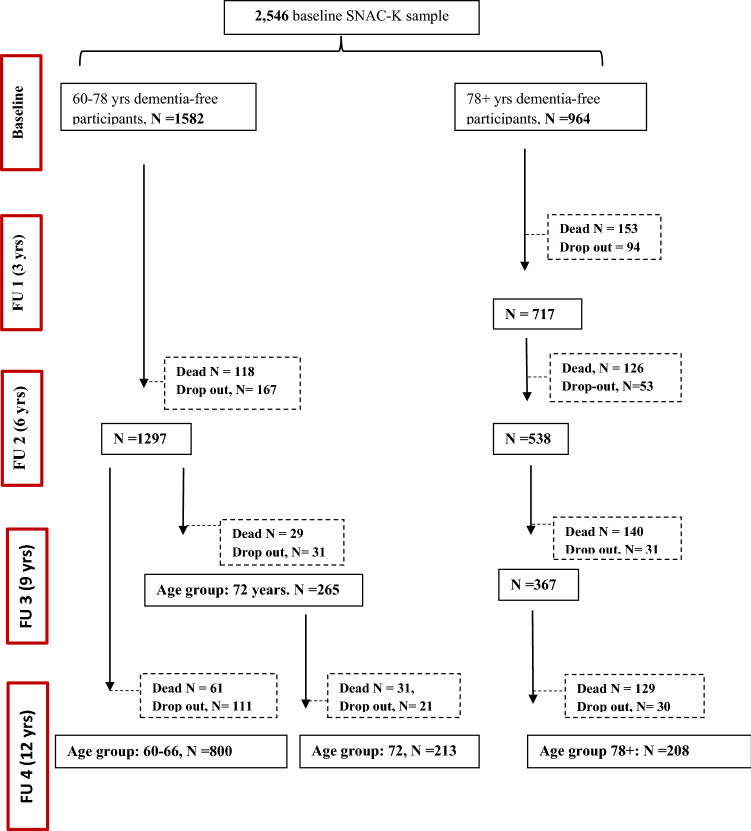
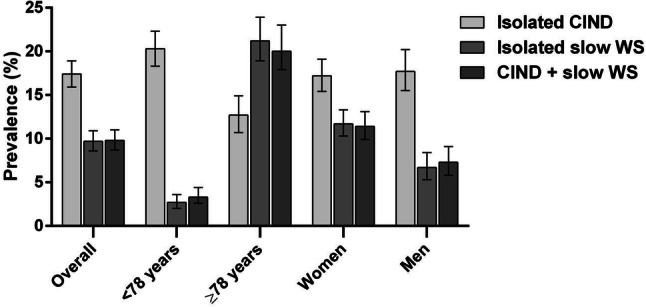
We examined 2546 dementia-free people aged ≥ 60 years, part of the Swedish National study on Aging and Care in Kungsholmen (SNAC-K) up to 12 years. The following four profiles were created: (1) healthy profile; (2) isolated CIND (scoring 1.5 SD below age-specific means on at least one cognitive domain); (3) isolated slow WS (< 0.8 m/s); (4) CIND+ slow WS. Disability was defined as the sum of impaired activities of daily living and trajectories of disability were derived from mixed-effect linear regression models. Piecewise proportional hazard models were used to estimate mortality rate [hazard ratios (HRs)]. Population attributable risks of death were calculated.
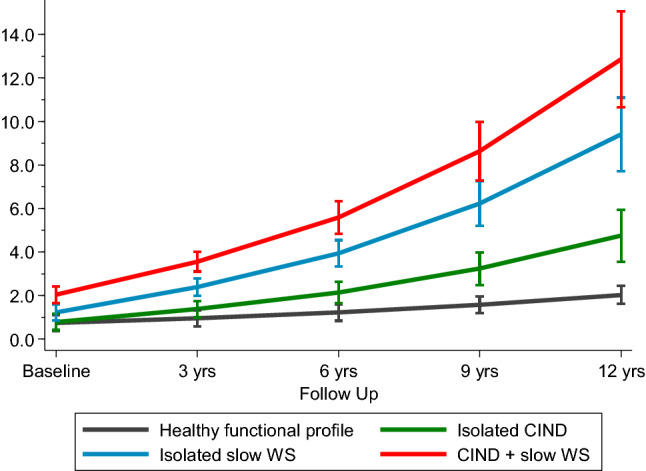
Participants with both CIND and slow WS had the worst prognosis, especially in the short-term period. They experienced the steepest increase in disability and five times the mortality rate (HR 5.1; 95% CI 3.5-7.4) of participants free from these conditions. Similar but attenuated results were observed for longer follow-ups. Co-occurring CIND and slow WS accounted for 30% of short-term deaths.
Co-occurring cognitive and physical limitations constitute a distinct risk profile in older people, and account for a large proportion of short-term deaths. Assessing cognitive and physical function could enable early identification of people at high risk for adverse events.
认知和身体缺陷独立增加老年人发生负面事件的风险。对于它们同时发生是否构成独特的风险特征,了解较少。本研究量化了认知障碍但无痴呆(CIND)、行走速度缓慢(WS)及其组合与残疾和死亡之间的关联。
我们研究了 2546 名年龄≥60 岁且无痴呆的瑞典全国老龄化和 Kungsholmen 护理研究(SNAC-K)参与者,随访时间长达 12 年。创建了以下四种特征:(1)健康特征;(2)孤立的 CIND(在至少一个认知域的得分低于年龄特异性平均值 1.5 个标准差);(3)孤立的 WS 缓慢(<0.8m/s);(4)CIND+WS 缓慢。残疾定义为日常生活活动受损的总和,残疾轨迹是从混合效应线性回归模型中得出的。分段比例风险模型用于估计死亡率[风险比(HRs)]。计算了死亡的人群归因风险。
同时患有 CIND 和 WS 缓慢的参与者预后最差,尤其是在短期内。他们的残疾程度急剧增加,死亡率是无这些疾病的参与者的五倍(HR 5.1;95%CI 3.5-7.4)。在更长的随访时间内观察到类似但减弱的结果。同时患有 CIND 和 WS 缓慢占短期死亡人数的 30%。
认知和身体功能同时受限在老年人中构成独特的风险特征,占短期死亡人数的很大比例。评估认知和身体功能可以使处于高风险的人群早期识别。