Piau Antoine, Wild Katherine, Mattek Nora, Kaye Jeffrey
Gerontopole, University Hospital of Toulouse, Université Paul Sabatier, Toulouse, France.
Oregon Center for Aging and Technology, Oregon Health and Science University, Portland, OR, United States.
J Med Internet Res. 2019 Aug 30;21(8):e12785. doi: 10.2196/12785.
Among areas that have challenged the progress of dementia care has been the assessment of change in symptoms over time. Digital biomarkers are defined as objective, quantifiable, physiological, and behavioral data that are collected and measured by means of digital devices, such as embedded environmental sensors or wearables. Digital biomarkers provide an alternative assessment approach, as they allow objective, ecologically valid, and long-term follow-up with continuous assessment. Despite the promise of a multitude of sensors and devices that can be applied, there are no agreed-upon standards for digital biomarkers, nor are there comprehensive evidence-based results for which digital biomarkers may be demonstrated to be most effective.
In this review, we seek to answer the following questions: (1) What is the evidence for real-life, home-based use of technologies for early detection and follow-up of mild cognitive impairment (MCI) or dementia? And (2) What transformation might clinicians expect in their everyday practices?
A systematic search was conducted in PubMed, Cochrane, and Scopus databases for papers published from inception to July 2018. We searched for studies examining the implementation of digital biomarker technologies for mild cognitive impairment or mild Alzheimer disease follow-up and detection in nonclinic, home-based settings. All studies that included the following were examined: community-dwelling older adults (aged 65 years or older); cognitively healthy participants or those presenting with cognitive decline, from subjective cognitive complaints to early Alzheimer disease; a focus on home-based evaluation for noninterventional follow-up; and remote diagnosis of cognitive deterioration.
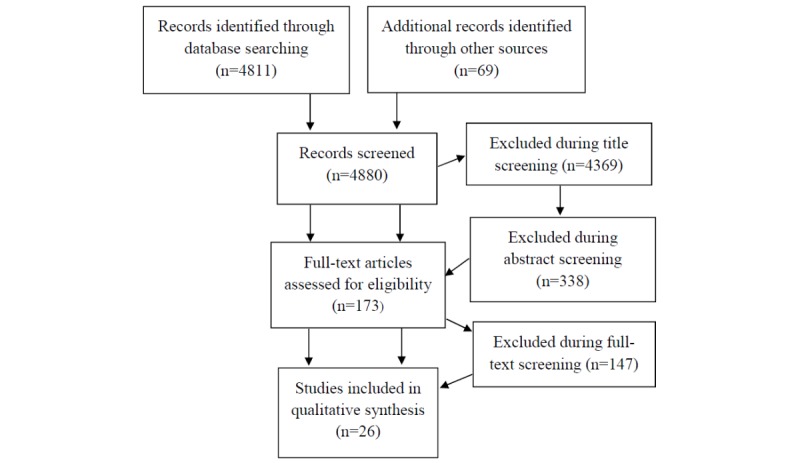
An initial sample of 4811 English-language papers were retrieved. After screening and review, 26 studies were eligible for inclusion in the review. These studies ranged from 12 to 279 participants and lasted between 3 days to 3.6 years. Most common reasons for exclusion were as follows: inappropriate setting (eg, hospital setting), intervention (eg, drugs and rehabilitation), or population (eg, psychiatry and Parkinson disease). We summarized these studies into four groups, accounting for overlap and based on the proposed technological solutions, to extract relevant data: (1) data from dedicated embedded or passive sensors, (2) data from dedicated wearable sensors, (3) data from dedicated or purposive technological solutions (eg, games or surveys), and (4) data derived from use of nondedicated technological solutions (eg, computer mouse movements).
Few publications dealt with home-based, real-life evaluations. Most technologies were far removed from everyday life experiences and were not mature enough for use under nonoptimal or uncontrolled conditions. Evidence available from embedded passive sensors represents the most relatively mature research area, suggesting that some of these solutions could be proposed to larger populations in the coming decade. The clinical and research communities would benefit from increasing attention to these technologies going forward.
随着时间推移对痴呆症症状变化进行评估一直是痴呆症护理进展面临挑战的领域之一。数字生物标志物被定义为通过数字设备(如嵌入式环境传感器或可穿戴设备)收集和测量的客观、可量化、生理和行为数据。数字生物标志物提供了一种替代评估方法,因为它们允许进行客观、生态有效且长期的随访以及持续评估。尽管有大量可应用的传感器和设备,但数字生物标志物尚无公认的标准,也没有全面的循证结果表明哪些数字生物标志物可能最有效。
在本综述中,我们试图回答以下问题:(1)在现实生活中居家使用技术对轻度认知障碍(MCI)或痴呆症进行早期检测和随访的证据是什么?以及(2)临床医生在日常实践中可能期望发生哪些转变?
在PubMed、Cochrane和Scopus数据库中进行了系统检索,以查找从数据库建立到2018年7月发表的论文。我们搜索了在非临床居家环境中研究数字生物标志物技术用于轻度认知障碍或轻度阿尔茨海默病随访与检测的实施情况的研究。对所有纳入以下内容的研究进行了审查:社区居住的老年人(65岁及以上);认知健康的参与者或有认知能力下降的参与者——从主观认知主诉到早期阿尔茨海默病;专注于居家非干预性随访评估;以及认知功能恶化的远程诊断。
初步检索到4811篇英文论文样本。经过筛选和审查,26项研究符合纳入本综述的条件。这些研究的参与者人数从12人到279人不等,持续时间在3天到3.6年之间。排除的最常见原因如下:环境不合适(如医院环境)、干预措施(如药物和康复治疗)或人群(如精神病学和帕金森病患者)。我们根据提出的技术解决方案将这些研究归纳为四组,考虑到重叠部分,以提取相关数据:(1)来自专用嵌入式或无源传感器的数据,(2)来自专用可穿戴传感器的数据,(3)来自专用或有针对性的技术解决方案(如游戏或调查)的数据,以及(4)来自使用非专用技术解决方案(如计算机鼠标移动)的数据。
很少有出版物涉及居家现实生活评估。大多数技术与日常生活体验相差甚远,在非最佳或不受控制的条件下使用还不够成熟。来自嵌入式无源传感器的现有证据代表了相对最成熟的研究领域,这表明在未来十年中可以向更多人群推荐其中一些解决方案。临床和研究界未来将受益于对这些技术的更多关注。
