Goodspeed Robert, Yan Xiang, Hardy Jean, Vydiswaran V G Vinod, Berrocal Veronica J, Clarke Philippa, Romero Daniel M, Gomez-Lopez Iris N, Veinot Tiffany
Urban and Regional Planning Program, Taubman College of Architecture and Urban Planning, University of Michigan, Ann Arbor, MI, United States.
School of Information, University of Michigan, Ann Arbor, MI, United States.
JMIR Mhealth Uhealth. 2018 Aug 13;6(8):e168. doi: 10.2196/mhealth.9771.
Mobile devices are increasingly used to collect location-based information from individuals about their physical activities, dietary intake, environmental exposures, and mental well-being. Such research, which typically uses wearable devices or mobile phones to track location, benefits from the growing availability of fine-grained data regarding human mobility. However, little is known about the comparative geospatial accuracy of such devices.
In this study, we compared the data quality of location information collected from two mobile devices that determine location in different ways-a global positioning system (GPS) watch and a mobile phone with Google's Location History feature enabled.
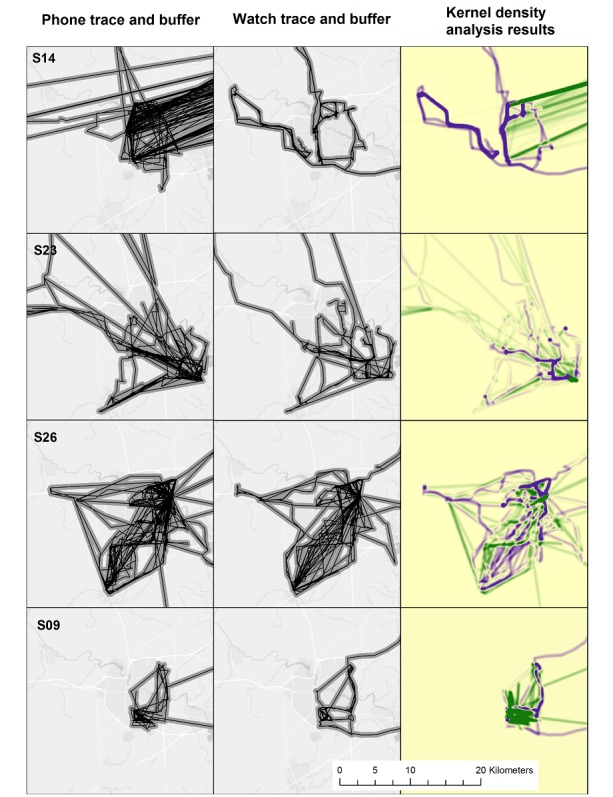
A total of 21 chronically ill participants carried both devices, which generated digital traces of locations, for 28 days. A mobile phone-based brief ecological momentary assessment (EMA) survey asked participants to manually report their location at 4 random times throughout each day. Participants also took part in qualitative interviews and completed surveys twice during the study period in which they reviewed recent mobile phone and watch trace data to compare the devices' trace data with their memory of their activities on those days. Trace data from the devices were compared on the basis of (1) missing data days, (2) reasons for missing data, (3) distance between the route data collected for matching day and the associated EMA survey locations, and (4) activity space total area and density surfaces.
The watch resulted in a much higher proportion of missing data days (P<.001), with missing data explained by technical differences between the devices as well as participant behaviors. The mobile phone was significantly more accurate in detecting home locations (P=.004) and marginally more accurate (P=.07) for all types of locations combined. The watch data resulted in a smaller activity space area and more accurately recorded outdoor travel and recreation.
The most suitable mobile device for location-based health research depends on the particular study objectives. Furthermore, data generated from mobile devices, such as GPS phones and smartwatches, require careful analysis to ensure quality and completeness. Studies that seek precise measurement of outdoor activity and travel, such as measuring outdoor physical activity or exposure to localized environmental hazards, would benefit from the use of GPS devices. Conversely, studies that aim to account for time within buildings at home or work, or those that document visits to particular places (such as supermarkets, medical facilities, or fast food restaurants), would benefit from the greater precision demonstrated by the mobile phone in recording indoor activities.
移动设备越来越多地用于收集个人的基于位置的信息,包括他们的身体活动、饮食摄入、环境暴露和心理健康状况。这类研究通常使用可穿戴设备或手机来跟踪位置,受益于关于人类移动性的细粒度数据的日益增多。然而,对于此类设备的相对地理空间准确性知之甚少。
在本研究中,我们比较了从两种以不同方式确定位置的移动设备收集的位置信息的数据质量——一款全球定位系统(GPS)手表和一款启用了谷歌位置历史记录功能的手机。
共有21名慢性病患者同时携带这两种设备28天,它们生成位置的数字轨迹。一项基于手机的简短生态瞬时评估(EMA)调查要求参与者在每天的4个随机时间手动报告他们的位置。参与者还参加了定性访谈,并在研究期间两次完成调查问卷,在问卷中他们回顾了最近的手机和手表轨迹数据,以将设备的轨迹数据与他们对那些日子活动的记忆进行比较。根据以下方面比较设备的轨迹数据:(1)数据缺失天数;(2)数据缺失原因;(3)为匹配日收集的路线数据与相关EMA调查位置之间的距离;(4)活动空间总面积和密度表面。
手表导致数据缺失天数的比例高得多(P<.001),数据缺失可由设备之间的技术差异以及参与者行为来解释。手机在检测家庭位置方面明显更准确(P=.004),对于所有类型的位置综合起来也略微更准确(P=.07)。手表数据导致活动空间面积较小,并且更准确地记录了户外旅行和娱乐活动。
基于位置的健康研究最合适的移动设备取决于特定的研究目标。此外,从移动设备(如GPS手机和智能手表)生成的数据需要仔细分析以确保质量和完整性。旨在精确测量户外活动和旅行(如测量户外体育活动或暴露于局部环境危害)的研究将受益于使用GPS设备。相反,旨在记录在家或工作场所建筑物内的时间的研究,或那些记录对特定场所(如超市、医疗设施或快餐店)访问情况的研究,将受益于手机在记录室内活动方面表现出的更高精度。