College of Biological Science and Agriculture, Qiannan Normal University for Nationalities, Duyun, 558000, Guizhou, China.
Key Laboratory of System Bio-medicine of Jiangxi Province, Jiujiang University, Jiujiang, 332000, Jiangxi, China.
Reprod Biol Endocrinol. 2019 Aug 31;17(1):71. doi: 10.1186/s12958-019-0517-4.
Palmitic acid (PA) is a common saturated fatty acid that induces apoptosis in various types of cells, including testicular Leydig cells. There is evidence suggesting that PA is increased in patients with obesity and that PA-induced cell apoptosis may play an important role in obesity-related male infertility. Curcumin, a natural polyphenol, has been reported to exert cytoprotective effects in various cell types. However, the cytoprotective effect of curcumin against PA-induced apoptosis in Leydig cells remains unknown. Therefore, the current study was performed to investigate the protective effects of curcumin in response to PA-induced toxicity and apoptosis in murine Leydig tumor cell line 1 (MLTC-1) cells and explore the mechanism underlying its anti-apoptotic action.
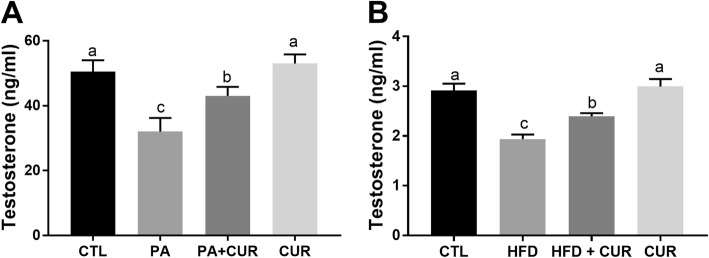
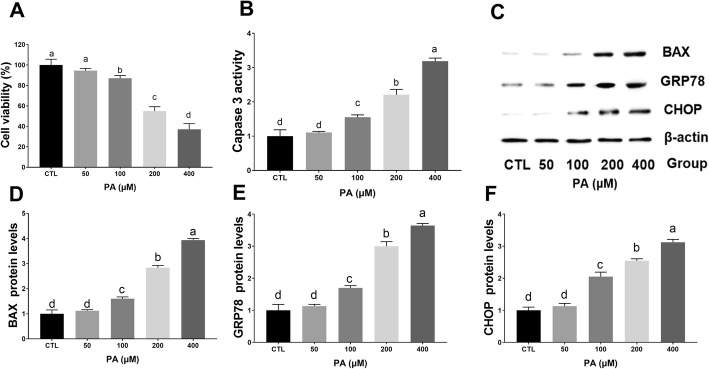
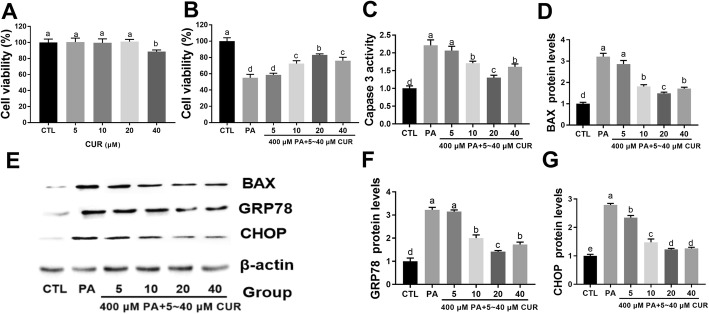
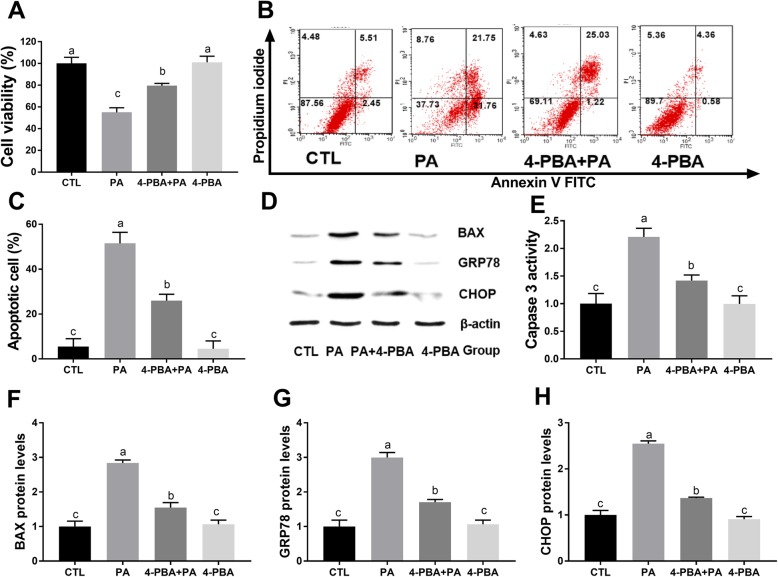
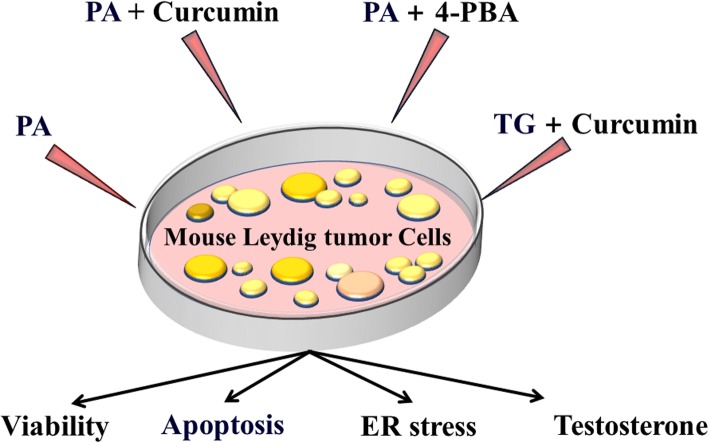
MLTC-1 cells were cultured in Roswell Park Institute-1640 medium and divided into five groups. First four groups were treated with 50-400 μM PA, 400 μM PA + 5-40 μM curcumin, 400 μM PA + 500 nM 4-phenylbutyric acid (4-PBA, an endoplasmic reticulum (ER) stress inhibitor), and 500 nM thapsigargin (TG, an ER stress inducer) + 20 μM curcumin, respectively, followed by incubation for 24 h. Effects of PA and/or curcumin on viability, apoptosis, and ER stress in MLTC-1 cells were then determined by cell proliferation assay, flow cytometry, and western blot analysis. The fifth group of MLTC-1 cells was exposed to 400 μM of PA and 5 IU/mL of human chorionic gonadotropin (hCG) for 24 h in the absence and presence of curcumin, followed by measurement of testosterone levels in cell-culture supernatants by enzyme-linked immunosorbent assay (ELISA). Rats fed a high-fat diet (HFD) were treated with or without curcumin for 4 weeks, and the testosterone levels were detected by ELISA.
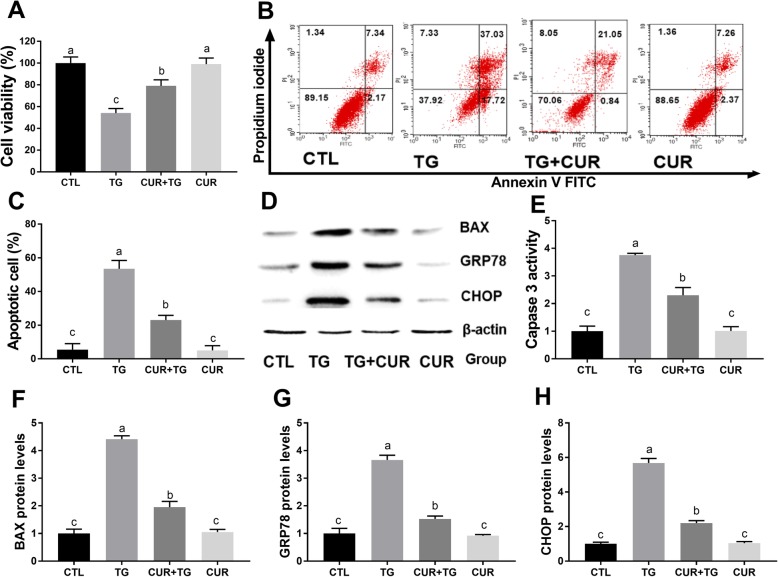
Exposure to 100-400 μM PA reduced cell viability, activated caspase 3, and enhanced the expression levels of the apoptosis-related protein BCL-2-associated X protein (BAX) and ER stress markers glucose-regulated protein 78 (GRP78) and CCAAT/enhancer binding protein homologous protein (CHOP) in MLTC-1 cells. Treating cells with 500 nM 4-PBA significantly attenuated PA-induced cytotoxicity through inhibition of ER stress. Curcumin (20 μM) significantly suppressed PA- or TG-induced decrease in cell viability, caspase 3 activity, and the expression levels of BAX, CHOP, and GRP78. In addition, treating MLTC-1 cells with 20 μM curcumin effectively restored testosterone levels, which were reduced in response to PA exposure. Similarly, curcumin treatment ameliorated the HFD-induced decrease in serum testosterone level in vivo.
The present study suggests that PA induces apoptosis via ER stress and curcumin ameliorates PA-induced apoptosis by inhibiting ER stress in MLTC-1 cells. This study suggests the application of curcumin as a potential therapeutic agent for the treatment of obesity-related male infertility.
棕榈酸(PA)是一种常见的饱和脂肪酸,可诱导包括睾丸间质细胞在内的多种细胞凋亡。有证据表明,肥胖症患者的 PA 水平升高,PA 诱导的细胞凋亡可能在肥胖相关男性不育中发挥重要作用。姜黄素是一种天然多酚,已被报道在多种细胞类型中具有细胞保护作用。然而,姜黄素对 Leydig 细胞中 PA 诱导的细胞凋亡的细胞保护作用尚不清楚。因此,本研究旨在探讨姜黄素对小鼠 Leydig 肿瘤细胞系 1(MLTC-1)细胞中 PA 诱导的毒性和细胞凋亡的保护作用,并探讨其抗细胞凋亡作用的机制。
将 MLTC-1 细胞在罗威尔帕克研究所-1640 培养基中培养,并分为五组。前四组分别用 50-400 μM PA、400 μM PA+5-40 μM 姜黄素、400 μM PA+500 nM 4-苯丁酸(4-PBA,内质网应激抑制剂)和 500 nM 他普西他汀(TG,内质网应激诱导剂)+20 μM 姜黄素处理 24 h,然后通过细胞增殖测定、流式细胞术和 Western blot 分析测定 PA 和/或姜黄素对 MLTC-1 细胞活力、凋亡和内质网应激的影响。第五组 MLTC-1 细胞在不存在和存在姜黄素的情况下用 400 μM 的 PA 和 5 IU/mL 的人绒毛膜促性腺激素(hCG)孵育 24 h,然后通过酶联免疫吸附试验(ELISA)测定细胞培养上清液中的睾酮水平。用高脂肪饮食(HFD)喂养大鼠 4 周,并通过 ELISA 检测睾酮水平。
暴露于 100-400 μM PA 降低了 MLTC-1 细胞的活力,激活了 caspase 3,并增强了与细胞凋亡相关的蛋白 BCL-2 相关 X 蛋白(BAX)和内质网应激标志物葡萄糖调节蛋白 78(GRP78)和 CCAAT/增强子结合蛋白同源蛋白(CHOP)的表达水平。用 500 nM 4-PBA 处理细胞可显著通过抑制内质网应激减轻 PA 诱导的细胞毒性。姜黄素(20 μM)可显著抑制 PA 或 TG 诱导的细胞活力、caspase 3 活性以及 BAX、CHOP 和 GRP78 的表达水平降低。此外,用 20 μM 姜黄素处理 MLTC-1 细胞可有效恢复因暴露于 PA 而降低的睾酮水平。同样,姜黄素治疗可改善体内 HFD 引起的血清睾酮水平降低。
本研究表明,PA 通过内质网应激诱导细胞凋亡,姜黄素通过抑制 MLTC-1 细胞中的内质网应激来改善 PA 诱导的细胞凋亡。本研究表明姜黄素可作为治疗肥胖相关男性不育的潜在治疗药物。