Department of Rheumatology, Sint Maartenskliniek, Nijmegen, the Netherlands.
Department of Rheumatology, Radboud University Medical Center, Nijmegen, the Netherlands.
BMC Musculoskelet Disord. 2019 Aug 31;20(1):398. doi: 10.1186/s12891-019-2768-9.
This paper describes (the development of) an eHealth tool (dr. Bart app) to enhance self-management and to optimize non-surgical health care utilization in patients with knee and/or hip osteoarthritis (OA) and presents a study aiming 1) to study the effectiveness of the dr. Bart app on health care use 2) to explore differences in use, usability and the clinical outcomes of the dr. Bart app between the Netherlands and Germany.
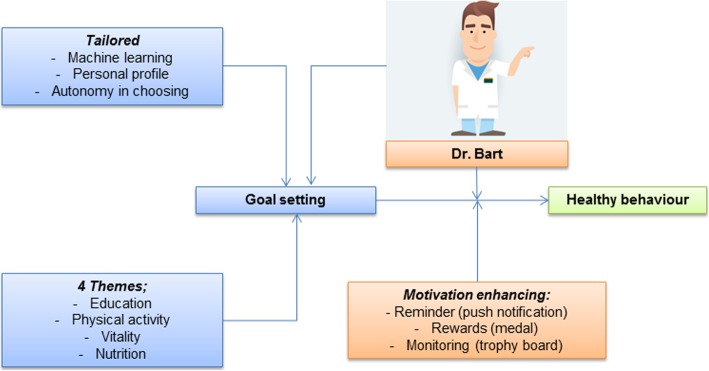
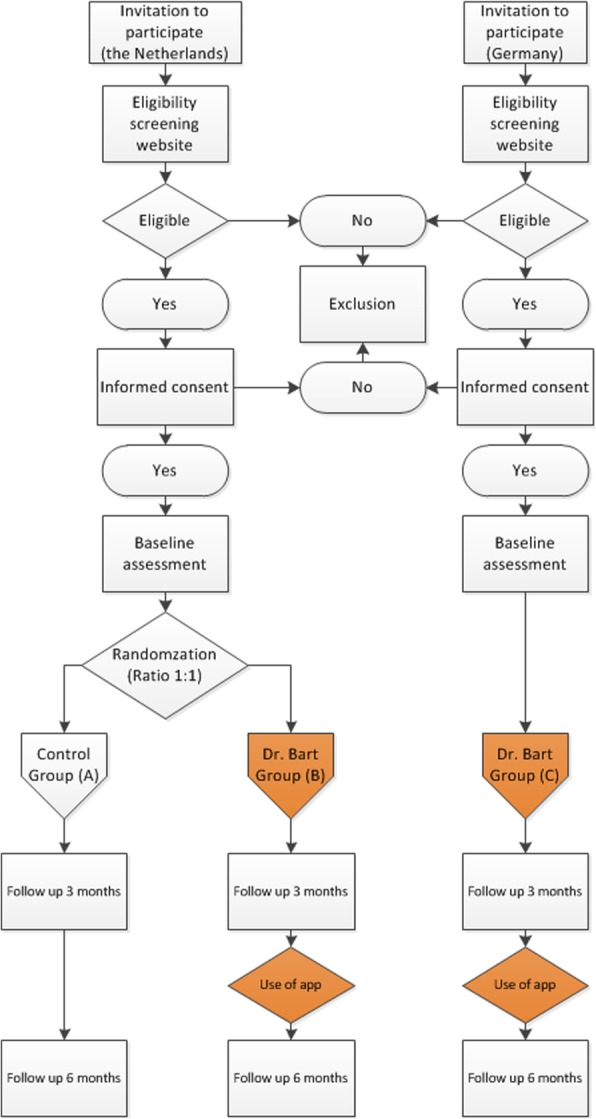
The dr. Bart app is a fully automated eHealth application and is based on the Fogg model for behavioural change, augmented with reminders, rewards and self-monitoring to reinforce app engagement and health behaviour. The dr. Bart app propose goals to a healthier lifestyle based on machine learning techniques fed by data collected in a personal profile and choosing behaviour of the app user. Patients ≥50 years with self-reported knee and/or hip OA will be eligible to participate. Participants will be recruited in the community through advertisements in local newspapers and campaigns on social media. This protocol presents a study with three arms, aiming to include 161 patients in each arm. In the Netherlands, patients are randomly allocated to usual care or dr. Bart app and in Germany all patients receive the dr. Bart app. The primary outcome of the first research question is the number of self-reported consultations in secondary health care. The primary outcome of the second research question (comparison between the Netherlands and Germany) is self-management behaviour assessed by the patient activation measure (PAM-13) questionnaire. Secondary outcomes are costs, health-related quality of life, physical functioning and activity, pain, use and usability of the dr. Bart app. Data will be collected through three online questionnaires (at baseline and after 3 and 6 months after inclusion).
This study will gain insight into the effectiveness of the dr. Bart app in the (conservative) treatment of patients with knee and/or hip OA and differences in the use and usability of the dr. Bart app between the Netherlands and Germany.
Dutch Trial Register (Trial Number NTR6693 / NL6505 ). Registration date: 4 September 2017.
本文描述了一种电子健康工具(dr. Bart 应用程序)的开发,旨在增强膝关节和/或髋关节骨关节炎(OA)患者的自我管理能力,并优化非手术保健的利用,并提出了一项旨在 1)研究 dr. Bart 应用程序对保健利用的有效性,2)探索荷兰和德国之间 dr. Bart 应用程序的使用、可用性和临床结果差异的研究。
dr. Bart 应用程序是一个完全自动化的电子健康应用程序,基于 Fogg 行为改变模型,通过提醒、奖励和自我监测增强应用程序的参与度和健康行为,增强其可用性。dr. Bart 应用程序根据机器学习技术提出基于个人资料和选择应用程序用户行为收集的数据更健康生活方式的目标。≥50 岁的自我报告膝关节和/或髋关节 OA 患者将有资格参加。参与者将通过当地报纸上的广告和社交媒体上的活动在社区中招募。本方案介绍了一项具有三个臂的研究,旨在每个臂中纳入 161 名患者。在荷兰,患者被随机分配到常规护理或 dr. Bart 应用程序,而在德国,所有患者都使用 dr. Bart 应用程序。第一个研究问题的主要结果是自我报告的二级保健咨询次数。第二个研究问题(荷兰和德国之间的比较)的主要结果是患者激活度量表(PAM-13)问卷评估的自我管理行为。次要结果是成本、健康相关生活质量、身体功能和活动、疼痛、dr. Bart 应用程序的使用和可用性。数据将通过三个在线问卷(基线和纳入后 3 个月和 6 个月)收集。
这项研究将深入了解 dr. Bart 应用程序在膝关节和/或髋关节 OA 患者保守治疗中的有效性,以及荷兰和德国之间 dr. Bart 应用程序使用和可用性的差异。
荷兰试验登记处(试验编号 NTR6693/NL6505)。注册日期:2017 年 9 月 4 日。