Center for Data Science in Health and Medicine, Shandong Provincial Qianfoshan Hospital, The First Affiliated Hospital of Shandong First Medical University, Jingshi Road 16766, Jinan, 250014, China.
Shandong Provincial Qianfoshan Hospital Affiliated to Shandong University, Jinan, China.
Lipids Health Dis. 2019 Aug 31;18(1):167. doi: 10.1186/s12944-019-1109-1.
Metabolic-related markers and inflammatory factors have been proved to be associated with increased risk of dyslipidemia. Elucidating the mechanisms underlying these associations might provide an important perspective for the prevention of dyslipidemia. In the present study, we aimed to explore the effect of metabolic-related markers on dyslipidemia, and to assess what extent inflammation mediating these associations.
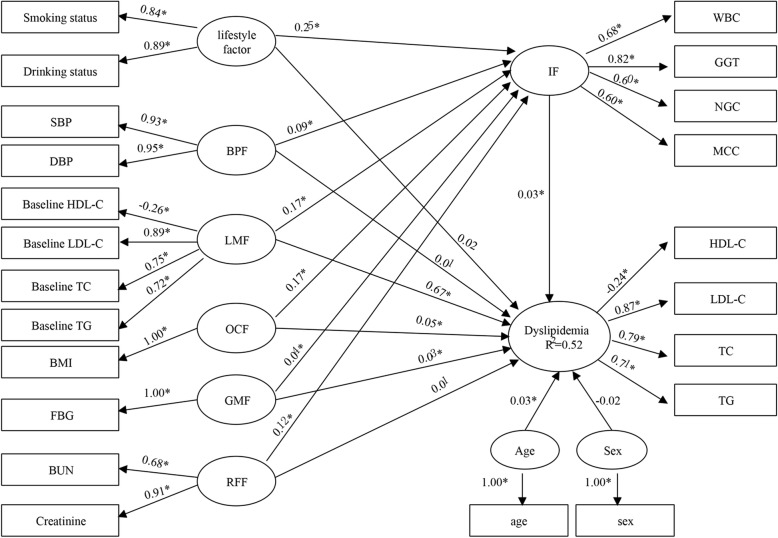
A total of 25,130 participants without dyslipidemia at baseline were included in the present study during 2010-2015. A partial least squares path model was used to explore possible pathways from metabolic-related markers to dyslipidemia, and the mediation role of inflammation.
Lipid metabolism factor, blood pressure factor, obesity condition factor, glucose metabolism factor, renal function factor and lifestyle factor had diverse impact on development of dyslipidemia, directly and (or) indirectly. Partial least squares path analysis revealed that the determination coefficient of the model (R) was 0.52. Lipid metabolism factor, obesity condition factor, and glucose metabolism factor had both direct and indirect effect on dyslipidemia through inflammatory factor. Lipid metabolism factor was the most important risk factor (β = 0.68) in the prediction of dyslipidemia, followed by obesity condition factor (β = 0.06) and glucose metabolism factor (β = 0.03).
Metabolic-related markers are strong risk factors for dyslipidemia. Inflammatory factors have significant mediating effect on these relationships. These findings suggested that comprehensive intervention strategies on metabolic biomarkers and inflammatory factors should be taken into consideration in prevention and treatment of dyslipidemia.
代谢相关标志物和炎症因子已被证明与血脂异常风险增加相关。阐明这些关联的机制可能为预防血脂异常提供一个重要视角。本研究旨在探讨代谢相关标志物对血脂异常的影响,并评估炎症在这些关联中起到的介导作用。
本研究共纳入 2010 年至 2015 年期间无血脂异常的 25130 名参与者。采用偏最小二乘路径模型探讨代谢相关标志物向血脂异常发展的可能途径,以及炎症的介导作用。
脂代谢因子、血压因子、肥胖状况因子、糖代谢因子、肾功能因子和生活方式因子对血脂异常的发生有直接和(或)间接的不同影响。偏最小二乘路径分析显示模型的确定系数(R)为 0.52。脂代谢因子、肥胖状况因子和糖代谢因子通过炎症因子对血脂异常既有直接作用,也有间接作用。脂代谢因子是预测血脂异常的最重要危险因素(β=0.68),其次是肥胖状况因子(β=0.06)和糖代谢因子(β=0.03)。
代谢相关标志物是血脂异常的强烈危险因素。炎症因子在这些关系中具有显著的介导作用。这些发现表明,在血脂异常的预防和治疗中,应考虑采取针对代谢生物标志物和炎症因子的综合干预策略。