US EPA, National Center for Environmental Economics, 1200 Pennsylvania Avenue, NW (mail Code 1809T), Washington, DC, 20460, USA.
Appalachian State University, Boone, NC, USA.
Environ Res. 2019 Nov;178:108643. doi: 10.1016/j.envres.2019.108643. Epub 2019 Aug 10.
There is consensus that early childhood lead exposure causes adverse cognitive and behavioral effects, even at blood lead levels (BLL) below 5 μg/dL. What has not been established is to what extent the effects of childhood lead exposure persist across grades.
To measure the effects of early childhood lead exposure (BLL 1-10 μg/dL) on educational performance from grades 3-8; to determine if effects in lower grades persist as a child progresses through school; and if so, to characterize the pattern of persistence.
We examine data from 560,624 children living in North Carolina between 2000 and 2012 with a BLL ≤10 μg/dL measured between age 0-5 years. Children are matched to their standardized math and reading scores for grades 3-8, creating an unbalanced panel of 2,344,358 student-year observations. We use socio-economic, demographic, and school information along with matching techniques to control for confounding effects.
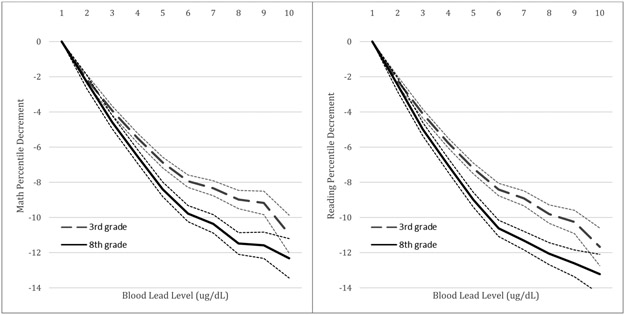
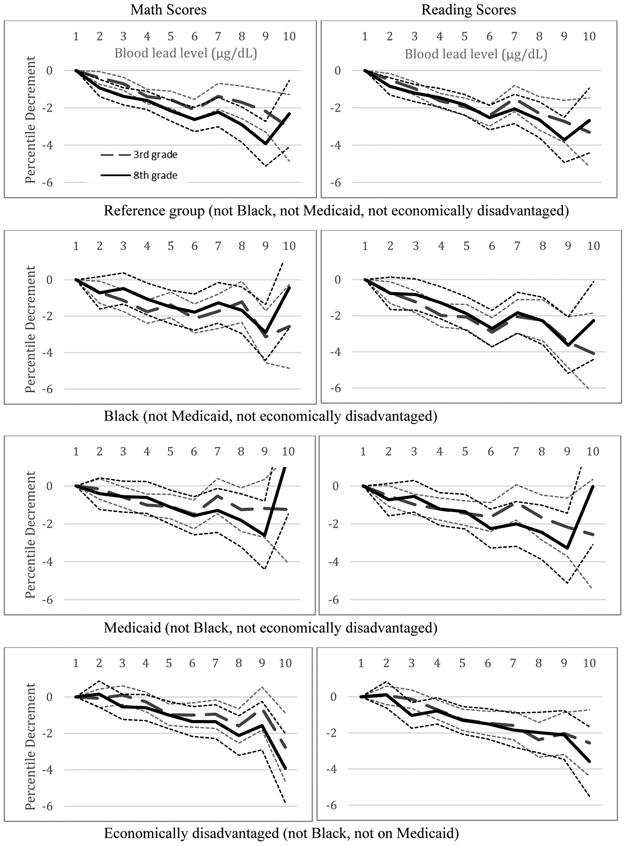
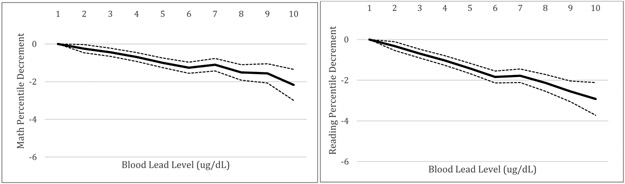
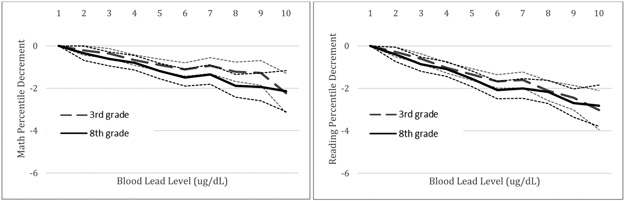
We find that early childhood exposure to low lead levels caused persistent deficits in educational performance across grades. In each grade (3-8), children with higher blood lead levels had, on average, lower percentile scores in both math and reading than children with lower blood lead levels. In our primary model, we find that children with BLL = 5 μg/dL in early childhood ranked 0.90-1.20 (1.35-1.55) percentiles lower than children with BLL ≤ 1 μg/dL on math (reading) tests during grades 3-8. As children progressed through school, the average percentile deficit in their test scores remained stable.
Our study shows that the adverse effects of early childhood exposure to low lead levels persist through early adolescence, and that the magnitude of the test-score percentile deficit remains steady between grades 3-8.
人们普遍认为,儿童早期铅暴露即使在血铅水平(BLL)低于 5μg/dL 以下,也会导致认知和行为方面的不良影响。但尚未确定的是,儿童期铅暴露的影响在整个年级中会持续到什么程度。
测量 1-10μg/dL 血铅水平的儿童早期铅暴露对 3-8 年级教育表现的影响;确定较低年级的影响是否会随着孩子在学校的进步而持续存在;如果是,描述持续存在的模式。
我们研究了 2000 年至 2012 年间生活在北卡罗来纳州的 560624 名儿童的数据,这些儿童的 BLL 为 0-5 岁时测量的≤10μg/dL。根据他们 3-8 年级的标准化数学和阅读成绩对儿童进行匹配,创建了一个不平衡的 2344358 名学生-年观察值的面板。我们使用社会经济、人口统计学和学校信息以及匹配技术来控制混杂效应。
我们发现,儿童早期接触低水平铅会导致整个年级教育表现持续出现缺陷。在每个年级(3-8 年级)中,血铅水平较高的儿童的数学和阅读成绩的百分位分数平均低于血铅水平较低的儿童。在我们的主要模型中,我们发现儿童在早期的 BLL 为 5μg/dL,在 3-8 年级的数学(阅读)测试中,比 BLL≤1μg/dL 的儿童低 0.90-1.20(1.35-1.55)个百分点。随着孩子在学校的进步,他们的测试成绩的平均百分位缺陷保持稳定。
我们的研究表明,儿童早期接触低水平铅的不良影响会持续到青春期早期,并且在 3-8 年级之间,测试成绩百分位缺陷的幅度保持稳定。