Department of Medical Radiation Physics and Nuclear Medicine, Karolinska University Hospital, Stockholm, Sweden; Department of Clinical Sciences, Intervention and Technology, Karolinska Institute, Stockholm, Sweden.
Neuroscience Graduate Program, University of Southern California, Los Angeles, CA, USA.
Neuroimage Clin. 2019;24:101981. doi: 10.1016/j.nicl.2019.101981. Epub 2019 Aug 13.
The supply territories of main cerebral arteries are predominantly identified based on distribution of infarct lesions in patients with large arterial occlusion; whereas, there is no consensus atlas regarding the supply territories of smaller end-arteries. In this study, we applied a data-driven approach to construct a stroke atlas of the brain using hierarchical density clustering in large number of infarct lesions, assuming that voxels/regions supplied by a common end-artery tend to infarct together.
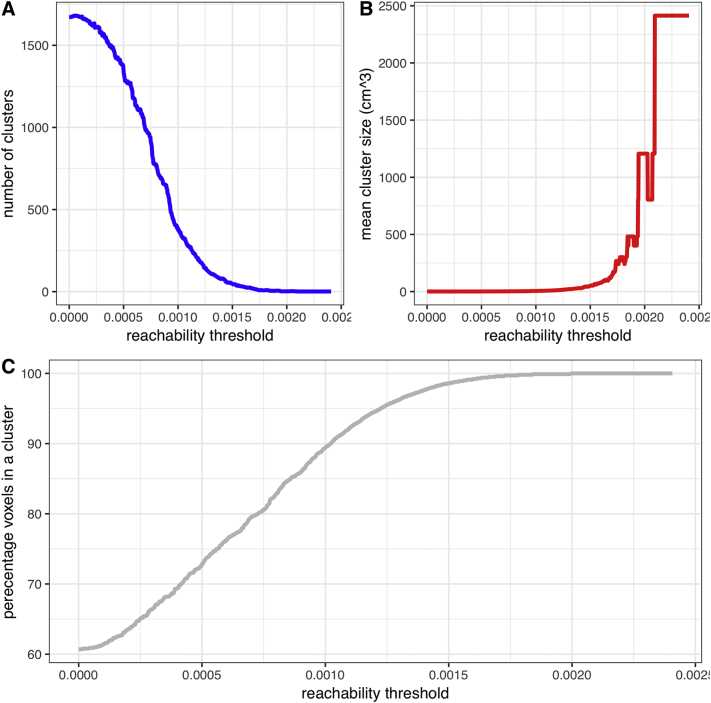
A total of 793 infarct lesions on MRI scans of 458 patients were segmented and coregistered to MNI-152 standard brain space. Applying a voxel-wise data-driven hierarchical density clustering algorithm, we identified those voxels that were most likely to be part of same infarct lesions in our dataset. A step-wise clustering scheme was applied, where the clustering threshold was gradually decreased to form the first 20 mother (>50 cm) or main (1-50 cm) clusters in addition to any possible number of tiny clusters (<1 cm); and then, any resultant mother clusters were iteratively subdivided using the same scheme. Also, in a randomly selected 2/3 subset of our cohort, a bootstrapping cluster analysis with 100 permutations was performed to assess the statistical robustness of proposed clusters.
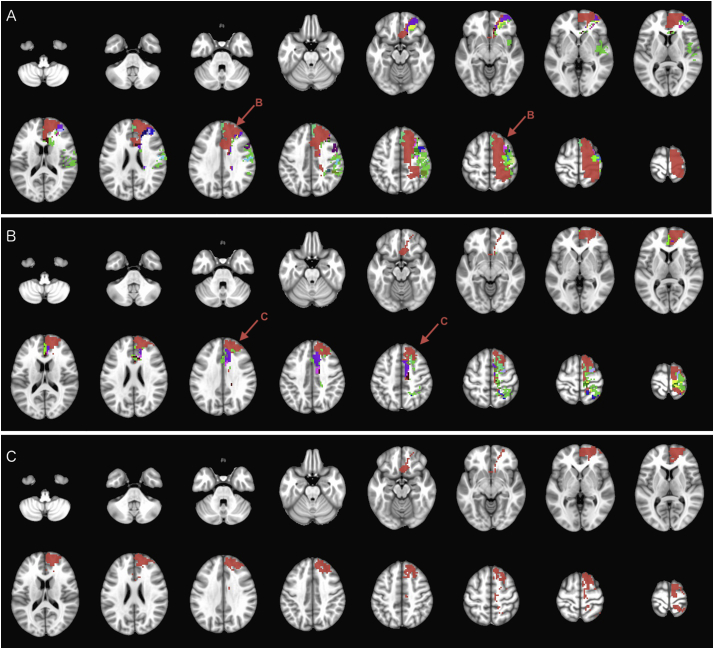
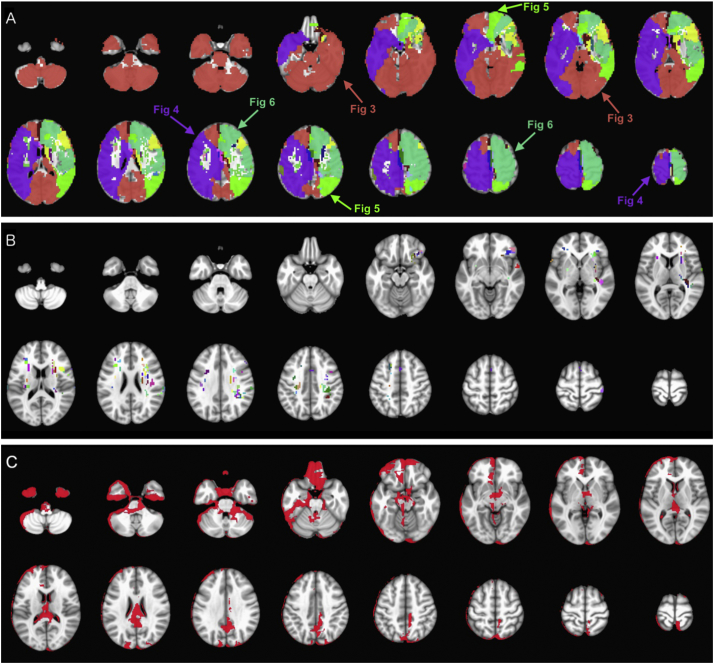
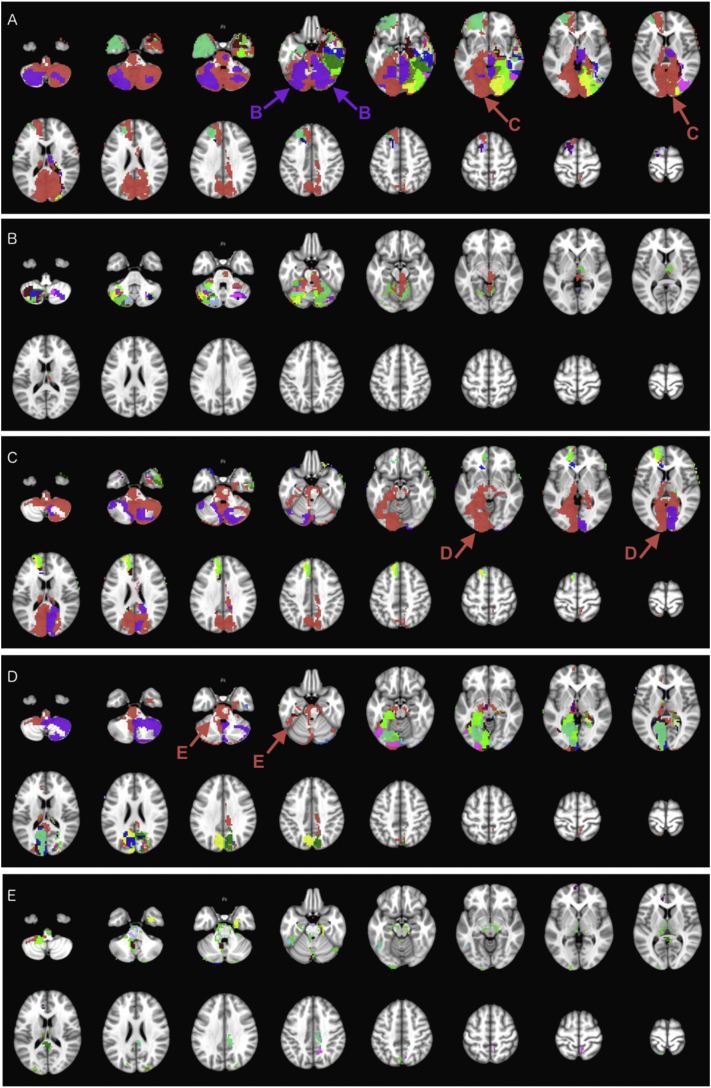
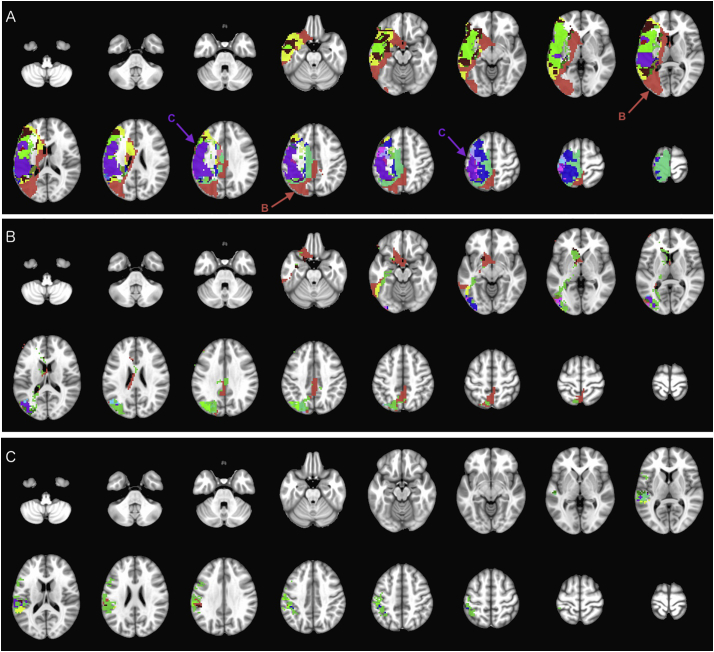
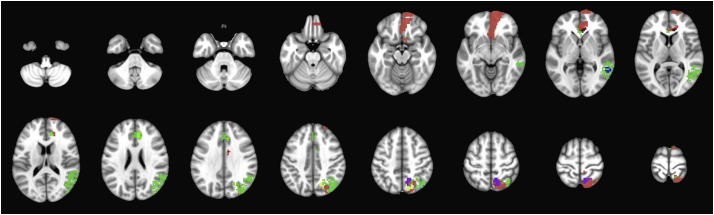
Approximately 91% of the MNI-152 brain mask was covered by 793 infarct lesions across patients. The covered area of brain was parcellated into 4 mother, 16 main, and 123 tiny clusters at the first hierarchy level. Upon iterative clustering subdivision of mother clusters, the brain tissue was eventually parcellated into 1 mother cluster (62.6 cm), 181 main clusters (total volume 1107.3 cm), and 917 tiny clusters (total volume of 264.8 cm). In bootstrap analysis, only 0.12% of voxels, were labelled as "unstable" - with a greater reachability distance in cluster scheme compared to their corresponding mean bootstrapped reachability distance. On visual assessment, the mother/main clusters were formed along supply territories of main cerebral arteries at initial hierarchical levels, and then tiny clusters emerged in deep white matter and gray matter nuclei prone to small vessel ischemic infarcts.
Applying voxel-wise data-driven hierarchical density clustering on a large number of infarct lesions, we have parcellated the brain tissue into clusters of voxels that tend to be part of same infarct lesion, and presumably representing end-arterial supply territories. This hierarchical stroke atlas of the brain is shared publicly, and can potentially be applied for future infarct location-outcome analysis.
大脑主要动脉的供血区主要是根据大动脉闭塞患者的梗死病灶分布来确定的;然而,对于较小终末动脉的供血区,目前还没有共识图谱。在这项研究中,我们应用基于层次密度聚类的方法,对大量梗死病灶进行脑卒中风图构建,假设由共同终末动脉供应的体素/区域倾向于一起梗死。
对 458 例患者的 MRI 扫描共 793 个梗死病灶进行分割,并与 MNI-152 标准脑空间配准。通过应用基于体素的、数据驱动的层次密度聚类算法,我们确定了在我们的数据集中最有可能属于同一梗死病灶的体素。应用逐步聚类方案,逐渐降低聚类阈值,除了任何可能数量的微小聚类(<1cm)外,形成前 20 个母(>50cm)或主(1-50cm)聚类;然后,使用相同的方案对任何得到的母聚类进行迭代细分。此外,在我们队列的随机选择的 2/3 子集中,进行了 100 次随机重排的 bootstrap 聚类分析,以评估所提出聚类的统计稳健性。
大约 91%的 MNI-152 脑掩模被患者的 793 个梗死病灶所覆盖。在第一层级,通过对母聚类进行迭代聚类细分,脑组织最终被分割成 1 个母聚类(62.6cm)、181 个主聚类(总容积 1107.3cm)和 917 个微小聚类(总容积 264.8cm)。在 bootstrap 分析中,只有 0.12%的体素被标记为“不稳定” - 与聚类方案中的可达距离相比,它们的相应平均 bootstrap 可达距离更大。通过视觉评估,母/主聚类在大脑主要动脉的供血区形成于初始层次,然后在深部白质和灰质核中出现微小的聚类,容易发生小血管缺血性梗死。
通过对大量梗死病灶进行基于体素的、数据驱动的层次密度聚类分析,我们将脑组织分割成倾向于属于同一梗死病灶的体素聚类,这些聚类可能代表终末动脉的供血区。这个公开的脑卒中风图图谱可以应用于未来的梗死部位-结局分析。