Section of Neuroradiology, Department of Radiology and Biomedical Imaging, Yale School of Medicine, New Haven, CT, United States.
Section of Neuroradiology, Department of Radiology and Biomedical Imaging, Yale School of Medicine, New Haven, CT, United States; CLAIM - Charité Lab for Artificial Intelligence in Medicine, Charité Universitätsmedizin Berlin, Berlin, Germany.
Neuroimage Clin. 2022;34:103034. doi: 10.1016/j.nicl.2022.103034. Epub 2022 May 7.
As "time is brain" in acute stroke triage, the need for automated prognostication tools continues to increase, particularly in rapidly expanding tele-stroke settings. We aimed to create an automated prognostication tool for anterior circulation large vessel occlusion (LVO) stroke based on admission CTA radiomics.
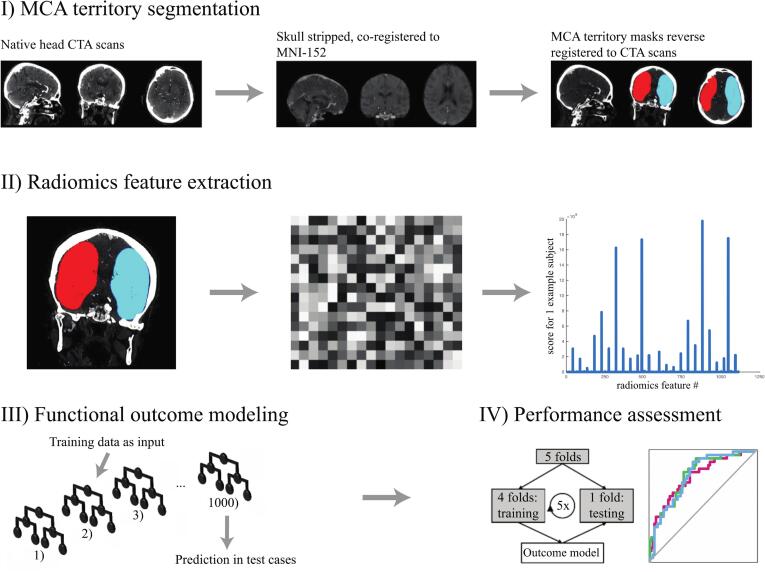
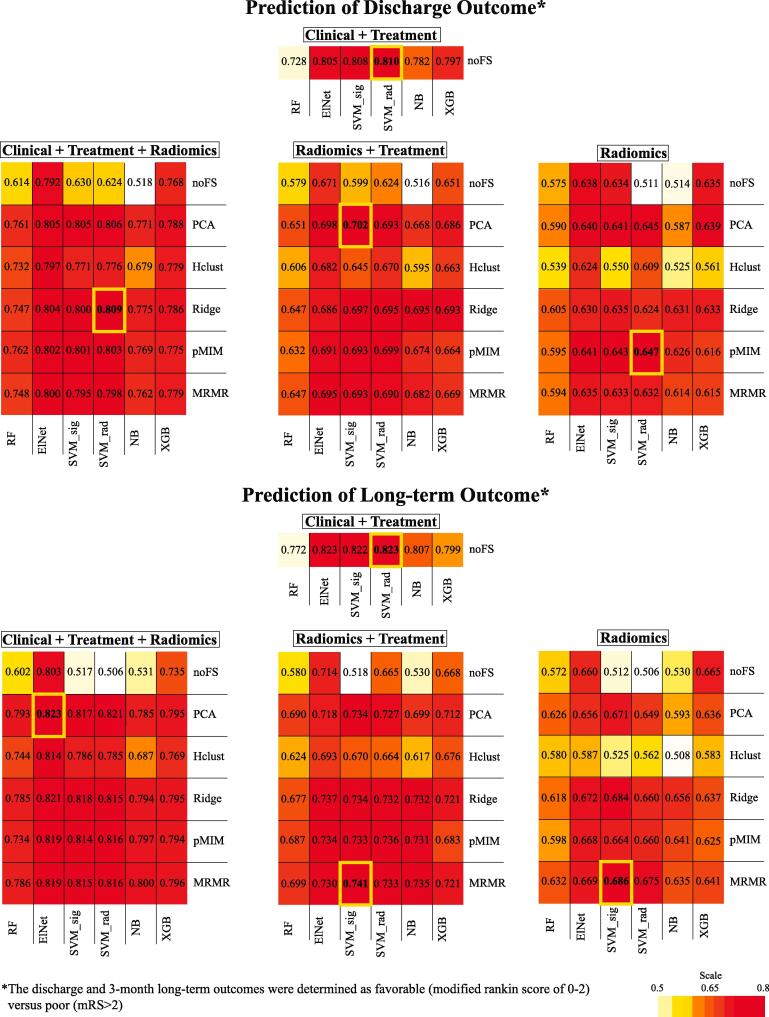
We automatically extracted 1116 radiomics features from the anterior circulation territory on admission CTAs of 829 acute LVO stroke patients who underwent mechanical thrombectomy in two academic centers. We trained, optimized, validated, and compared different machine-learning models to predict favorable outcome (modified Rankin Scale ≤ 2) at discharge and 3-month follow-up using four different input sets: "Radiomics", "Radiomics + Treatment" (radiomics, post-thrombectomy reperfusion grade, and intravenous thrombolysis), "Clinical + Treatment" (baseline clinical variables and treatment), and "Combined" (radiomics, treatment, and baseline clinical variables).
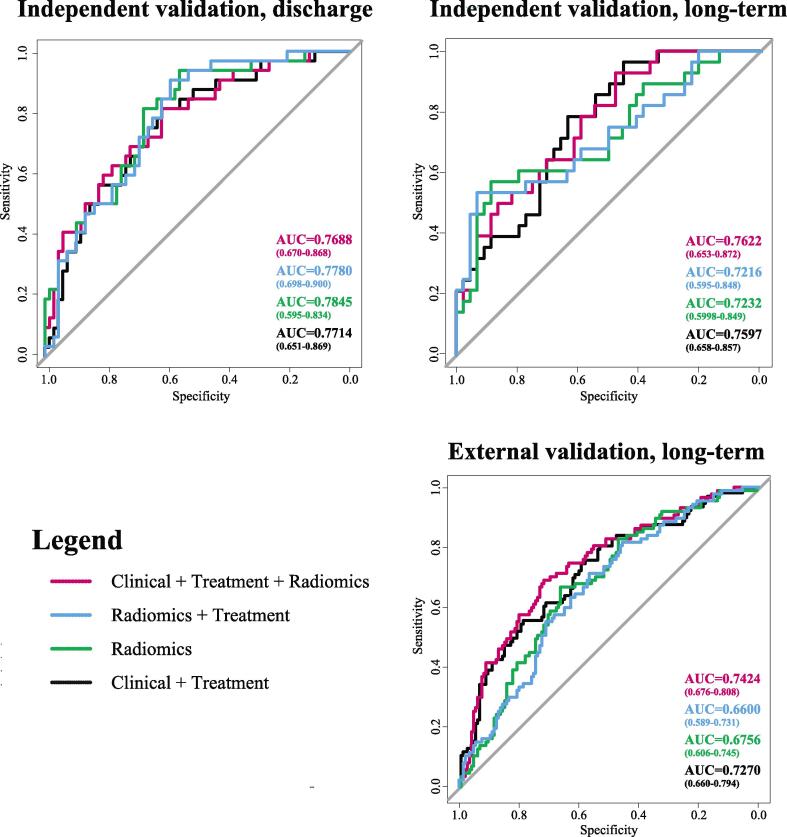
For discharge outcome prediction, models were optimized/trained on n = 494 and tested on an independent cohort of n = 100 patients from Yale. Receiver operating characteristic analysis of the independent cohort showed no significant difference between best-performing Combined input models (area under the curve, AUC = 0.77) versus Radiomics + Treatment (AUC = 0.78, p = 0.78), Radiomics (AUC = 0.78, p = 0.55), or Clinical + Treatment (AUC = 0.77, p = 0.87) models. For 3-month outcome prediction, models were optimized/trained on n = 373 and tested on an independent cohort from Yale (n = 72), and an external cohort from Geisinger Medical Center (n = 232). In the independent cohort, there was no significant difference between Combined input models (AUC = 0.76) versus Radiomics + Treatment (AUC = 0.72, p = 0.39), Radiomics (AUC = 0.72, p = 0.39), or Clinical + Treatment (AUC = 76, p = 0.90) models; however, in the external cohort, the Combined model (AUC = 0.74) outperformed Radiomics + Treatment (AUC = 0.66, p < 0.001) and Radiomics (AUC = 0.68, p = 0.005) models for 3-month prediction.
Machine-learning signatures of admission CTA radiomics can provide prognostic information in acute LVO stroke candidates for mechanical thrombectomy. Such objective and time-sensitive risk stratification can guide treatment decisions and facilitate tele-stroke assessment of patients. Particularly in the absence of reliable clinical information at the time of admission, models solely using radiomics features can provide a useful prognostication tool.
在急性脑卒中分诊中,“时间就是大脑”,因此对自动预后预测工具的需求持续增加,特别是在快速发展的远程脑卒中环境中。我们旨在基于入院 CT 血管造影的前循环大血管闭塞(LVO)脑卒中患者创建一个自动预后预测工具。
我们从前循环区域自动提取了 829 例接受机械取栓术的急性 LVO 脑卒中患者入院 CTAs 中的 1116 个放射组学特征,这些患者来自两个学术中心。我们使用四种不同的输入集(放射组学、放射组学+治疗、临床+治疗和联合)在 n = 494 个病例中进行模型训练、优化、验证和比较,以预测出院和 3 个月随访时的良好结局(改良 Rankin 量表≤2)。在耶鲁大学的独立队列中,对 n = 100 例患者进行了测试。对独立队列的接收器工作特征分析显示,最佳表现的联合输入模型(曲线下面积 AUC = 0.77)与放射组学+治疗(AUC = 0.78,p = 0.78)、放射组学(AUC = 0.78,p = 0.55)或临床+治疗(AUC = 0.77,p = 0.87)模型之间无显著差异。对于 3 个月的预后预测,模型在 n = 373 个病例中进行优化/训练,并在耶鲁大学的独立队列(n = 72)和 Geisinger 医疗中心的外部队列(n = 232)中进行了测试。在独立队列中,联合输入模型(AUC = 0.76)与放射组学+治疗(AUC = 0.72,p = 0.39)、放射组学(AUC = 0.72,p = 0.39)或临床+治疗(AUC = 0.76,p = 0.90)模型之间无显著差异;然而,在外部队列中,联合模型(AUC = 0.74)优于放射组学+治疗(AUC = 0.66,p < 0.001)和放射组学(AUC = 0.68,p = 0.005)模型,用于 3 个月的预测。
急性 LVO 脑卒中机械取栓候选患者入院 CT 血管造影的机器学习特征可以提供预后信息。这种客观且对时间敏感的风险分层可以指导治疗决策,并促进远程脑卒中患者的评估。特别是在入院时缺乏可靠的临床信息的情况下,仅使用放射组学特征的模型可以提供有用的预后预测工具。