Department of Thoracic Medicine and Surgery, Temple University, Philadelphia, PA, 19140, USA.
Center for Inflammation, Translational and Clinical Lung Research, Temple University, Philadelphia, PA, 19140, USA.
Cell Death Dis. 2019 Sep 2;10(9):638. doi: 10.1038/s41419-019-1833-5.
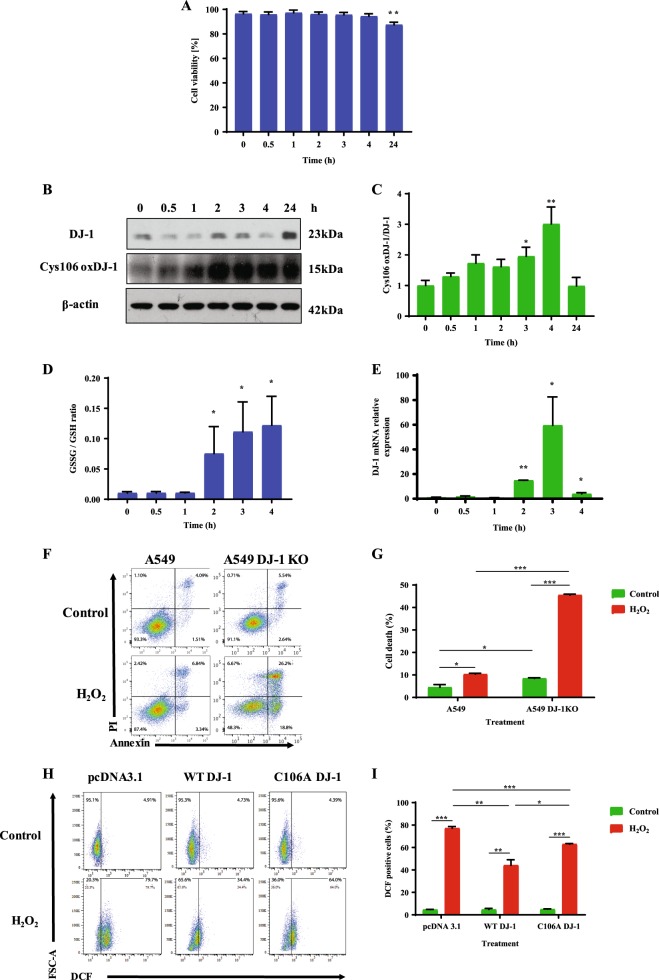
DJ-1 is a multifunctional protein with cytoprotective functions. It is localized in the cytoplasm, nucleus, and mitochondria. The conserved cysteine residue at position 106 (Cys106) within DJ-1 serves as a sensor of redox state and can be oxidized to both the sulfinate (-SO) and sulfonate (-SO) forms. DJ-1 with Cys106-SO has cytoprotective activity but high levels of reactive oxygen species can induce its overoxidation to Cys106-SO. We found increased oxidative stress in alveolar type II (ATII) cells isolated from emphysema patients as determined by 4-HNE expression. DJ-1 with Cys106-SO was detected in these cells by mass spectrometry analysis. Moreover, ubiquitination of Cys106-SO DJ-1 was identified, which suggests that this oxidized isoform is targeted for proteasomal destruction. Furthermore, we performed controlled oxidation using HO in A549 cells with DJ-1 knockout generated using CRISPR-Cas9 strategy. Lack of DJ-1 sensitized cells to apoptosis induced by HO as detected using Annexin V and propidium iodide by flow cytometry analysis. This treatment also decreased both mitochondrial DNA amount and mitochondrial ND1 (NADH dehydrogenase 1, subunit 1) gene expression, as well as increased mitochondrial DNA damage. Consistent with the decreased cytoprotective function of overoxidized DJ-1, recombinant Cys106-SO DJ-1 exhibited a loss of its thermal unfolding transition, mild diminution of secondary structure in CD spectroscopy, and an increase in picosecond-nanosecond timescale dynamics as determined using NMR. Altogether, our data indicate that very high oxidative stress in ATII cells in emphysema patients induces DJ-1 overoxidation to the Cys106-SO form, leading to increased protein flexibility and loss of its cytoprotective function, which may contribute to this disease pathogenesis.
DJ-1 是一种具有细胞保护功能的多功能蛋白。它定位于细胞质、细胞核和线粒体中。DJ-1 中第 106 位保守半胱氨酸(Cys106)残基作为氧化还原状态的传感器,可以被氧化为亚磺酸盐(-SO)和磺酸盐(-SO)形式。具有 Cys106-SO 的 DJ-1 具有细胞保护活性,但高水平的活性氧会诱导其过度氧化为 Cys106-SO。我们通过 4-HNE 表达发现,从肺气肿患者分离的肺泡 II 型(ATII)细胞中氧化应激增加。通过质谱分析在这些细胞中检测到 DJ-1 与 Cys106-SO。此外,鉴定了 Cys106-SO DJ-1 的泛素化,表明这种氧化同工型是针对蛋白酶体破坏的。此外,我们使用 HO 在使用 CRISPR-Cas9 策略生成的 DJ-1 敲除的 A549 细胞中进行了受控氧化。流式细胞术分析用 Annexin V 和碘化丙啶检测到缺乏 DJ-1 使细胞对 HO 诱导的凋亡敏感。这种处理还降低了线粒体 DNA 量和线粒体 ND1(NADH 脱氢酶 1,亚单位 1)基因表达,并增加了线粒体 DNA 损伤。与过氧化物 DJ-1 的保护功能降低一致,重组 Cys106-SO DJ-1 表现出其热展开转变的丧失、CD 光谱中二级结构的轻微减少以及使用 NMR 确定的皮秒-纳秒时间尺度动力学的增加。总之,我们的数据表明,肺气肿患者 ATII 细胞中的极高氧化应激诱导 DJ-1 过度氧化为 Cys106-SO 形式,导致蛋白质柔韧性增加和保护功能丧失,这可能导致这种疾病的发病机制。