Antonenko Daria, Thams Friederike, Uhrich Jessica, Dix Annika, Thurm Franka, Li Shu-Chen, Grittner Ulrike, Flöel Agnes
Department of Neurology, Universitätsmedizin Greifswald, Greifswald, Germany.
Chair of Lifespan Developmental Neuroscience, Faculty of Psychology, TU Dresden, Dresden, Germany.
Front Aging Neurosci. 2019 Aug 16;11:200. doi: 10.3389/fnagi.2019.00200. eCollection 2019.
With increasing aging populations worldwide, developing interventions against age-associated cognitive decline is particularly important. Evidence suggests that combination of brain stimulation with cognitive training intervention may enhance training effects in terms of performance gain or transfer to untrained domains. This protocol describes a Phase IIb clinical trial that investigates the intervention effects of training combined with brain stimulation in older adults.
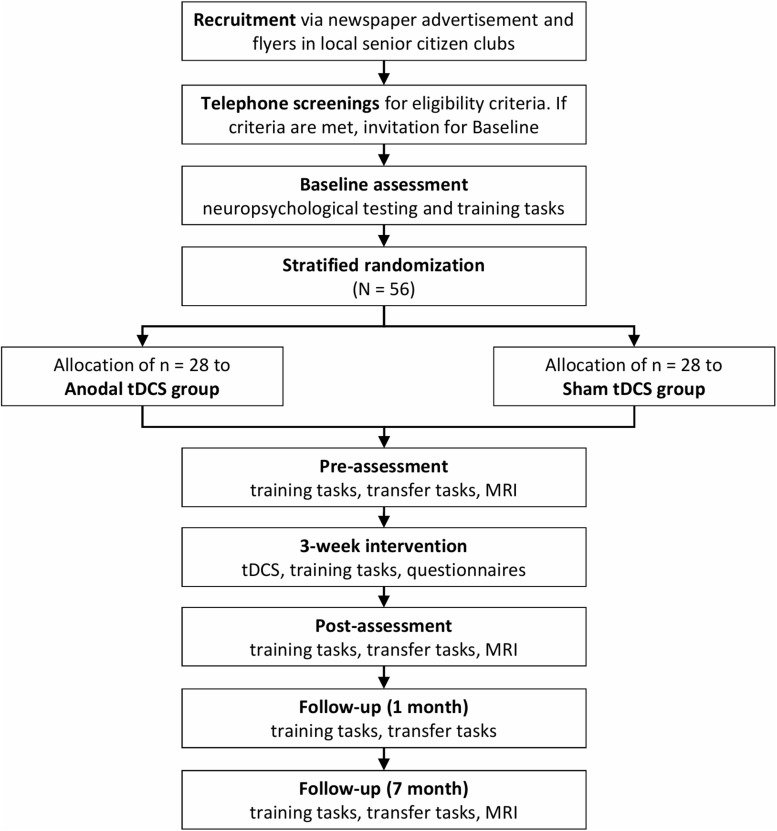
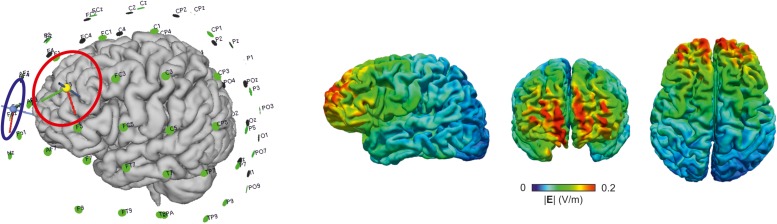
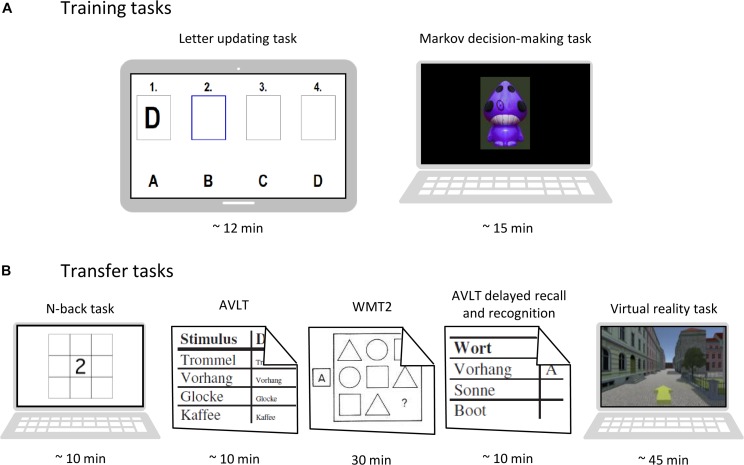
The TrainStim-Cog study is a monocentric, randomized, single-blind, placebo-controlled intervention. The study will investigate cognitive training with concurrent anodal transcranial direct current stimulation (tDCS) over the left dorsolateral prefrontal cortex (target intervention) compared to cognitive training with sham stimulation (control intervention) over nine sessions in 3 weeks, consisting of a letter updating task, and a three-stage Markov decision-making task. Fifty-six older adults will be recruited from the general population. Baseline assessment will be performed including neuropsychological screening and performance on training tasks. Participants will be allocated to one of the two study arms using block-wise randomization stratified by age and baseline performance with a 1:1 allocation ratio. Primary outcome is performance in the letter updating task after training under anodal tDCS compared to sham stimulation. Secondary outcomes include performance changes in the decision-making task and transfer tasks, as well as brain structure and functional networks assessed by structural, and functional magnetic resonance imaging (MRI) that are acquired pre- and post-intervention.
The main aim of the TrainStim-Cog study is to provide evidence for behavioral and neuronal effects of tDCS-accompanied cognitive training and to elucidate the underlying mechanisms in older adults. Our findings will contribute toward developing efficient interventions for age-associated cognitive decline.
This trial was retrospectively registered at Clinicaltrials.gov Identifier: NCT03838211 at February 12, 2019, https://clinicaltrials.gov/ct2/show/NCT03838211.
Based on BB 004/18 version 1.2 (May 17, 2019).
随着全球老龄化人口的增加,开发针对与年龄相关的认知衰退的干预措施尤为重要。有证据表明,将脑刺激与认知训练干预相结合,在提高表现或向未训练领域迁移方面可能会增强训练效果。本方案描述了一项IIb期临床试验,该试验研究了训练与脑刺激相结合对老年人的干预效果。
TrainStim-Cog研究是一项单中心、随机、单盲、安慰剂对照的干预试验。该研究将调查在3周内进行9次 sessions,对左侧背外侧前额叶皮层进行同步阳极经颅直流电刺激(tDCS)的认知训练(目标干预)与假刺激的认知训练(对照干预)相比,包括字母更新任务和三阶段马尔可夫决策任务。将从普通人群中招募56名老年人。将进行基线评估,包括神经心理学筛查和训练任务表现。参与者将使用按年龄和基线表现分层的区组随机化以1:1的分配比例分配到两个研究组之一。主要结局是与假刺激相比,阳极tDCS训练后字母更新任务的表现。次要结局包括决策任务和迁移任务的表现变化,以及通过干预前后获取的结构和功能磁共振成像(MRI)评估的脑结构和功能网络。
TrainStim-Cog研究的主要目的是为tDCS辅助认知训练的行为和神经元效应提供证据,并阐明老年人的潜在机制。我们的研究结果将有助于开发针对与年龄相关的认知衰退的有效干预措施。
该试验于2019年2月12日在Clinicaltrials.gov上进行回顾性注册,标识符:NCT03838211,https://clinicaltrials.gov/ct2/show/NCT03838211。
基于BB 004/18版本1.2(2019年5月17日)。