Koscielniak Maciej, Bojanowska Agnieszka
Faculty in Poznan, SWPS University of Social Sciences and Humanities, Poznań, Poland.
Department of Psychology, SWPS University of Social Sciences and Humanities, Warsaw, Poland.
Front Psychol. 2019 Aug 16;10:1887. doi: 10.3389/fpsyg.2019.01887. eCollection 2019.
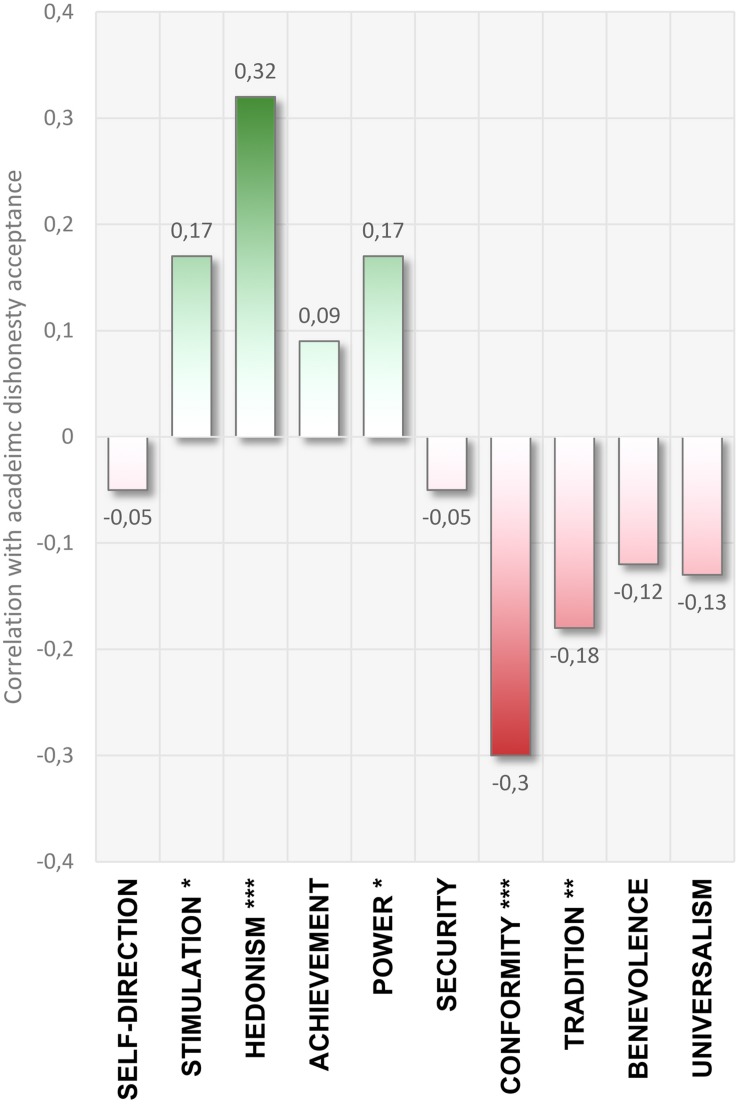
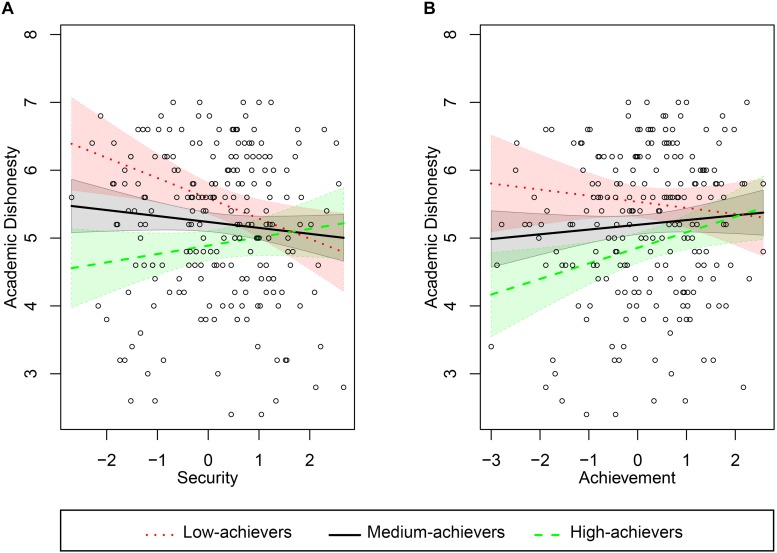
Although multiple individual and environmental causes of students' dishonest behaviors have been well documented in past research, not much attention has been paid to the human values perspective yet. The current study investigates the direct relationship of values with academic dishonesty, as well as the moderating role of students' past achievements (grades). Analyses were performed on 219 Polish university students ( = 46, = 173). Questionnaire measures were used, including Schwartz's Portrait of Values Questionnaire. It was found that socially orientated human values (Conformity and Tradition) were negatively related to unethical behaviors, while personally focused values (Hedonism, Power, and Stimulation) correlate positively. Additional analyses revealed that the relationships of some values (Achievement and Security) with academic dishonesty are significantly moderated by students' academic performance (grades). In the discussion we suggest that academic dishonesty is a pattern of behavior that can be successfully investigated from the perspective of human values - in order to identify its correlates and to plan preventive actions.
尽管过去的研究已经充分记录了导致学生不诚实行为的多种个人和环境原因,但从人类价值观的角度却没有得到太多关注。当前的研究调查了价值观与学术不诚实之间的直接关系,以及学生过去的成绩(分数)所起的调节作用。对219名波兰大学生(男生46名,女生173名)进行了分析。采用问卷调查方法,包括施瓦茨价值观问卷。研究发现,社会导向型的人类价值观(遵从和传统)与不道德行为呈负相关,而个人导向型价值观(享乐主义、权力和刺激)呈正相关。进一步分析表明,某些价值观(成就和安全)与学术不诚实之间的关系受到学生学业成绩(分数)的显著调节。在讨论中,我们认为学术不诚实是一种行为模式,可以从人类价值观的角度成功地进行研究——以便确定其相关因素并规划预防措施。