Hama-Ba Fatoumata, Mouquet-Rivier Claire, Diawara Bréhima, Weltzien Eva, Icard-Vernière Christèle
Département de Technologie Alimentaire, IRSAT, Ouagadougou, Burkina Faso.
Nutripass, IRD, University Montpellier, Montpellier, France.
Front Nutr. 2019 Aug 14;6:115. doi: 10.3389/fnut.2019.00115. eCollection 2019.
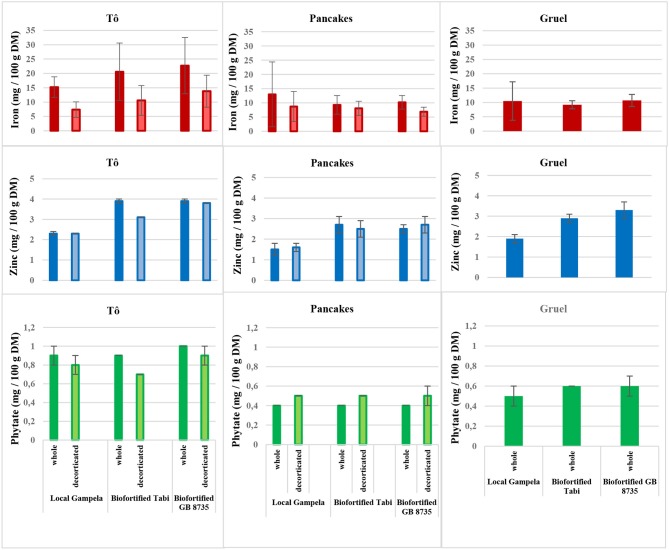
Biofortification is among the food-based strategies, recently implemented and still in development, to fight micronutrient deficiencies. Three cereal-based traditional dishes of Sub-Saharan Africa (tô paste, pancakes, and gruel) prepared from one local (Gampela), or two biofortified (GB 8735 and Tabi) varieties of millet were assessed for their (i) acceptability by local consumers, (ii) iron and zinc absorption predicted by phytate-to-mineral molar ratios and (iii) contribution to the iron and zinc requirements of young children. Tasters preferred the color, texture, and taste of dishes prepared with the local variety, whether or not the grains were decorticated. Hedonic and preference tests showed no significant difference between the two biofortified varieties, but the cooks reported different behaviors during processing. Biofortified millet contained up to two times more iron than the local variety, reaching 6.5 mg iron/100 g dry matter. Iron and zinc contents remained higher in biofortified varieties even after decortication. Iron content in the dishes was highly variable, depending on iron loss and potential contamination during processing. The phytate-to-mineral molar ratios of all dishes indicated low iron absorption, independent of the millet variety, but improved zinc absorption in dishes prepared with biofortified varieties. The contribution of a dish prepared with one of the two biofortified millet varieties to the recommended iron and zinc intakes for 6-11-month-old children was estimated to be about 5 and 7%, respectively, compared to 2 and 4% for the same dish prepared with local millet. For 12-23-month-old children, the contribution to the recommended intakes was estimated to be about 14 and 12% with biofortified millet, respectively, and about 6 and 7% with local millet. The use of biofortified millet varieties could be complementary to food diversification strategies to increase iron and zinc intakes. As in Ouagadougou, cereals are eaten in different forms by young children several times per day, iron and zinc intakes could be improved in the long term by using the biofortified varieties of pearl millet.
生物强化是最近实施且仍在发展中的基于食物的应对微量营养素缺乏的策略之一。对用一种当地(甘佩拉)或两种生物强化(GB 8735和塔比)小米品种制作的撒哈拉以南非洲的三种以谷物为基础的传统菜肴(tô酱、薄煎饼和稀粥)进行了评估,评估内容包括:(i)当地消费者的接受度;(ii)通过植酸与矿物质摩尔比预测的铁和锌的吸收情况;(iii)对幼儿铁和锌需求的贡献。品尝者更喜欢用当地品种制作的菜肴的颜色、质地和味道,无论谷物是否去皮。享乐和偏好测试表明,两种生物强化品种之间没有显著差异,但厨师报告了加工过程中的不同表现。生物强化小米的铁含量比当地品种高出两倍,达到6.5毫克铁/100克干物质。即使去皮后,生物强化品种中的铁和锌含量仍然较高。菜肴中的铁含量变化很大,这取决于加工过程中的铁损失和潜在污染。所有菜肴的植酸与矿物质摩尔比表明铁吸收较低,与小米品种无关,但用生物强化品种制作的菜肴中锌吸收有所改善。用两种生物强化小米品种之一制作的菜肴对6至11个月大儿童推荐的铁和锌摄入量的贡献估计分别约为5%和7%,而用当地小米制作的同一菜肴的贡献分别为2%和4%。对于12至23个月大的儿童,生物强化小米对推荐摄入量的贡献估计分别约为14%和12%,当地小米分别约为6%和7%。使用生物强化小米品种可以作为食物多样化策略的补充,以增加铁和锌的摄入量。正如在瓦加杜古一样,幼儿每天多次以不同形式食用谷物,长期使用珍珠粟的生物强化品种可以改善铁和锌的摄入量。