Hawkins Irana W, Mangels A Reed, Goldman Robert, Wood Richard J
Department of Nutrition, University of Massachusetts Amherst, Amherst, MA, United States.
Doctoral Programs in Public Health, School of Health Sciences, Walden University, Minneapolis, MN, United States.
Front Nutr. 2019 Aug 14;6:123. doi: 10.3389/fnut.2019.00123. eCollection 2019.
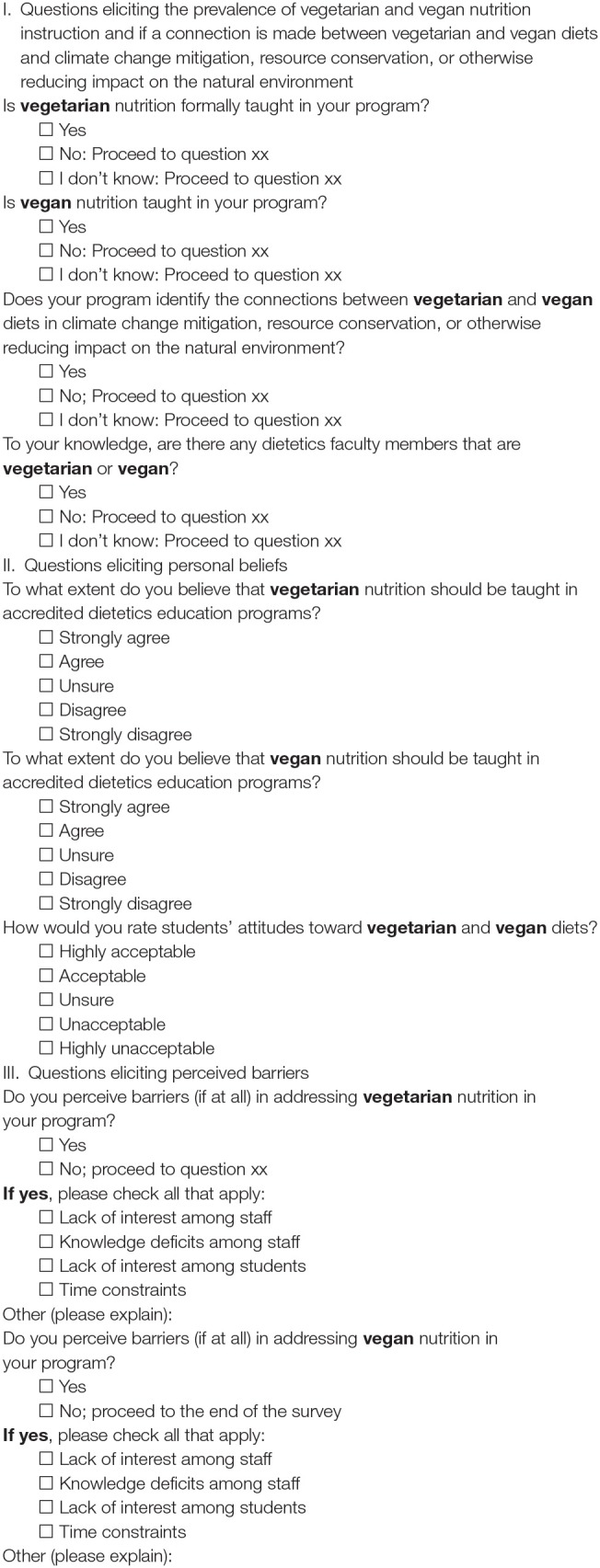
Registered Dietitian Nutritionists (RDNs) are clinicians trained in the application of food, nutrition, and dietetics. Vegetarians and vegans have a lower risk of many nutrition-related chronic diseases that are epidemic while vegetarian and vegan diets are associated with reduced environmental impact. Despite this strong diet-disease and diet-environment connection, it is not known if dietetics students are taught the principles of vegetarian and vegan nutrition. The overarching goal of our study was to investigate curricular practices in accredited dietetics training programs in the United States (U.S.) including (1) the prevalence and perceived importance of vegetarian and vegan nutrition instruction and (2) if program directors connect vegetarian and vegan diets to climate change mitigation and resource conservation. Primary data were collected by way of a cross-sectional, Internet-based survey. All Accreditation Council for Education in Nutrition and Dietetics (ACEND) program directors in the U.S. ( = 574) were sent a 37-question survey and invited to participate in the study. Outcome measures included the prevalence of vegetarian and vegan nutrition instruction, quantifying if relationships exist among variables, and the frequency of connecting vegetarian and vegan diets to environmental impact. Descriptive and inferential statistics were utilized. Respondents ( = 205) indicated that over 51% of programs teach vegetarian nutrition while 49% teach vegan nutrition. There were significant differences between program type and the prevalence of vegetarian ( = 0.00005) and vegan ( = 0.00005) nutrition instruction. Over 90% of program directors believe that vegetarian and vegan nutrition should be taught. Over 50% of programs identify the connection between vegetarian and vegan diets in climate change mitigation and resource conservation. Most ACEND program directors believe vegetarian and vegan nutrition should be taught and half connect diet to environmental concern. Nevertheless, there is a discrepancy between beliefs and practice behaviors. These results suggest the need for increased collaboration and the use of novel techniques that better incorporate vegan and vegetarian nutrition throughout dietetics education.
注册营养师(RDN)是接受过食品、营养和饮食学应用培训的临床医生。素食者和纯素食者患许多流行的营养相关慢性病的风险较低,同时素食和纯素食饮食对环境的影响较小。尽管存在这种饮食与疾病以及饮食与环境的紧密联系,但尚不清楚营养学专业学生是否接受过素食和纯素食营养原则的教学。我们研究的总体目标是调查美国认可的营养学培训项目中的课程实践,包括(1)素食和纯素食营养教学的普及率和感知重要性,以及(2)项目主任是否将素食和纯素食饮食与缓解气候变化和资源保护联系起来。通过基于互联网的横断面调查收集了主要数据。向美国所有营养与饮食学教育认证委员会(ACEND)的项目主任(n = 574)发送了一份包含37个问题的调查问卷,并邀请他们参与研究。结果指标包括素食和纯素食营养教学的普及率、量化变量之间是否存在关系,以及将素食和纯素食饮食与环境影响联系起来的频率。使用了描述性和推断性统计方法。受访者(n = 205)表示,超过51%的项目教授素食营养,而49%的项目教授纯素食营养。项目类型与素食(p = 0.00005)和纯素食(p = 0.00005)营养教学的普及率之间存在显著差异。超过90%的项目主任认为应该教授素食和纯素食营养。超过50%的项目确定了素食和纯素食饮食在缓解气候变化和资源保护方面的联系。大多数ACEND项目主任认为应该教授素食和纯素食营养,并且有一半将饮食与环境问题联系起来。然而,信念与实践行为之间存在差异。这些结果表明需要加强合作,并使用新颖的技术,以便在整个营养学教育中更好地纳入纯素食和素食营养。