Spannbauer Andreas, Traxler Denise, Zlabinger Katrin, Gugerell Alfred, Winkler Johannes, Mester-Tonczar Julia, Lukovic Dominika, Müller Claudia, Riesenhuber Martin, Pavo Noemi, Gyöngyösi Mariann
Division of Cardiology, Department of Internal Medicine II, Medical University of Vienna, Vienna, Austria.
Front Cardiovasc Med. 2019 Aug 14;6:117. doi: 10.3389/fcvm.2019.00117. eCollection 2019.
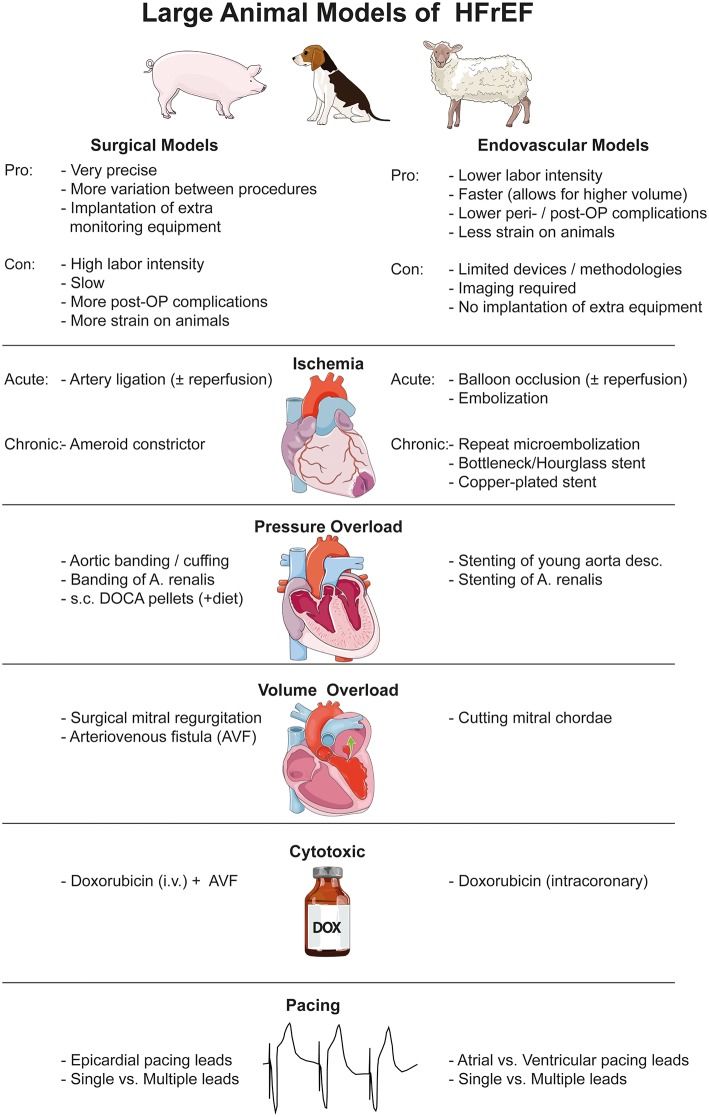
Heart failure with reduced ejection fraction (HFrEF) is defined by an ejection fraction (EF) below 40%. Many distinct disease processes culminate in HFrEF, among them acute and chronic ischemia, pressure overload, volume overload, cytotoxic medication, and arrhythmia. To study these different etiologies the development of accurate animal models is vital. While small animal models are generally cheaper, allow for larger sample sizes and offer a greater variety of transgenic models, they have important limitations in the context of HFrEF research. Small mammals have much higher heart rates and distinct ion channels. They also have much higher basal metabolic rates and their physiology in many ways does not reflect that of humans. The size of their organs also puts practical constraints on experiments. Therefore, large animal models have been developed to accurately simulate human HFrEF. This review aims to give a short overview of the currently established large animal models of HFrEF. The main animal models discussed are dogs, pigs, and sheep. Furthermore, multiple approaches for modeling the different etiologies of HF are discussed, namely models of acute and chronic ischemia, pressure overload, volume overload as well as cytotoxic, and tachycardic pacing approaches.
射血分数降低的心力衰竭(HFrEF)定义为射血分数(EF)低于40%。许多不同的疾病过程最终都会导致HFrEF,其中包括急性和慢性缺血、压力超负荷、容量超负荷、细胞毒性药物以及心律失常。为了研究这些不同的病因,开发准确的动物模型至关重要。虽然小动物模型通常更便宜,能提供更大的样本量并提供更多种类的转基因模型,但在HFrEF研究背景下它们有重要局限性。小型哺乳动物心率更高且离子通道不同。它们的基础代谢率也高得多,并且其生理机能在许多方面不能反映人类的生理机能。它们器官的大小也给实验带来实际限制。因此,已开发出大型动物模型来准确模拟人类HFrEF。本综述旨在简要概述当前已建立的HFrEF大型动物模型。讨论的主要动物模型是狗、猪和羊。此外,还讨论了针对HF不同病因建模的多种方法,即急性和慢性缺血模型、压力超负荷模型、容量超负荷模型以及细胞毒性和心动过速起搏方法。