Lan Xiangzhou, Li Lingjia, Jia Qing, He Fangyi, Kuang Gaoyan, Zeng Weike, Chen Miao, Guo Cheng, Wen Zhi, Chen Qing
The First Affiliated Hospital of Hunan University of Traditional Chinese Medicine, Changsha, Hunan, 410007, China.
School of Nursing, Hunan University of Chinese Medicine, Changsha, Hunan, 410208, China.
Aging Clin Exp Res. 2025 Apr 7;37(1):121. doi: 10.1007/s40520-025-03015-6.
This network meta-analysis (NMA) aimed to compare the efficacy of various physical modalities in alleviating pain, stiffness, and functional impairment in patients with knee osteoarthritis (KOA).
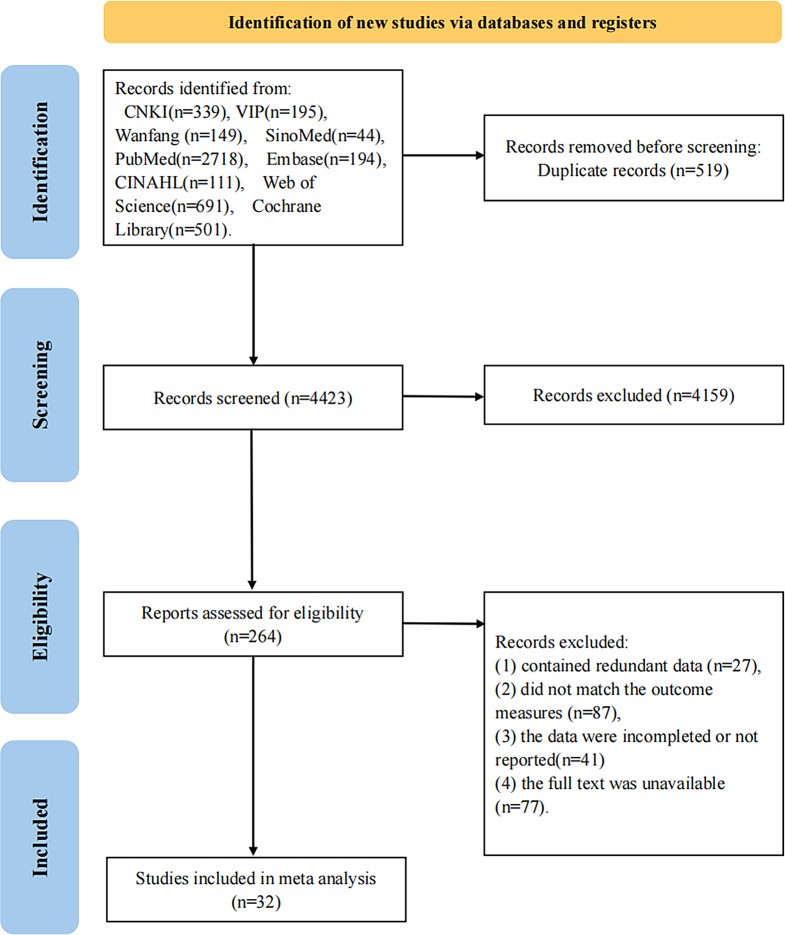
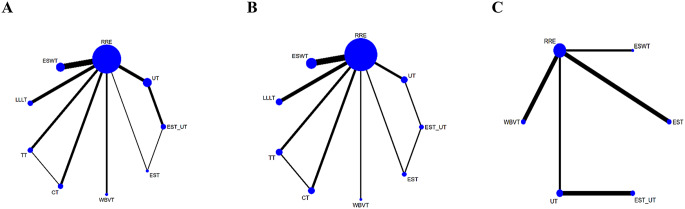
In accordance with PRISMA-P guidelines, we systematically searched nine databases(CNKI, VIP Database, Wanfang Database, SinoMed, PubMed, Embase, CINAHL, Web of Science, and the Cochrane Library) from inception to October 2024 to identify randomized controlled trials (RCTs) evaluating physical therapies for KOA. The interventions assessed included electrical stimulation therapy (EST), low-level light therapy (LLLT), thermotherapy (TT), cryotherapy (CT), and extracorporeal shock wave therapy (ESWT), with resistance and range of motion exercises (RRE) serving as comparators. Outcome measures comprised the Visual Analog Scale (VAS), Western Ontario and McMaster Universities Osteoarthritis Index (WOMAC), and 6-minute walk test (6 MWT). Bayesian network meta-analyses and pairwise meta-analyses were performed using Stata 17.0 and R 4.4.1 software.
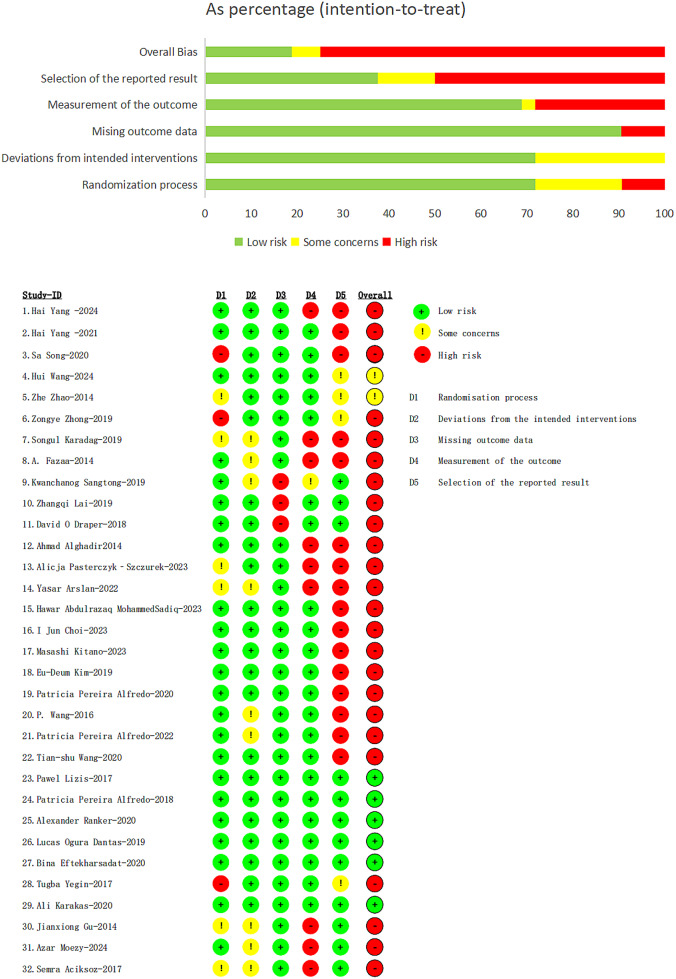
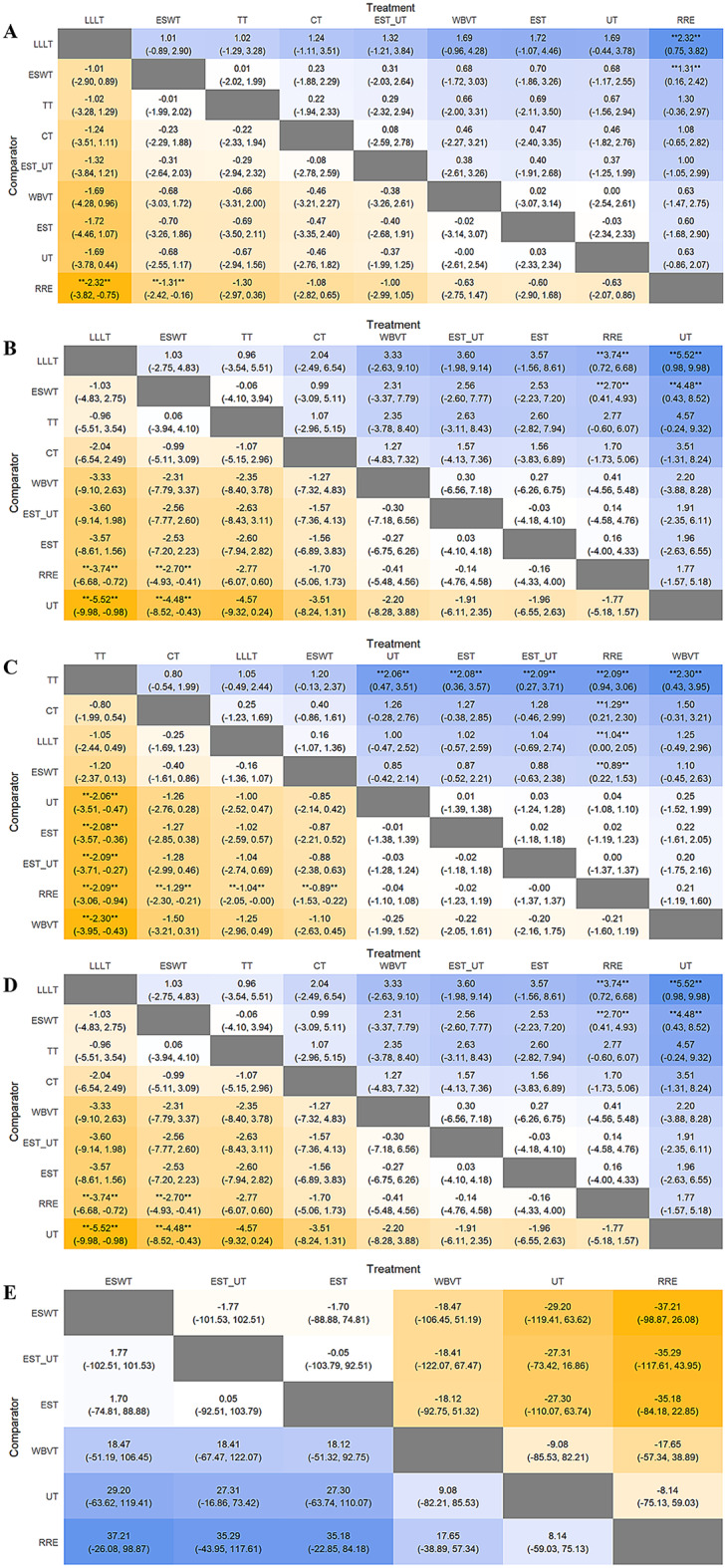
32 RCTs involving 2,078 participants were included. LLLT demonstrated the highest efficacy for pain reduction (VAS: MD=-3.32, 95% CI:-3.82 to-0.75; WOMAC pain: MD=-3.74, 95% CI:-6.68 to-0.72) and joint function improvement (SUCRA = 79.8). ESWT ranked second for pain relief (VAS: MD=-1.31, 95% CI:-2.42 to-0.16) and mobility enhancement (6 MWT: SUCRA = 71.5), while TT showed superior efficacy in reducing stiffness (WOMAC stiffness: MD=-2.09, 95%CI:-3.06 to-0.94; SUCRA = 98.1). In contrast, ultrasonic therapy (UT) did not provide significant benefits.
The findings suggest that LLLT and ESWT may be optimal for pain relief and functional improvement in patients with KOA, whereas TT appears to be the most effective in reducing stiffness. Optimal dosing parameters of these physical modalities are crucial for maximizing clinical benefits. Clinicians should individualize treatment strategies based on patient-specific factors. Future large-scale RCTs are warranted to validate these protocols and address the heterogeneity of existing evidence.
Not applicable.
本网络荟萃分析(NMA)旨在比较各种物理治疗方法在缓解膝关节骨关节炎(KOA)患者疼痛、僵硬和功能障碍方面的疗效。
按照PRISMA-P指南,我们系统检索了9个数据库(中国知网、维普数据库、万方数据库、中国生物医学文献数据库、PubMed、Embase、CINAHL、科学引文索引和考克兰图书馆),检索时间从建库至2024年10月,以识别评估KOA物理治疗的随机对照试验(RCT)。评估的干预措施包括电刺激疗法(EST)、低强度光疗法(LLLT)、热疗法(TT)、冷疗法(CT)和体外冲击波疗法(ESWT),以阻力和运动范围练习(RRE)作为对照。结局指标包括视觉模拟量表(VAS)、西安大略和麦克马斯特大学骨关节炎指数(WOMAC)以及6分钟步行试验(6 MWT)。使用Stata 17.0和R 4.4.1软件进行贝叶斯网络荟萃分析和成对荟萃分析。
纳入了32项RCT,涉及2078名参与者。LLLT在减轻疼痛(VAS:MD=-3.32,95%CI:-3.82至-0.75;WOMAC疼痛:MD=-3.74,95%CI:-6.68至-0.72)和改善关节功能方面显示出最高疗效(累积排序曲线下面积[SUCRA]=79.8)。ESWT在缓解疼痛(VAS:MD=-1.31,95%CI:-2.42至-0.16)和增强活动能力方面(6 MWT:SUCRA=71.5)排名第二,而TT在减轻僵硬方面显示出更高的疗效(WOMAC僵硬:MD=-2.09,95%CI:-3.06至-0.94;SUCRA=98.1)。相比之下,超声疗法(UT)没有提供显著益处。
研究结果表明,LLLT和ESWT可能是缓解KOA患者疼痛和改善功能的最佳选择,而TT似乎在减轻僵硬方面最有效。这些物理治疗方法的最佳剂量参数对于最大化临床益处至关重要。临床医生应根据患者的具体因素制定个体化的治疗策略。未来需要进行大规模RCT来验证这些方案并解决现有证据的异质性问题。
不适用。