Department of Family Medicine, Seoul Metropolitan Government Seoul National University Boramae Medical Center, Seoul, Korea.
Department of Tumor Biology, Seoul National University, Seoul, Korea.
Cancer Res Treat. 2020 Apr;52(2):396-405. doi: 10.4143/crt.2019.152. Epub 2019 Aug 28.
High rate of false-positive tests is a major obstacle to use human papillomavirus (HPV) detection as a diagnostic tool for high-grade squamous intraepithelial lesions or cervical cancer (HSIL+). We investigated whether type-specific viral load or physical state of HPV 16, 18, and 58 are useful biomarkers for HSIL+.
Type-specific viral loads of E6 and E2 genes in cervical cells from 240, 83, and 79 HPV 16-, 18-, and 58-infected women, respectively, were determined using real-time polymerase chain reaction. Viral loads were normalized to cellular DNA (copy/cell). Total and integrated viral loads and physical state were compared between HSIL+ and controls, and diagnostic value was determined using receiver operating characteristic analysis.
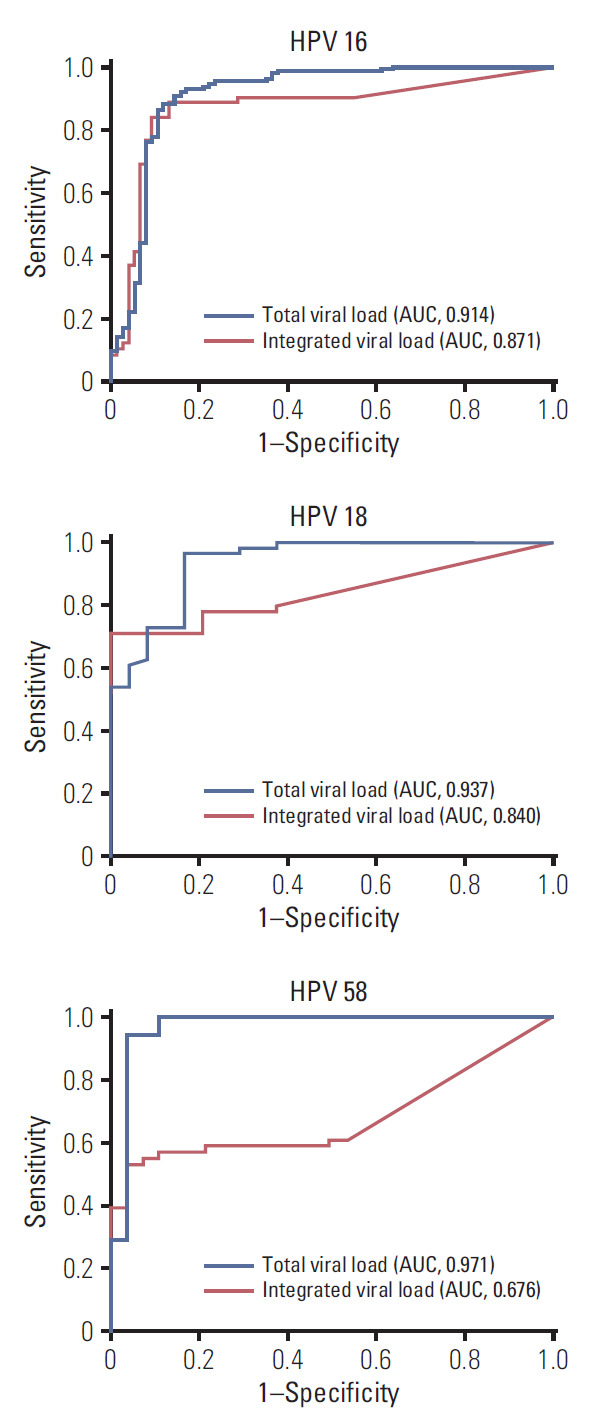
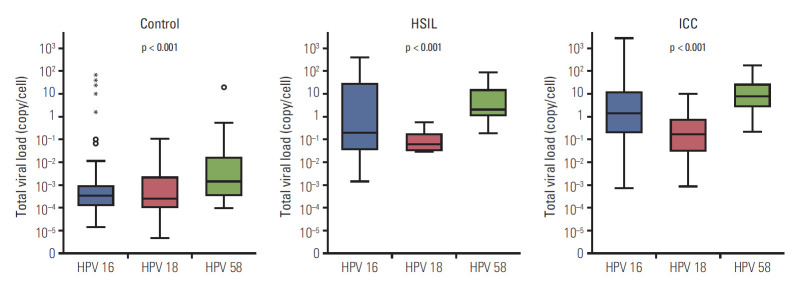
Viral loads of HPV 16, 18, and 58 were significantly different in lesions in the same pathologic grade. High type-specific total viral loads were significantly associated with HSIL+ (odds ratio [OR], 14.065, 39.472, and 7.103 for HPV 16, 18, and 58, respectively). High integrated viral load was related to HSIL+ in women with HPV 16 (OR, 8.242), and integrated state was associated with HSIL+ in women with HPV 18 (OR, 9.443). Type-specific total viral load was significantly associated with HSIL+ (area under curve, 0.914, 0.937, and 0.971 for HPV 16, 18, and 58, respectively), indicating an excellent performance in detecting HSIL+.
Type-specific total viral load may be a powerful diagnostic marker for HSIL+ in HPV 16-, 18-, and 58-infected HSIL+ lesions. If demonstrated in all other high-risk HPV types, this method can lead to a paradigm shift in the strategy of equivocal cytologic abnormalities.
高假阳性率是将人乳头瘤病毒(HPV)检测作为高级别鳞状上皮内病变或宫颈癌(HSIL+)诊断工具的主要障碍。我们研究了 HPV 16、18 和 58 的病毒载量或物理状态是否可作为 HSIL+的有用生物标志物。
使用实时聚合酶链反应测定 240、83 和 79 名 HPV 16、18 和 58 感染女性宫颈细胞中 E6 和 E2 基因的病毒载量。将病毒载量归一化为细胞 DNA(拷贝/细胞)。比较 HSIL+和对照组中总病毒载量和整合病毒载量以及物理状态,并使用受试者工作特征分析确定诊断价值。
同一病理分级的病变中 HPV 16、18 和 58 的病毒载量存在显著差异。高病毒载量与 HSIL+显著相关(HPV 16、18 和 58 的比值比 [OR] 分别为 14.065、39.472 和 7.103)。HPV 16 感染者中高整合病毒载量与 HSIL+相关(OR,8.242),HPV 18 感染者中整合状态与 HSIL+相关(OR,9.443)。病毒载量与 HSIL+显著相关(HPV 16、18 和 58 的曲线下面积分别为 0.914、0.937 和 0.971),表明其在检测 HSIL+方面具有优异的性能。
病毒载量与 HSIL+显著相关(HPV 16、18 和 58 的曲线下面积分别为 0.914、0.937 和 0.971),表明其在检测 HSIL+方面具有优异的性能。在 HPV 16、18 和 58 感染的 HSIL+病变中,特定类型的总病毒载量可能是 HSIL+的有力诊断标志物。如果在所有其他高危 HPV 类型中得到证实,这种方法可能会导致对不确定细胞学异常的策略发生范式转变。