Head of Urology Department, Zahra Hospital, University Medical Center, Lebanese University, Beirut, Lebanon.
Department of Urology, Lebanese University, Beirut, Lebanon.
BMC Emerg Med. 2019 Sep 2;19(1):48. doi: 10.1186/s12873-019-0263-0.
No known data in the literature assessing practice of kidney stone prevention in the emergency department (ED) is available.
Assess patient perception and compliance to kidney stone prevention given within the emergency department. It also indirectly detects the attitude and practice patterns of primary care providers in kidney stone prevention.
This is a qualitative study done in a single institution from January 2018 to January 2019 that includes 99 patients that were diagnosed with kidney or ureteral stone in ED and were discharged home, all of them where stone formers. They were asked to fill a self- administered questionnaire when they are able to read, or interviewed by the resident within the ED when they are unable to read.
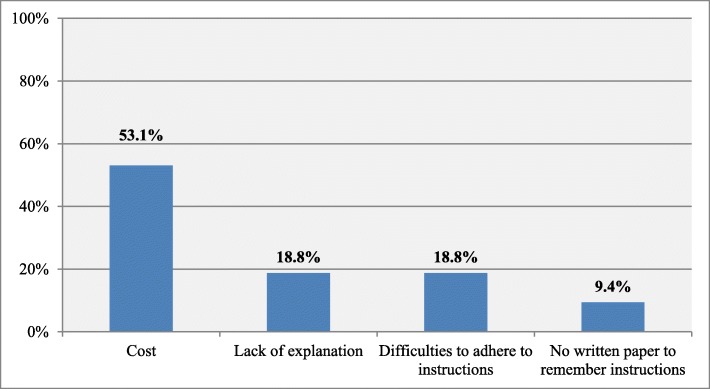
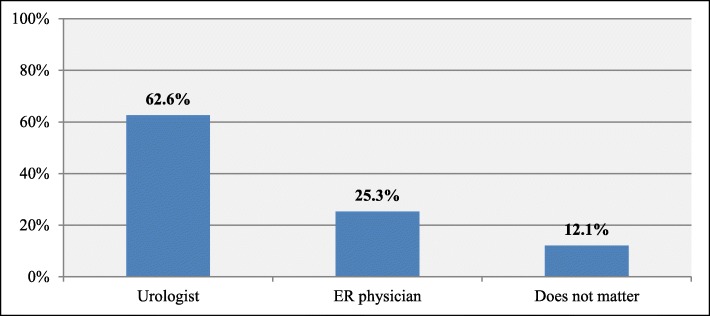
The majority of patients (68%) did not receive any instructions about kidney stones prevention within the ED. Most of patients who follow instructions if it was given were educated (90%), had an insurance coverage (85%), and had an income higher than $1000 per month (76%), (p < 0.05). Seventy one percents of patients believe in the effectiveness of stone prevention if it was provided and most of them are interested in learning about these preventive strategies (82%). Reasons for not following the instructions about kidney stones prevention measures were the cost (53.1%) following by the lack of explanation by ED physicians (18.8%). The majority of patients (62.6%) prefer to receive kidney stones prevention measures from urologists.
Most of patients in our institute did not receive kidney stones prevention measures in ED despite that they declared their interest in following these measures. Most of the time they did not adhere to those measures due to socioeconomic factors and lack of clarifications. If these instructions were given within the ED, it could lead to an acceptable compliance rate.
目前尚无文献评估急诊科(ED)中肾结石预防的实践情况。
评估患者对 ED 内肾结石预防的认知和依从性。这也间接检测了初级保健提供者在肾结石预防方面的态度和实践模式。
这是一项单中心的定性研究,于 2018 年 1 月至 2019 年 1 月进行,纳入 99 例在 ED 诊断为肾结石或输尿管结石并出院回家的患者,所有患者均为结石形成者。当他们能够阅读时,要求他们填写一份自我管理问卷;当他们无法阅读时,由 ED 住院医师对他们进行访谈。
大多数患者(68%)在 ED 未接受任何肾结石预防指导。如果给予指导,大多数患者(90%)接受过教育、有保险(85%)、月收入高于 1000 美元(76%),他们会遵循指导(p<0.05)。71%的患者认为如果提供结石预防措施,其将有效,他们大多数对了解这些预防策略感兴趣(82%)。不遵循肾结石预防措施指导的原因是费用(53.1%),其次是 ED 医生缺乏解释(18.8%)。大多数患者(62.6%)更愿意接受泌尿科医生提供的肾结石预防措施。
尽管我们机构的大多数患者表示有兴趣遵循这些措施,但他们在 ED 并未接受肾结石预防措施。大多数时候,他们不遵守这些措施是由于社会经济因素和缺乏说明。如果这些指导在 ED 内给予,可能会导致可接受的依从率。