Department of Urology, Tangdu Hospital, Air Force Medical University, 1 Xinsi Rd, Xi'an, 710038, China.
Urolithiasis. 2022 Aug;50(4):431-437. doi: 10.1007/s00240-022-01331-4. Epub 2022 May 27.
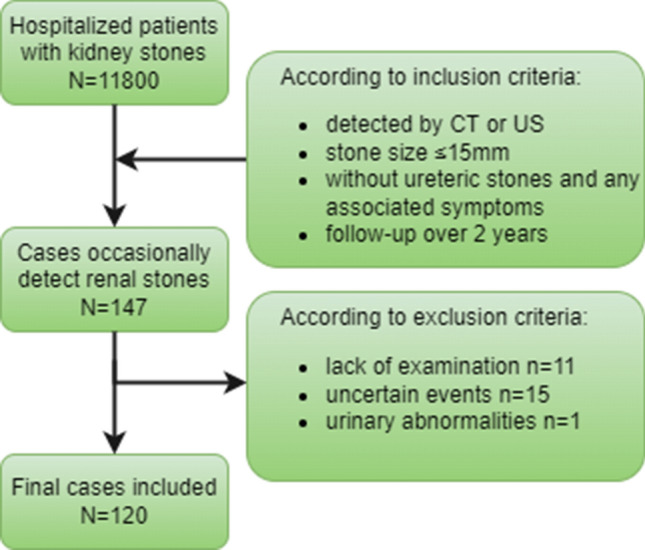
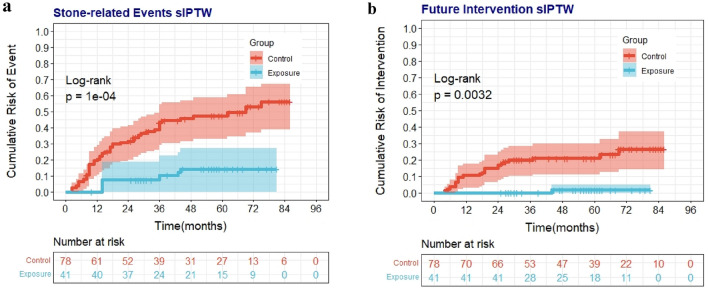
The purpose of this study was to evaluate the long-term outcomes of patients undergoing prophylactic intervention or active surveillance for asymptomatic kidney stones and identify factors influencing the outcomes. In this retrospective cohort study, we reviewed the medical records of patients with asymptomatic kidney stones in two institutes between November 2014 and November 2019. Standardized questions were asked via phone calls to supplement the outcomes. Pain, hydronephrosis, stone growth, serious infection, gross hematuria, and spontaneous passage were defined as stone-related events. Future intervention was also recorded to evaluate management. A total of 101 patients with 120 kidney units were enrolled in this study. The median follow-up time was 63 months. The patients were classified into the control group (79 cases) or exposure group (41 cases) according to whether they underwent prophylactic intervention before any stone-related events. Generally, the rates of stone-related events and future intervention were significantly different between the two groups (57.0 vs. 12.2%, p < 0.001; and 31.6 vs. 4.9%, p = 0.002, respectively). After applying stabilized inverse probability of treatment weighted, Cox regression suggested that patients who underwent prophylactic intervention were less likely to experience stone-related events and future intervention (HR = 0.175, and HR = 0.028, respectively). In conclusion, patients who underwent prophylactic intervention had a lower risk of stone-related events and future intervention, although they had some slight complications.
本研究旨在评估接受预防性干预或主动监测无症状肾结石患者的长期结局,并确定影响结局的因素。在这项回顾性队列研究中,我们回顾了 2014 年 11 月至 2019 年 11 月期间两个机构中无症状肾结石患者的病历。通过电话询问了标准化问题以补充结局。疼痛、肾积水、结石生长、严重感染、肉眼血尿和自发排出被定义为与结石相关的事件。还记录了未来的干预措施以评估管理情况。本研究共纳入 101 例 120 个肾脏单位的患者。中位随访时间为 63 个月。根据是否在发生任何与结石相关的事件之前进行预防性干预,将患者分为对照组(79 例)或暴露组(41 例)。一般来说,两组之间的结石相关事件和未来干预的发生率差异具有统计学意义(57.0%比 12.2%,p<0.001;31.6%比 4.9%,p=0.002)。应用稳定逆概率治疗加权后,Cox 回归提示接受预防性干预的患者发生结石相关事件和未来干预的风险较低(HR=0.175,HR=0.028)。总之,尽管预防性干预有一些轻微的并发症,但接受预防性干预的患者发生结石相关事件和未来干预的风险较低。