Mash Bob, Ray Sunanda, Essuman Akye, Burgueño Edu
Department of Family and Emergency Medicine, Stellenbosch University, Cape Town, South Africa.
Department of Community Health, University of Zimbabwe College of Health Sciences, Harare, Zimbabwe.
BMJ Glob Health. 2019 Aug 16;4(Suppl 8):e001489. doi: 10.1136/bmjgh-2019-001489. eCollection 2019.
Community-orientated primary care (COPC) is an approach to primary healthcare (PHC) that originated in South Africa and contributed to the formulation of the Declaration of Alma-Ata 40 years ago. Despite this, PHC remains poorly developed in sub-Saharan African countries. There has been a resurgence of interest in strengthening PHC systems in the last few years and identifying key knowledge gaps. COPC has been an effective strategy elsewhere, most notably Brazil. This scoping review investigated COPC in the sub-Saharan African context and looked for evidence of different models, effectiveness and feasibility.
Databases were systematically searched using a comprehensive search strategy to identify studies from the last 10 years. A methodological guideline for conducting scoping reviews was followed. A standardised template was used to extract data and compare study characteristics and findings. Studies were grouped into five categories: historical analysis, models, implementation, educational studies and effectiveness.
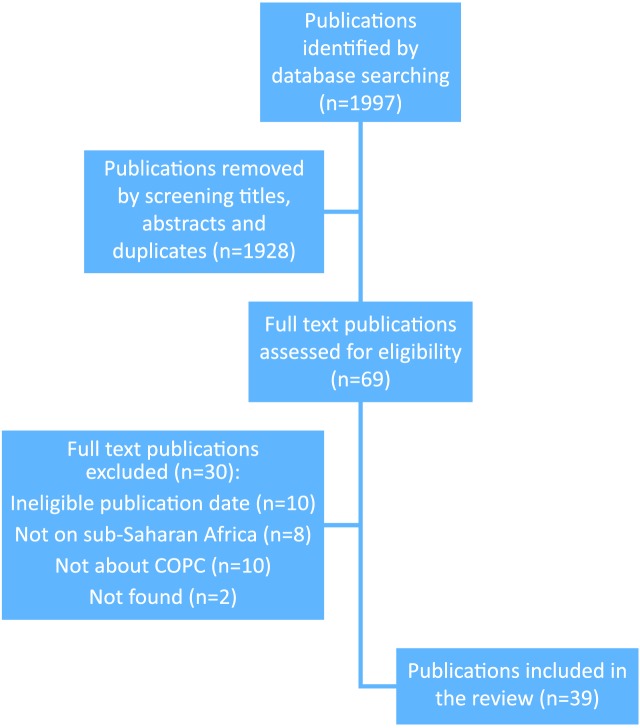
A total of 1997 publications were identified and 39 included in the review. Most publications were from the last 5 years (n = 32), research (n = 27), from South Africa (n = 27), focused on implementation (n = 25) and involving case studies (n = 9), programme evaluation (n = 6) or qualitative methods (n = 10). Nine principles of COPC were identified from different models. Factors related to the implementation of COPC were identified in terms of governance, finances, community health workers, primary care facilities, community participation, health information and training. There was very little evidence of effectiveness of COPC.
There is a need for further research to describe models of COPC in Africa, investigate the appropriate skills mix to integrate public health and primary care in these models, evaluate the effectiveness of COPC and whether it is included in training of healthcare workers and government policy.
以社区为导向的初级保健(COPC)是一种初级卫生保健(PHC)方法,起源于南非,并在40年前为《阿拉木图宣言》的制定做出了贡献。尽管如此,撒哈拉以南非洲国家的初级卫生保健仍然发展不佳。在过去几年中,人们对加强初级卫生保健系统并找出关键知识差距的兴趣再度兴起。COPC在其他地方,尤其是巴西,一直是一项有效的策略。本范围综述在撒哈拉以南非洲背景下对COPC进行了调查,并寻找不同模式、有效性和可行性的证据。
使用全面的搜索策略对数据库进行系统搜索,以识别过去10年的研究。遵循了进行范围综述的方法指南。使用标准化模板提取数据,并比较研究特征和结果。研究分为五类:历史分析、模式、实施、教育研究和有效性。
共识别出1997篇出版物,其中39篇纳入综述。大多数出版物来自过去5年(n = 32),为研究性(n = 27),来自南非(n = 27),侧重于实施(n = 25),涉及案例研究(n = 9)、项目评估(n = 6)或定性方法(n = 10)。从不同模式中确定了COPC的九条原则。从治理、财务、社区卫生工作者、初级保健设施、社区参与、健康信息和培训等方面确定了与COPC实施相关的因素。几乎没有证据表明COPC具有有效性。
需要进一步开展研究,以描述非洲的COPC模式,调查在这些模式中整合公共卫生和初级保健的适当技能组合,评估COPC的有效性,以及它是否纳入了医护人员培训和政府政策。