Austin-Evelyn Katherine, Rabkin Miriam, Macheka Tonderayi, Mutiti Anthony, Mwansa-Kambafwile Judith, Dlamini Thomas, El-Sadr Wafaa M
International Women's Health Coalition, New York, New York, United States of America.
ICAP at Columbia University, New York, New York, United States of America.
PLoS One. 2017 Mar 16;12(3):e0173863. doi: 10.1371/journal.pone.0173863. eCollection 2017.
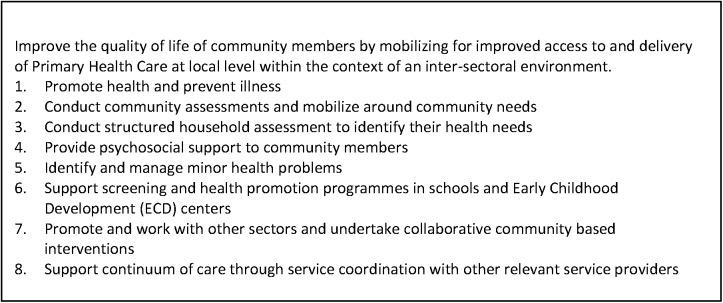
In 2010, South Africa's National Department of Health launched a national primary health care (PHC) initiative to strengthen health promotion, disease prevention, and early disease detection. The strategy, called Re-engineering Primary Health Care (rPHC), aims to provide a preventive and health-promoting community-based PHC model. A key component of rPHC is the use of community-based outreach teams staffed by generalist community health workers (CHWs).
We conducted focus group discussions and surveys on the knowledge and attitudes of 91 CHWs working on community-based rPHC teams in the King Sabata Dalindyebo (KSD) sub-district of Eastern Cape Province.
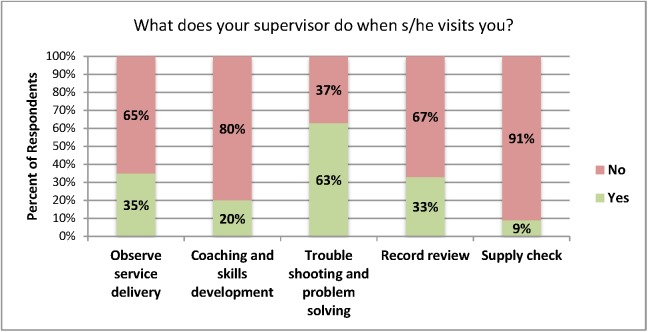
The CHWs we studied enjoyed their work and found it meaningful, as they saw themselves as agents of change. They also perceived weaknesses in the implementation of outreach team oversight, and desired field-based training and more supervision in the community.
There is a need to provide CHWs with basic resources like equipment, supplies and transport to improve their acceptability and credibility to the communities they serve.
2010年,南非国家卫生部发起了一项国家初级卫生保健(PHC)倡议,以加强健康促进、疾病预防和疾病早期检测。该战略称为“重新设计初级卫生保健”(rPHC),旨在提供一种基于社区的预防性和促进健康的初级卫生保健模式。rPHC的一个关键组成部分是使用由通才社区卫生工作者(CHW)组成的社区外展团队。
我们对东开普省萨巴塔·达林德耶博国王(KSD)分区从事基于社区的rPHC团队工作的91名CHW的知识和态度进行了焦点小组讨论和调查。
我们研究的CHW喜欢他们的工作并认为其有意义,因为他们将自己视为变革的推动者。他们还察觉到外展团队监督实施方面的弱点,并希望获得实地培训以及在社区中得到更多监督。
有必要为CHW提供设备、用品和交通等基本资源,以提高他们在其所服务社区中的可接受性和可信度。