Medical University of South Carolina, Department of Neuroscience, Charleston, SC, USA.
Medical University of South Carolina, Department of Psychiatry and Behavioral Sciences, Charleston, SC, USA.
Neuroimage Clin. 2019;24:101993. doi: 10.1016/j.nicl.2019.101993. Epub 2019 Aug 26.
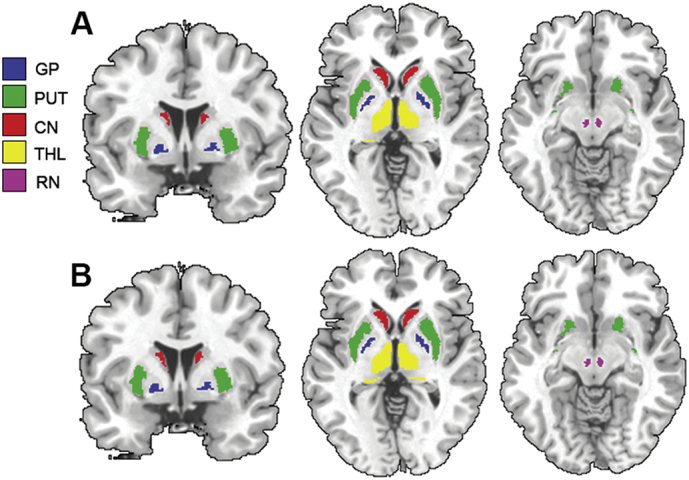
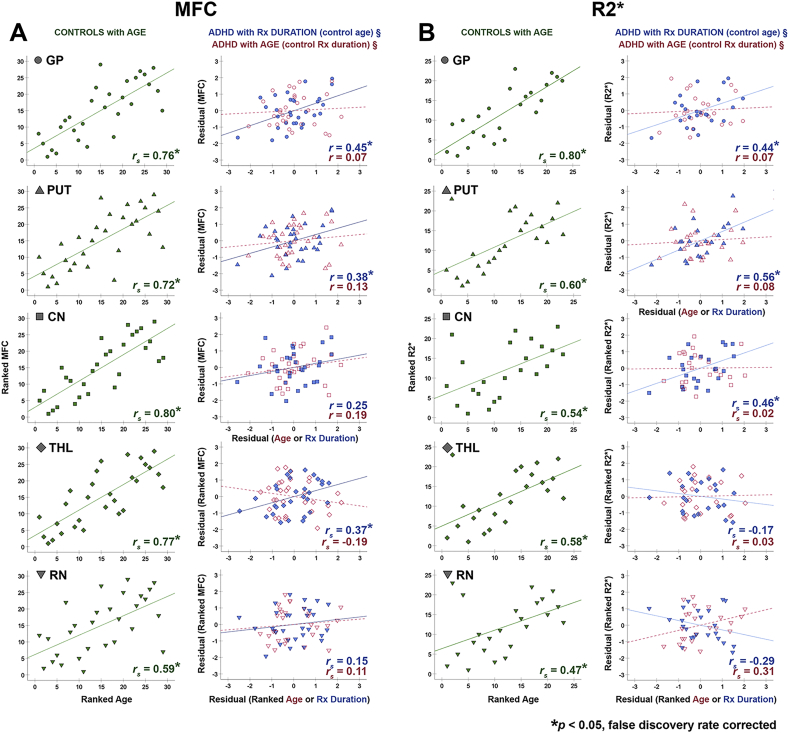
Brain iron homeostasis is a dopamine-related mechanism that may be modified with long-term psychostimulant treatment in attention-deficit/hyperactivity disorder (ADHD). We previously reported that while medication-naïve youth with ADHD have reduced brain iron compared to controls and psychostimulant-medicated patients, no differences were detected between the latter groups. In this follow-up study, we examined whether the duration of psychostimulant treatment correlates with the degree of iron normalization. Brain iron was indexed with MRI using an advanced method called magnetic field correlation (MFC) imaging and the conventional R2* proton transverse relaxation rate method. MFC was acquired in 30 psychostimulant-medicated youth with comorbid-free ADHD and 29 age-matched controls (all males). R2* was acquired in a subset of these individuals. Region-of-interest analyses for MFC and R2* group differences and within-group correlations with age and years of psychostimulant treatment were conducted in the globus pallidus (GP), putamen (PUT), caudate nucleus (CN), thalamus (THL) and red nucleus. No significant MFC and R2* group differences were detected. However, while all regional MFC and R2* significantly increased with age in the control group, MFC and R2* increased in the GP, PUT, CN and THL with psychostimulant treatment duration in the ADHD group to a greater degree than with age. Our findings suggest that while youth with ADHD may have less prominent age-related brain iron increases than that seen in typical development, long-term use of psychostimulant medications may compensate through a normalizing effect on basal ganglia iron. Longitudinal studies following ADHD patients before and after long-term psychostimulant treatment are needed to confirm these findings.
脑铁稳态是一种与多巴胺相关的机制,在注意缺陷多动障碍(ADHD)中,它可能会随着长期使用精神兴奋剂治疗而改变。我们之前报道过,与对照组和接受精神兴奋剂治疗的患者相比,未经药物治疗的 ADHD 青少年的大脑铁含量较低,但后两组之间没有发现差异。在这项随访研究中,我们研究了精神兴奋剂治疗的持续时间是否与铁正常化的程度相关。使用一种称为磁场相关(MFC)成像的先进方法以及传统的 R2质子横向弛豫率方法,通过 MRI 对大脑铁进行了索引。在 30 名患有共病性 ADHD 的接受精神兴奋剂治疗的青少年和 29 名年龄匹配的对照组(均为男性)中采集了 MFC。在这些个体的亚组中采集了 R2。在苍白球(GP)、壳核(PUT)、尾状核(CN)、丘脑(THL)和红核中进行了 MFC 和 R2组差异的感兴趣区域分析以及与年龄和接受精神兴奋剂治疗年限的组内相关性分析。未发现 MFC 和 R2组间差异。然而,虽然对照组中所有区域的 MFC 和 R2均随年龄显著增加,但 ADHD 组中 MFC 和 R2随精神兴奋剂治疗时间的延长而增加,与年龄相比增加幅度更大。我们的研究结果表明,与典型发育过程中所见相比,ADHD 青少年的大脑铁增加可能不那么明显,但长期使用精神兴奋剂药物可能通过对基底节铁的正常化作用来补偿。需要对接受长期精神兴奋剂治疗前后的 ADHD 患者进行前瞻性研究,以证实这些发现。