Rusnak Janice M, Glass Pamela J, Weaver Scott C, Sabourin Carol L, Glenn Andrew M, Klimstra William, Badorrek Christopher S, Nasar Farooq, Ward Lucy A
Joint Program Executive Office for Chemical, Biological, Radiological and Nuclear Defense (JPEO-CBRND), Joint Project Manager-Medical Countermeasure Systems (JMP-MCS), Joint Vaccine Acquisition Program (JVAP), 1564 Freedman Drive, Fort Detrick, MD 21702, USA.
Department of Virology, United States Army Medical Research Institute of Infectious Diseases (USAMRIID), 1425 Porter Street, Fort Detrick, MD 21702, USA.
Viruses. 2019 Aug 31;11(9):807. doi: 10.3390/v11090807.
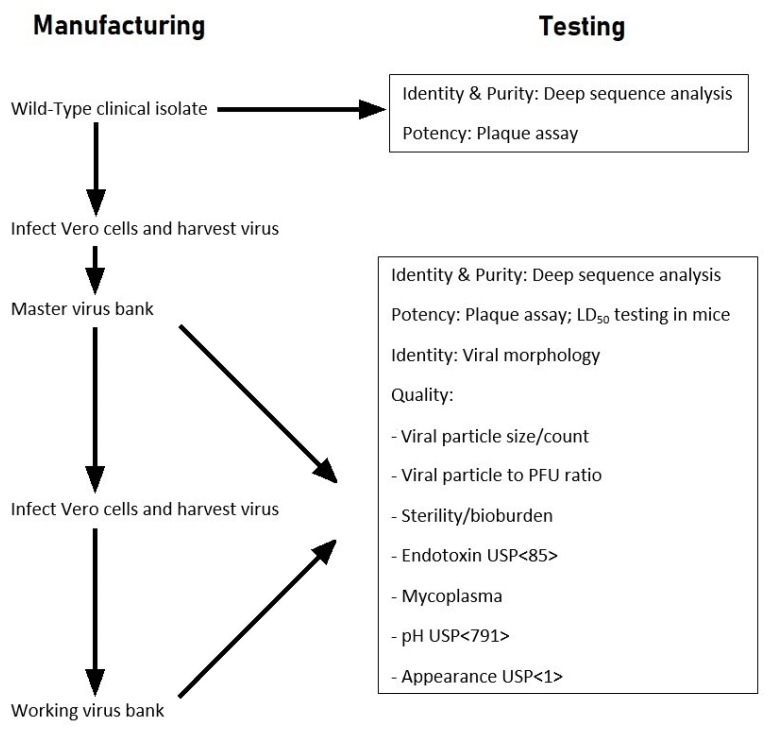
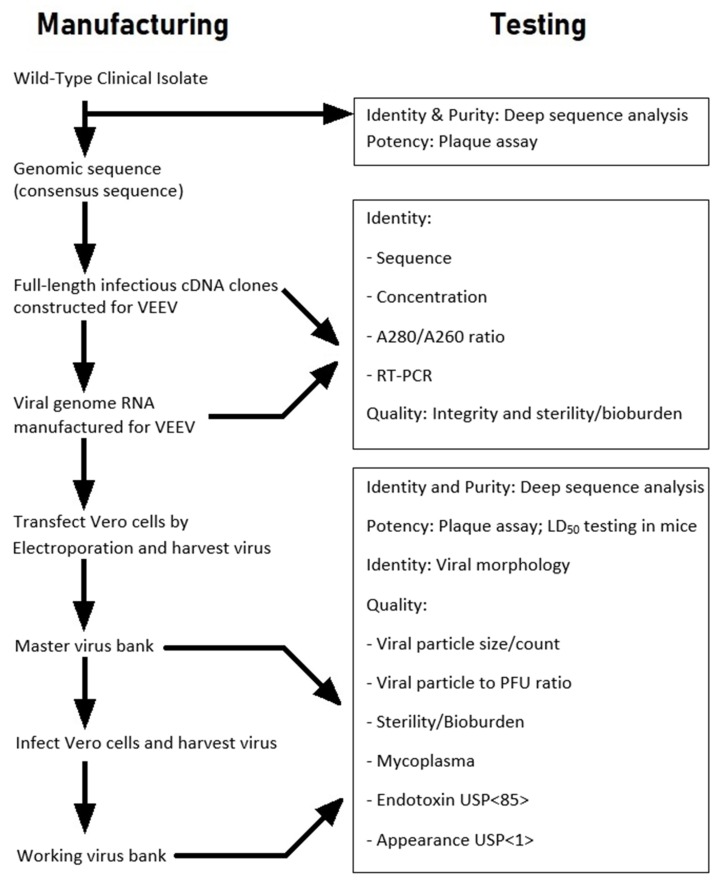
Licensure of a vaccine to protect against aerosolized Venezuelan equine encephalitis virus (VEEV) requires use of the U.S. Food and Drug Administration (FDA) Animal Rule to assess vaccine efficacy as human studies are not feasible or ethical. An approach to selecting VEEV challenge strains for use under the Animal Rule was developed, taking into account Department of Defense (DOD) vaccine requirements, FDA Animal Rule guidelines, strain availability, and lessons learned from the generation of filovirus challenge agents within the Filovirus Animal Nonclinical Group (FANG). Initial down-selection to VEEV IAB and IC epizootic varieties was based on the DOD objective for vaccine protection in a bioterrorism event. The subsequent down-selection of VEEV IAB and IC isolates was based on isolate availability, origin, virulence, culture and animal passage history, known disease progression in animal models, relevancy to human disease, and ability to generate sufficient challenge material. Methods for the propagation of viral stocks (use of uncloned (wild-type), plaque-cloned, versus cDNA-cloned virus) to minimize variability in the potency of the resulting challenge materials were also reviewed. The presented processes for VEEV strain selection and the propagation of viral stocks may serve as a template for animal model development product testing under the Animal Rule to other viral vaccine programs. This manuscript is based on the culmination of work presented at the "Alphavirus Workshop" organized and hosted by the Joint Vaccine Acquisition Program (JVAP) on 15 December 2014 at Fort Detrick, Maryland, USA.
由于人体研究不可行或不符合伦理道德,因此需要使用美国食品药品监督管理局(FDA)的动物规则来评估疫苗效力,以确保批准用于预防气溶胶化委内瑞拉马脑炎病毒(VEEV)的疫苗。考虑到美国国防部(DOD)的疫苗要求、FDA动物规则指南、毒株可用性以及从丝状病毒动物非临床研究小组(FANG)中丝状病毒攻击剂的产生中吸取的经验教训,制定了一种在动物规则下选择VEEV攻击毒株的方法。最初将选择范围缩小到VEEV IAB和IC流行变种是基于国防部在生物恐怖主义事件中疫苗保护的目标。随后对VEEV IAB和IC分离株的进一步筛选基于分离株的可用性、来源、毒力、培养和动物传代历史、动物模型中已知的疾病进展、与人类疾病的相关性以及产生足够攻击材料的能力。还审查了病毒种子繁殖的方法(使用未克隆的(野生型)、空斑克隆的与cDNA克隆的病毒),以尽量减少所得攻击材料效力的变异性。所介绍的VEEV毒株选择和病毒种子繁殖过程可作为动物规则下动物模型开发产品测试到其他病毒疫苗项目的模板。本手稿基于2014年12月15日在美国马里兰州德特里克堡由联合疫苗采购计划(JVAP)组织和主办的“甲病毒研讨会”上所展示工作的总结。