Komosa Anna, Perek Bartłomiej, Rzymski Piotr, Lesiak Maciej, Siller-Matula Jolanta M, Grygier Marek, Puślecki Mateusz, Misterski Marcin, Olasińska-Wiśniewska Anna, Ropacka-Lesiak Mariola, Krasiński Zbigniew, Niedzielski Przemysław, Mularek-Kubzdela Tatiana, Poniedziałek Barbara
1st Department of Cardiology, Poznan University of Medical Sciences, 61-848 Poznan, Poland.
Department of Cardiac Surgery and Transplantology, Poznan University of Medical Sciences, 61-848 Poznan, Poland.
J Clin Med. 2019 Sep 2;8(9):1364. doi: 10.3390/jcm8091364.
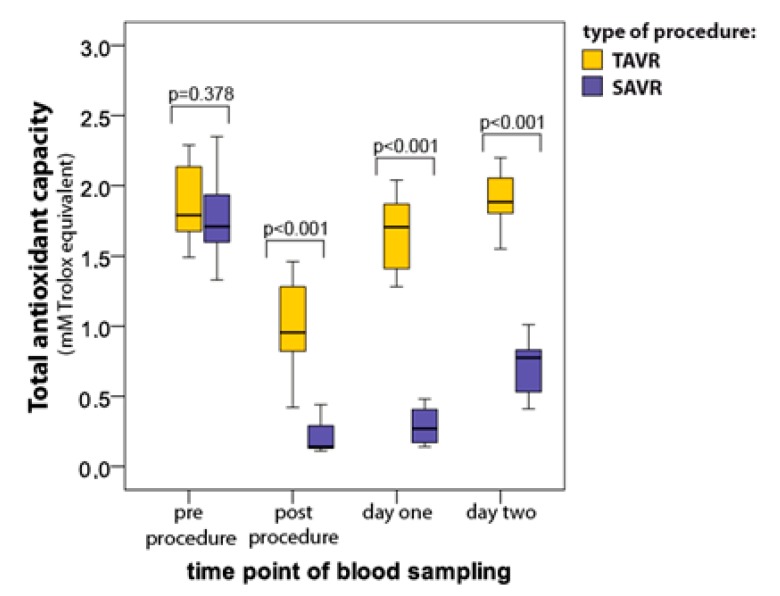
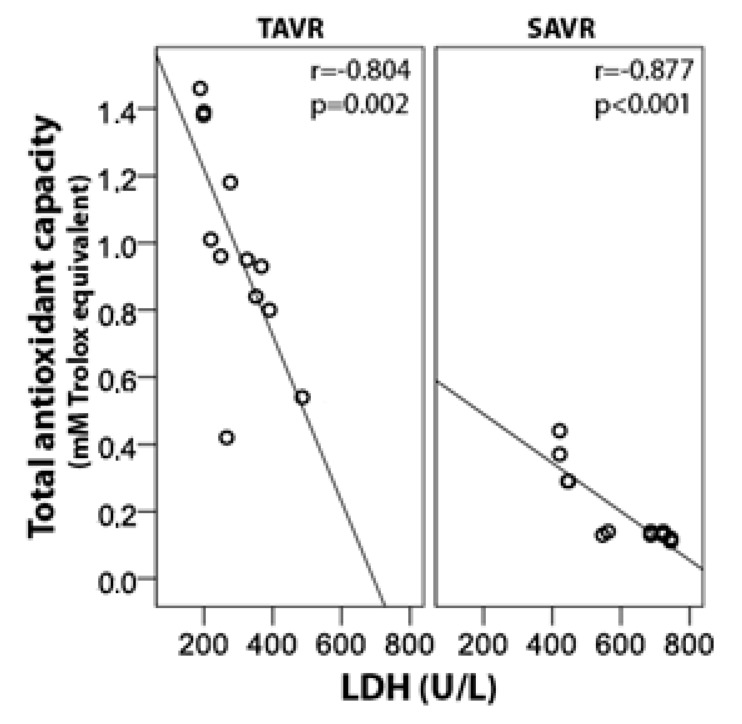
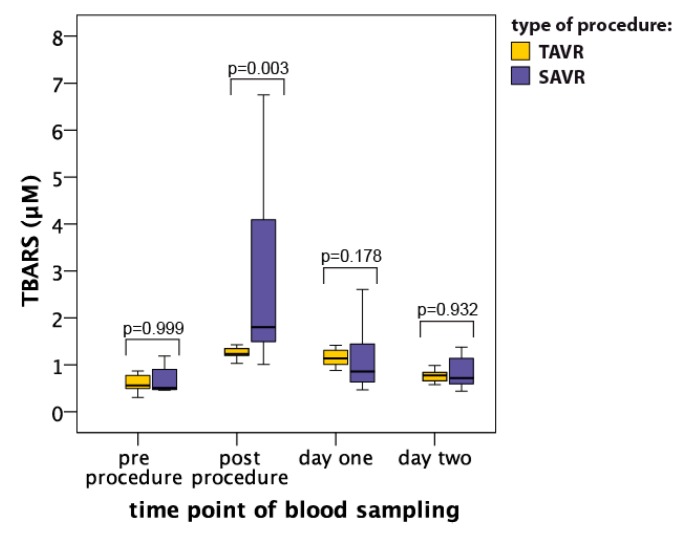
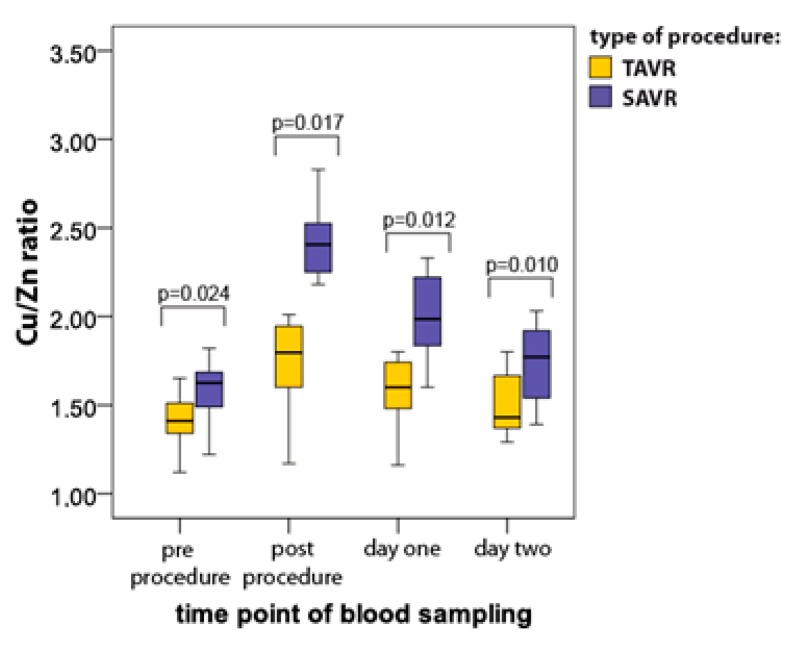
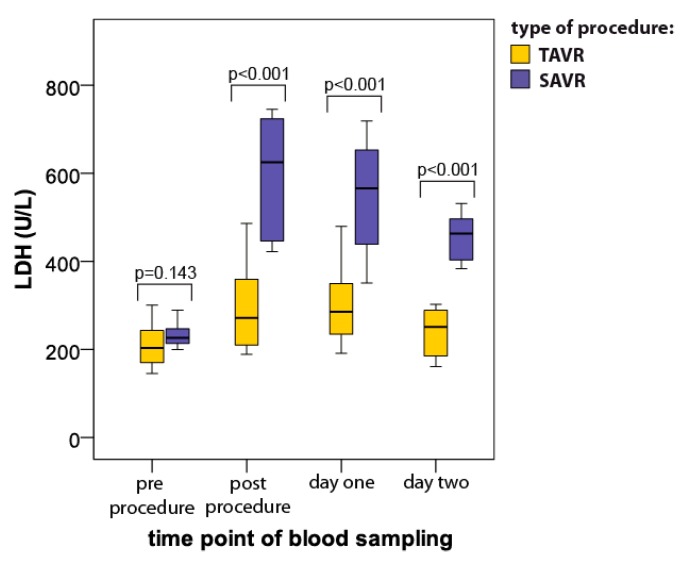
The objective of this study was to compare oxidative stress indices in 24 patients (mean ± SD age 71 ± 13 years) undergoing surgical aortic valve replacement (SAVR) versus transcatheter aortic valve replacement (TAVR). Serum total antioxidant capacity (TAC), copper/zinc ratio (Cu/Zn), activity of lactate dehydrogenase (LDH), and thiobarbituric acid reactive substances (TBARS) were assessed at four different time-points: pre-procedure, immediately post-procedure, and one day and two days after the procedure. All oxidative stress parameters were comparable in both groups pre-procedure. TAC decreased significantly when assessed immediately after procedures in both groups ( < 0.001); however, the magnitude of the reduction was more pronounced after SAVR (88% decrease from baseline: 1.8 ± 0.1 vs. 0.2 ± 0.03 mM) compared to TAVR procedures (53% decrease from baseline: 1.9 ± 0.1 vs. 1.0 ± 0.1 mM; < 0.001). TAC returned to baseline two days after TAVR in all patients, but was still reduced by 55% two days after SAVR. In concordance, TBARS levels and Cu/Zn ratio increased significantly with maximum levels immediately after procedures in both groups ( < 0.001), but the magnitude of the increase was significantly higher in SAVR compared to TAVR (TBARS: 3.93 ± 0.61 µM vs. 1.25 ± 0.30 µM, = 0.015; Cu/Zn ratio: 2.33 ± 0.11 vs. 1.80 ± 0.12; < 0.001). Two days after the procedure, TBARS levels and the Cu/Zn ratio returned to baseline after TAVR, with no full recovery after SAVR. TAVR is associated with a lesser redox imbalance and faster recovery of antioxidant capacity compared to SAVR.
本研究的目的是比较24例接受外科主动脉瓣置换术(SAVR)与经导管主动脉瓣置换术(TAVR)患者(平均年龄±标准差为71±13岁)的氧化应激指标。在四个不同时间点评估血清总抗氧化能力(TAC)、铜/锌比值(Cu/Zn)、乳酸脱氢酶(LDH)活性和硫代巴比妥酸反应性物质(TBARS):术前、术后即刻、术后一天和术后两天。两组术前所有氧化应激参数均具有可比性。两组术后即刻评估时TAC均显著降低(<0.001);然而,与TAVR手术相比,SAVR术后TAC降低幅度更明显(从基线下降88%:1.8±0.1 vs. 0.2±0.03 mM)(TAVR从基线下降53%:1.9±0.1 vs. 1.0±0.1 mM;<0.001)。所有TAVR患者术后两天TAC恢复至基线水平,但SAVR术后两天仍降低55%。与此一致,两组术后即刻TBARS水平和Cu/Zn比值均显著升高,且达到最高水平(<0.001),但SAVR组升高幅度显著高于TAVR组(TBARS:3.93±0.61 µM vs. 1.25±0.30 µM,P=0.015;Cu/Zn比值:2.33±0.11 vs. 1.80±0.12;<0.001)。术后两天,TAVR术后TBARS水平和Cu/Zn比值恢复至基线水平,SAVR术后未完全恢复。与SAVR相比,TAVR导致的氧化还原失衡较小,抗氧化能力恢复更快。