Brain Language Laboratory, Department of Philosophy and Humanities, WE4, Freie Universität Berlin, 14195, Berlin, Germany.
Berlin School of Mind and Brain, Humboldt Universität zu Berlin, 10099, Berlin, Germany.
Sci Rep. 2019 Sep 3;9(1):12705. doi: 10.1038/s41598-019-49101-4.
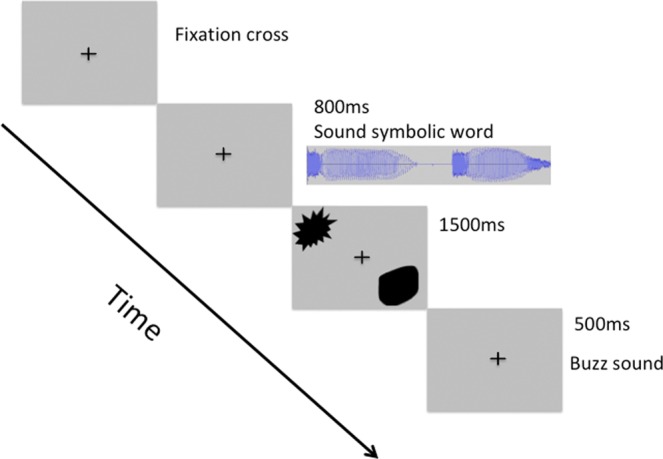
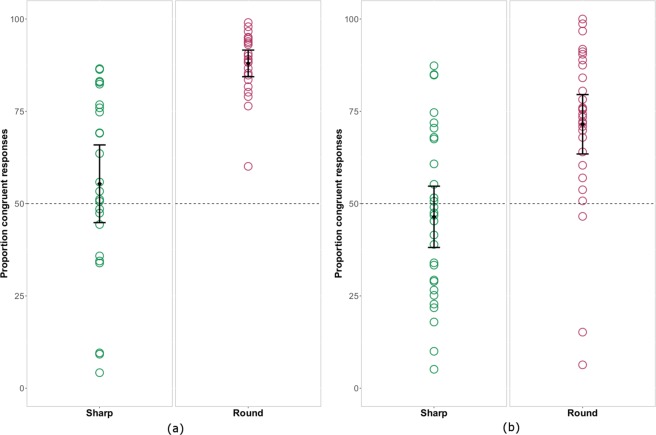
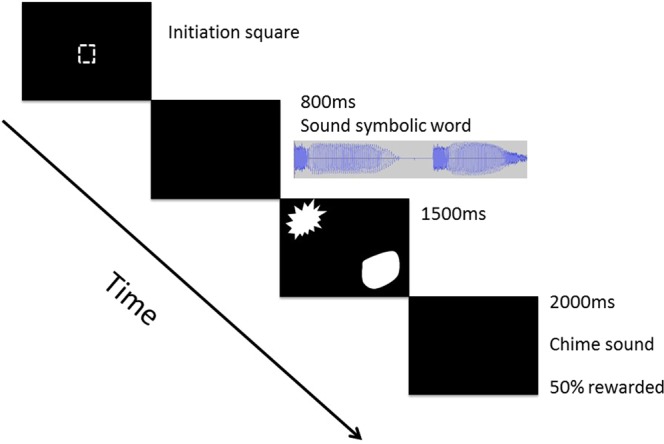
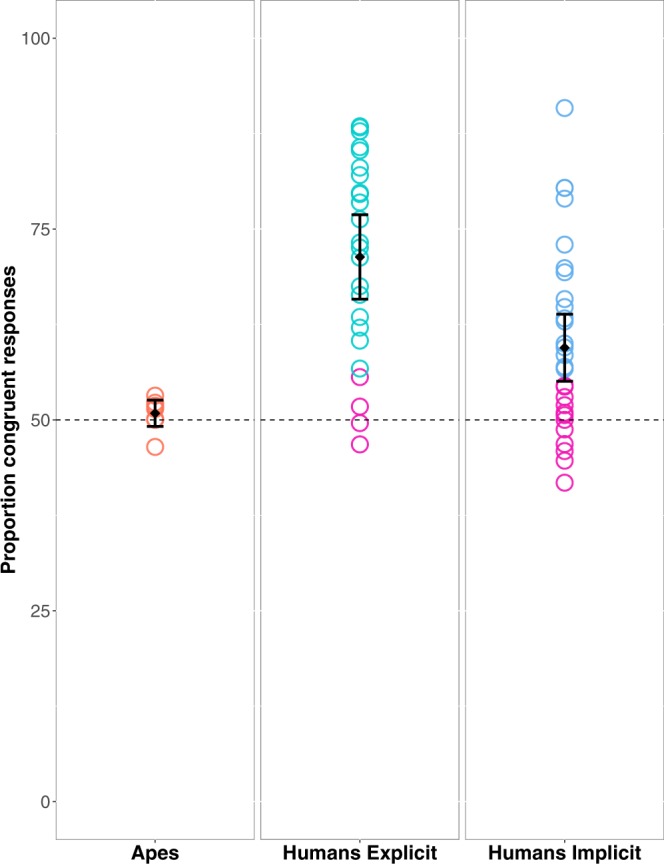
Theories on the evolution of language highlight iconicity as one of the unique features of human language. One important manifestation of iconicity is sound symbolism, the intrinsic relationship between meaningless speech sounds and visual shapes, as exemplified by the famous correspondences between the pseudowords 'maluma' vs. 'takete' and abstract curved and angular shapes. Although sound symbolism has been studied extensively in humans including young children and infants, it has never been investigated in non-human primates lacking language. In the present study, we administered the classic "takete-maluma" paradigm in both humans (N = 24 and N = 31) and great apes (N = 8). In a forced choice matching task, humans but not great apes, showed crossmodal sound symbolic congruency effects, whereby effects were more pronounced for shape selections following round-sounding primes than following edgy-sounding primes. These results suggest that the ability to detect sound symbolic correspondences is the outcome of a phylogenetic process, whose underlying emerging mechanism may be relevant to symbolic ability more generally.
语言进化理论强调象似性是人类语言的独特特征之一。象似性的一个重要表现形式是声音象征,即无意义的语音和视觉形状之间的内在关系,例如伪词“maluma”与“takete”与抽象的曲线和角形之间的著名对应关系。尽管声音象征在包括幼儿和婴儿在内的人类中得到了广泛研究,但在缺乏语言的非人类灵长类动物中从未进行过研究。在本研究中,我们在人类(N=24 和 N=31)和大猿(N=8)中都进行了经典的“takete-maluma”范式。在强制选择匹配任务中,人类而非大猿表现出跨模态声音象征一致性效应,其中在听到圆润的声音后进行形状选择的效果比听到尖锐的声音后的效果更为明显。这些结果表明,检测声音象征对应关系的能力是一个进化过程的结果,其潜在的出现机制可能与更普遍的符号能力有关。