Schomers Malte R, Garagnani Max, Pulvermüller Friedemann
Brain Language Laboratory, Freie Universität Berlin, 14195 Berlin, Germany,
Berlin School of Mind and Brain, Humboldt-Universität zu Berlin, 10099 Berlin, Germany.
J Neurosci. 2017 Mar 15;37(11):3045-3055. doi: 10.1523/JNEUROSCI.2693-16.2017. Epub 2017 Feb 13.
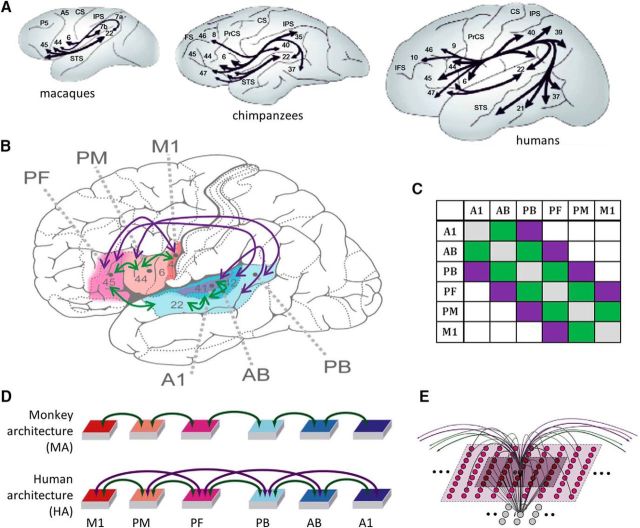
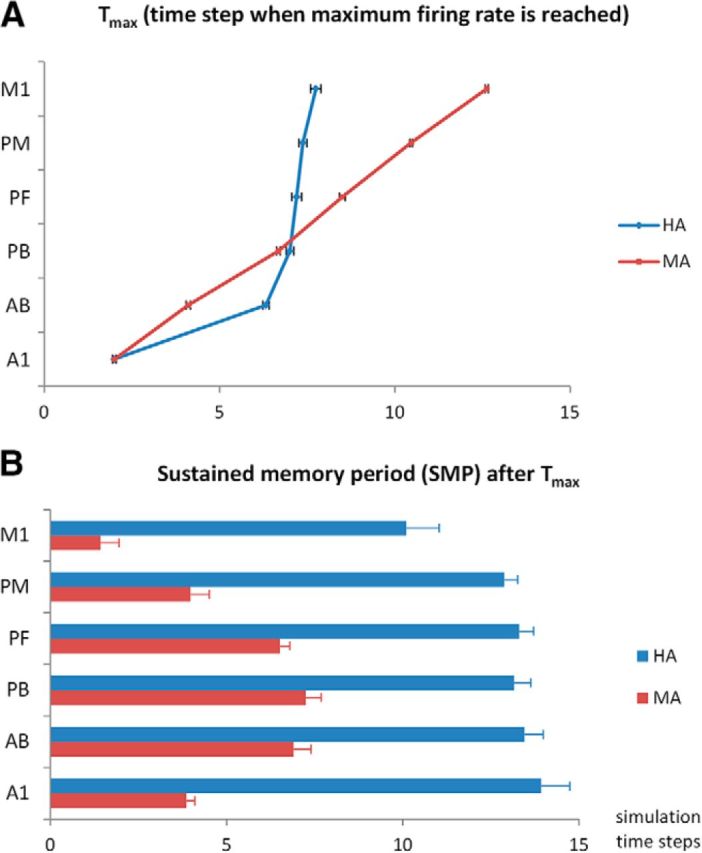
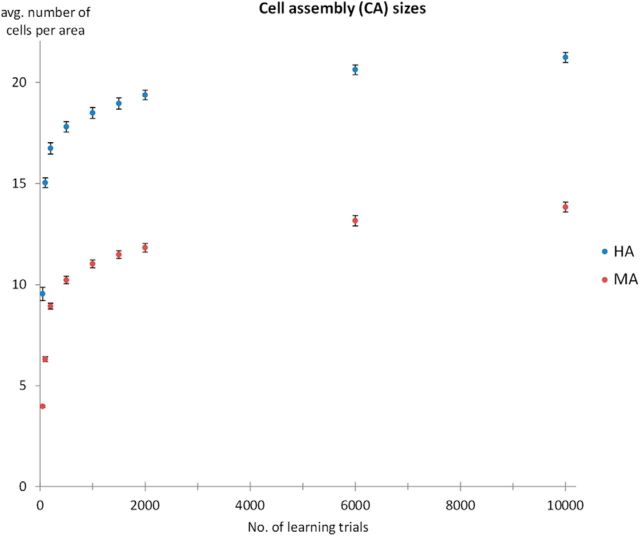
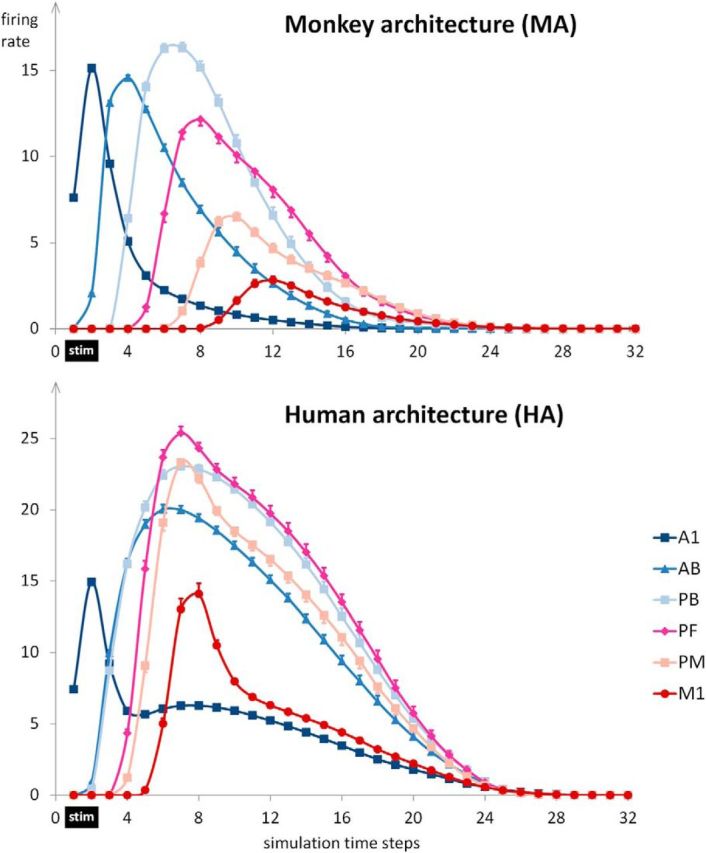
The human brain sets itself apart from that of its primate relatives by specific neuroanatomical features, especially the strong linkage of left perisylvian language areas (frontal and temporal cortex) by way of the arcuate fasciculus (AF). AF connectivity has been shown to correlate with verbal working memory-a specifically human trait providing the foundation for language abilities-but a mechanistic explanation of any related causal link between anatomical structure and cognitive function is still missing. Here, we provide a possible explanation and link, by using neurocomputational simulations in neuroanatomically structured models of the perisylvian language cortex. We compare networks mimicking key features of cortical connectivity in monkeys and humans, specifically the presence of relatively stronger higher-order "jumping links" between nonadjacent perisylvian cortical areas in the latter, and demonstrate that the emergence of working memory for syllables and word forms is a functional consequence of this structural evolutionary change. We also show that a mere increase of learning time is not sufficient, but that this specific structural feature, which entails higher connectivity degree of relevant areas and shorter sensorimotor path length, is crucial. These results offer a better understanding of specifically human anatomical features underlying the language faculty and their evolutionary selection advantage. Why do humans have superior language abilities compared to primates? Recently, a uniquely human neuroanatomical feature has been demonstrated in the strength of the arcuate fasciculus (AF), a fiber pathway interlinking the left-hemispheric language areas. Although AF anatomy has been related to linguistic skills, an explanation of how this fiber bundle may support language abilities is still missing. We use neuroanatomically structured computational models to investigate the consequences of evolutionary changes in language area connectivity and demonstrate that the human-specific higher connectivity degree and comparatively shorter sensorimotor path length implicated by the AF entail emergence of verbal working memory, a prerequisite for language learning. These results offer a better understanding of specifically human anatomical features for language and their evolutionary selection advantage.
人类大脑通过特定的神经解剖学特征使其自身有别于灵长类近亲,特别是通过弓状束(AF)实现左颞周语言区(额叶和颞叶皮质)的紧密连接。AF的连通性已被证明与言语工作记忆相关——这是一种人类特有的特质,为语言能力奠定了基础——但对于解剖结构与认知功能之间任何相关因果联系的机制性解释仍然缺失。在此,我们通过在颞周语言皮质的神经解剖学结构模型中进行神经计算模拟,提供了一种可能的解释和联系。我们比较了模拟猴子和人类皮质连通性关键特征的网络,特别是后者非相邻颞周皮质区域之间相对更强的高阶“跳跃连接”的存在,并证明音节和单词形式工作记忆的出现是这种结构进化变化的功能结果。我们还表明,仅仅增加学习时间是不够的,而这种特定的结构特征,即相关区域具有更高的连通度和更短的感觉运动路径长度,才是至关重要的。这些结果有助于更好地理解语言能力背后的特定人类解剖学特征及其进化选择优势。为什么人类比灵长类具有更卓越的语言能力?最近,在连接左半球语言区的纤维束弓状束(AF)的强度方面,已证明了一种独特的人类神经解剖学特征。尽管AF的解剖结构已与语言技能相关,但对于这个纤维束如何支持语言能力的解释仍然缺失。我们使用神经解剖学结构的计算模型来研究语言区连通性进化变化的后果,并证明AF所涉及的人类特有的更高连通度和相对较短的感觉运动路径长度导致了言语工作记忆的出现,而言语工作记忆是语言学习的先决条件。这些结果有助于更好地理解语言的特定人类解剖学特征及其进化选择优势。