Wu Tailai, Deng Zhaohua, Chen Zhuo, Zhang Donglan, Wu Xiang, Wang Ruoxi
School of Medicine and Health Management, Tongji Medical College, Huazhong University of Science and Technology, Wuhan, China.
Department of Health Policy and Management, College of Public Health, University of Georgia, Athens, GA, United States.
J Med Internet Res. 2019 Sep 3;21(9):e14484. doi: 10.2196/14484.
Web-based health communities provide means for patients to not only seek care but also to promote their relationship with doctors. However, little is known about the predictors of patients' loyalty toward doctors in Web-based health communities.
This study aimed to investigate the predictors of patients' loyalty toward doctors in Web-based health communities.
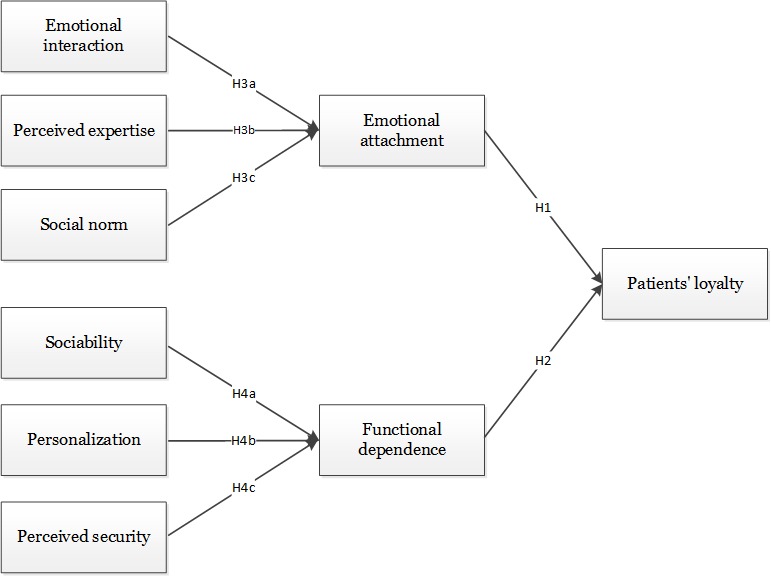
On the basis of sociotechnical systems theory and attachment theory, we propose that social factors including emotional interaction, perceived expertise, and social norm influence patients' loyalty through their emotional attachment, whereas technical factors including sociability, personalization, and perceived security affect patients' loyalty through functional dependence. To validate our proposed research model, we used the survey method and collected 373 valid answers. Partial least square was used to analyze the data.
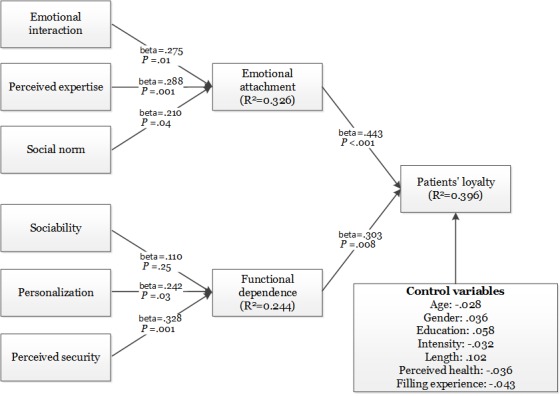
Our empirical analysis results showed that all the social factors including emotional interaction (beta=.257, t=2.571; P=.01), perceived expertise (beta=.288, t=3.412; P=.001), and social norm (beta=.210, t=2.017; P=.04) affect patients' emotional attachment toward doctors significantly, whereas except sociability (beta=.110, t=1.152; P=.25), technical factors such as personalization (beta=.242, t=2.228; P=.03) and perceived security (beta=.328, t=3.438; P=.001) impact functional dependence significantly. Considering the effect of working mechanisms, both emotional attachment (beta=.443, t=4.518; P<.001) and functional dependence (beta=.303, t=2.672; P=.008) influence patients' loyalty toward doctors in Web-based health communities significantly.
Patients' loyalty toward doctors in Web-based health communities is important for the effectiveness of doctors' advice or service in Web-based health communities. The research results not only fill the gaps in the literature of the patient-doctor relationship and Web-based health communities but also has many implications for establishing patients' loyalty on Web-based health communities and in physical context.
基于网络的健康社区为患者提供了寻求医疗服务的途径,同时也促进了他们与医生之间的关系。然而,对于基于网络的健康社区中患者对医生忠诚度的预测因素,我们知之甚少。
本研究旨在探讨基于网络的健康社区中患者对医生忠诚度的预测因素。
基于社会技术系统理论和依恋理论,我们提出,包括情感互动、感知专业能力和社会规范在内的社会因素通过情感依恋影响患者的忠诚度,而包括社交性、个性化和感知安全性在内的技术因素则通过功能依赖影响患者的忠诚度。为了验证我们提出的研究模型,我们采用了调查方法,收集了373份有效答案。使用偏最小二乘法对数据进行分析。
我们的实证分析结果表明,所有社会因素,包括情感互动(β = 0.257,t = 2.571;P = 0.01)、感知专业能力(β = 0.288,t = 3.412;P = 0.001)和社会规范(β = 0.210,t = 2.017;P = 0.04),均对患者对医生的情感依恋有显著影响;而除社交性(β = 0.110,t = 1.152;P = 0.25)外,个性化(β = 0.242,t = 2.228;P = 0.03)和感知安全性(β = 0.328,t = 3.438;P = 0.001)等技术因素对功能依赖有显著影响。考虑到作用机制的影响,情感依恋(β = 0.443,t = 4.518;P < 0.001)和功能依赖(β = 0.303,t = 2.672;P = 0.008)均对基于网络的健康社区中患者对医生的忠诚度有显著影响。
在基于网络的健康社区中,患者对医生的忠诚度对于医生建议或服务的有效性至关重要。研究结果不仅填补了医患关系和基于网络的健康社区文献中的空白,而且对于在基于网络的健康社区以及实际环境中建立患者忠诚度具有诸多启示。