School of Business, Central South University, Changsha, China.
Department of Information Systems, City University of Hong Kong, Hong Kong, Hong Kong.
J Med Internet Res. 2022 Mar 11;24(3):e25275. doi: 10.2196/25275.
In the physician-patient relationship, patients' uncertainty about diseases and the lack of trust in physicians not only hinder patients' rehabilitation but also disrupt the harmony in this relationship. With the development of the web-based health industry, patients can easily access web-based information about health care and physicians, thus reducing patients' uncertainty to some extent. However, it is not clear how patients' web-based health information-seeking behaviors reduce their uncertainty.
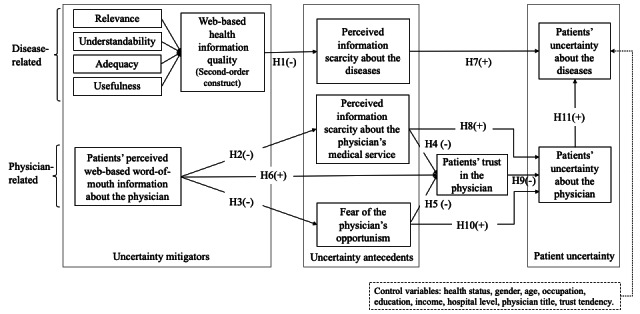
On the basis of the principal-agent theory and the perspective of uncertainty reduction, this study aims to investigate the mechanism of how web-based disease-related information and web-based physician-related information reduce patients' uncertainty.
A web-based survey involving 337 participants was conducted. In this study, we constructed a structural equation model and used SmartPLS (version 3.3.3; SmartPLS GmbH) software to test the reliability and validity of the measurement model. The path coefficients of the structural model were also calculated to test our hypotheses.
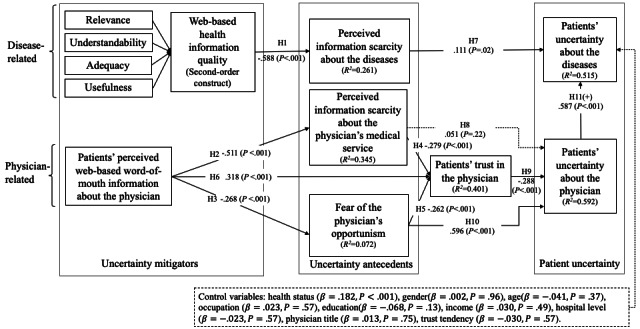
By classifying patients' uncertainties into those concerning diseases and those concerning physicians, this study identified the different roles of the two types of patients' uncertainty and revealed that web-based disease-related information quality and web-based physician-related information can act as uncertainty mitigators. The quality of disease-related information reduces patients' perceived information scarcity about the disease (β=-.588; P<.001), and the higher the information scarcity perceived by patients, the higher their uncertainty toward the disease (β=.111; P=.02). As for physician-related information, web-based word-of-mouth information about physicians reduces patients' perceived information scarcity about the physician (β=-.511; P<.001), mitigates patients' fears about physician opportunism (β=-.268; P<.001), and facilitates patients' trust (β=.318; P<.001). These factors further influence patients' uncertainty about the physician. In addition, from the test of mediating effect, patients' trust in the physician fully mediates the relationship between their perceived information scarcity about the physician's medical service and their uncertainty about the physician. Patients' trust also partially mediates the relationship between their fear of the physician's opportunism and their uncertainty about the physician. As for the two different types of uncertainty, patients' uncertainty about the physician also increases their uncertainty about the diseases (β=.587; P<.001).
This study affirms the role of disease-related web-based information quality and physician-related web-based word-of-mouth information in reducing patients' uncertainties. With regard to the traits of principal-agent relationships, this study describes the influence mechanism based on patients' perceived information scarcity, fears of physicians' opportunism, and patients' trust. Moreover, information about physicians is effective in reducing patients' uncertainties, but only if the information enhances patients' trust in their physicians. This research generates new insights into understanding the impact of web-based health information on patients' uncertainties.
在医患关系中,患者对疾病的不确定性和对医生的不信任不仅阻碍了患者的康复,也破坏了这种关系的和谐。随着基于网络的健康产业的发展,患者可以轻松地获取有关医疗保健和医生的基于网络的信息,从而在一定程度上降低了患者的不确定性。然而,目前尚不清楚患者的基于网络的健康信息搜索行为如何降低他们的不确定性。
基于委托代理理论和不确定性降低的视角,本研究旨在探讨基于网络的疾病相关信息和基于网络的医生相关信息如何降低患者的不确定性。
本研究进行了一项基于网络的调查,共涉及 337 名参与者。在本研究中,我们构建了一个结构方程模型,并使用 SmartPLS(版本 3.3.3;SmartPLS GmbH)软件来测试测量模型的可靠性和有效性。还计算了结构模型的路径系数以检验我们的假设。
通过将患者的不确定性分为疾病相关不确定性和医生相关不确定性,本研究确定了这两种类型的患者不确定性的不同作用,并揭示了基于网络的疾病相关信息质量和基于网络的医生相关信息可以作为不确定性缓解因素。疾病相关信息的质量降低了患者对疾病信息匮乏的感知(β=-.588;P<.001),而患者感知到的信息匮乏程度越高,他们对疾病的不确定性就越高(β=.111;P=.02)。至于医生相关信息,基于网络的医生口碑信息降低了患者对医生信息匮乏的感知(β=-.511;P<.001),减轻了患者对医生机会主义的恐惧(β=-.268;P<.001),并促进了患者的信任(β=.318;P<.001)。这些因素进一步影响了患者对医生的不确定性。此外,从中介效应检验来看,患者对医生的信任完全中介了他们对医生医疗服务信息匮乏的感知与对医生的不确定性之间的关系。患者的信任也部分中介了他们对医生机会主义的恐惧与对医生的不确定性之间的关系。对于两种不同类型的不确定性,患者对医生的不确定性也增加了他们对疾病的不确定性(β=.587;P<.001)。
本研究肯定了疾病相关网络信息质量和医生相关网络口碑信息在降低患者不确定性方面的作用。鉴于委托代理关系的特点,本研究根据患者感知到的信息匮乏、对医生机会主义的恐惧和患者的信任来描述影响机制。此外,医生信息在降低患者不确定性方面是有效的,但前提是信息能增强患者对医生的信任。本研究为理解基于网络的健康信息对患者不确定性的影响提供了新的见解。