Department of Anesthesia, St. Michael's Hospital, Toronto, Ontario, Canada.
Department of Anesthesia, University of Toronto, Toronto, Ontario, Canada.
JAMA Netw Open. 2019 Sep 4;2(9):e1910734. doi: 10.1001/jamanetworkopen.2019.10734.
Small studies and anecdotal evidence suggest marked differences in the use of opioids after surgery internationally; however, this has not been evaluated systematically across populations receiving similar procedures in different countries.
To determine whether there are differences in the frequency, amount, and type of opioids dispensed after surgery among the United States, Canada, and Sweden.
DESIGN, SETTING, AND PARTICIPANTS: This cohort study included patients without previous opioid prescriptions aged 16 to 64 years who underwent 4 low-risk surgical procedures (ie, laparoscopic cholecystectomy, laparoscopic appendectomy, arthroscopic knee meniscectomy, and breast excision) between January 2013 and December 2015 in the United States, between July 2013 and March 2016 in Canada, and between January 2013 and December 2014 in Sweden. Data analysis was conducted in all 3 countries from July 2018 to October 2018.
The main outcome was postoperative opioid prescriptions filled within 7 days after discharge; the percentage of patients who filled a prescription, the total morphine milligram equivalent (MME) dose, and type of opioid dispensed were compared.
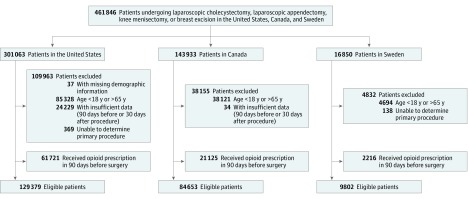
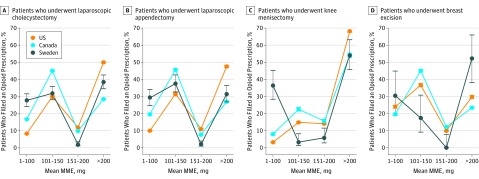
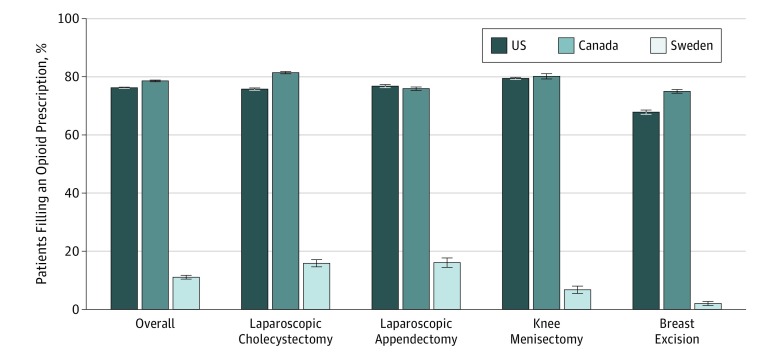
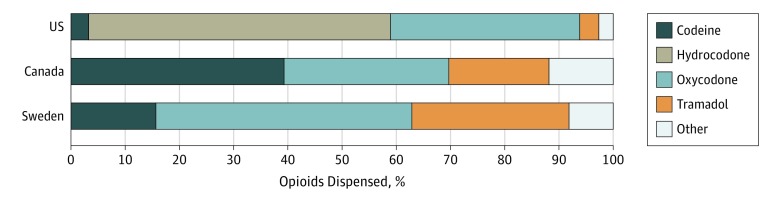
The study sample consisted of 129 379 patients in the United States, 84 653 in Canada, and 9802 in Sweden. Overall, 52 427 patients (40.5%) in the United States were men, with a mean (SD) age of 45.1 (12.7) years; in Canada, 25 074 patients (29.6%) were men, with a mean (SD) age of 43.5 (13.0) years; and in Sweden, 3314 (33.8%) were men, with a mean (SD) age of 42.5 (13.0). The proportion of patients in Sweden who filled an opioid prescription within the first 7 days after discharge for any procedure was lower than patients treated in the United States and Canada (Sweden, 1086 [11.1%]; United States, 98 594 [76.2%]; Canada, 66 544 [78.6%]; P < .001). For patients who filled a prescription, the mean (SD) MME dispensed within 7 days of discharge was highest in United States (247 [145] MME vs 169 [93] MME in Canada and 197 [191] MME in Sweden). Codeine and tramadol were more commonly dispensed in Canada (codeine, 26 136 patients [39.3%]; tramadol, 12 285 patients [18.5%]) and Sweden (codeine, 170 patients [15.7%]; tramadol, 315 patients [29.0%]) than in the United States (codeine, 3210 patients [3.3%]; tramadol, 3425 patients [3.5%]).
The findings indicate that the United States and Canada have a 7-fold higher rate of opioid prescriptions filled in the immediate postoperative period compared with Sweden. Of the 3 countries examined, the mean dose of opioids for most surgical procedures was highest in the United States.
一些小型研究和轶事证据表明,国际上手术后阿片类药物的使用存在明显差异;然而,这并没有在不同国家接受类似手术的人群中进行系统评估。
确定在美国、加拿大和瑞典,接受低风险手术的患者在手术后的用药频率、用量和类型是否存在差异。
设计、地点和参与者:本队列研究纳入了 2013 年 1 月至 2015 年 12 月在美国、2013 年 7 月至 2016 年 3 月在加拿大和 2013 年 1 月至 2014 年 12 月在瑞典进行的 4 种低风险手术(腹腔镜胆囊切除术、腹腔镜阑尾切除术、关节镜半月板切除术和乳房切除术)的年龄在 16 至 64 岁之间且无阿片类药物处方史的患者。数据分析于 2018 年 7 月至 2018 年 10 月在所有 3 个国家进行。
主要结局是出院后 7 天内开出的术后阿片类药物处方;比较了开处方的患者比例、总吗啡毫克当量(MME)剂量和开处方的阿片类药物类型。
研究样本包括美国的 129379 例患者、加拿大的 84653 例患者和瑞典的 9802 例患者。总体而言,美国有 52427 例(40.5%)男性,平均(SD)年龄为 45.1(12.7)岁;加拿大有 25074 例(29.6%)男性,平均(SD)年龄为 43.5(13.0)岁;瑞典有 3314 例(33.8%)男性,平均(SD)年龄为 42.5(13.0)岁。瑞典在出院后 7 天内开出任何手术阿片类药物处方的患者比例低于美国和加拿大(瑞典,11.1%;美国,76.2%;加拿大,78.6%;P<0.001)。对于开处方的患者,出院后 7 天内开出的 MME 平均(SD)剂量以美国最高(247[145]MME 与加拿大的 169[93]MME 和瑞典的 197[191]MME)。在美国(曲马多,3425 例[3.5%])和瑞典(曲马多,315 例[29.0%]),阿片类药物比加拿大(可待因,26136 例[39.3%];曲马多,12285 例[18.5%])更常开处方。
研究结果表明,与瑞典相比,美国和加拿大在术后立即开出阿片类药物处方的比例高 7 倍。在所研究的 3 个国家中,美国大多数手术的阿片类药物平均剂量最高。