Cancer Epidemiology Unit, Nuffield Department of Population Health, University of Oxford, Richard Doll Building, Oxford OX3 7LF, UK
Cancer Epidemiology Unit, Nuffield Department of Population Health, University of Oxford, Richard Doll Building, Oxford OX3 7LF, UK.
BMJ. 2019 Sep 4;366:l4897. doi: 10.1136/bmj.l4897.
To examine the associations of vegetarianism with risks of ischaemic heart disease and stroke.
Prospective cohort study.
The EPIC-Oxford study, a cohort in the United Kingdom with a large proportion of non-meat eaters, recruited across the country between 1993 and 2001.
48 188 participants with no history of ischaemic heart disease, stroke, or angina (or cardiovascular disease) were classified into three distinct diet groups: meat eaters (participants who consumed meat, regardless of whether they consumed fish, dairy, or eggs; n=24 428), fish eaters (consumed fish but no meat; n=7506), and vegetarians including vegans (n=16 254), based on dietary information collected at baseline, and subsequently around 2010 (n=28 364).
Incident cases of ischaemic heart disease and stroke (including ischaemic and haemorrhagic types) identified through record linkage until 2016.
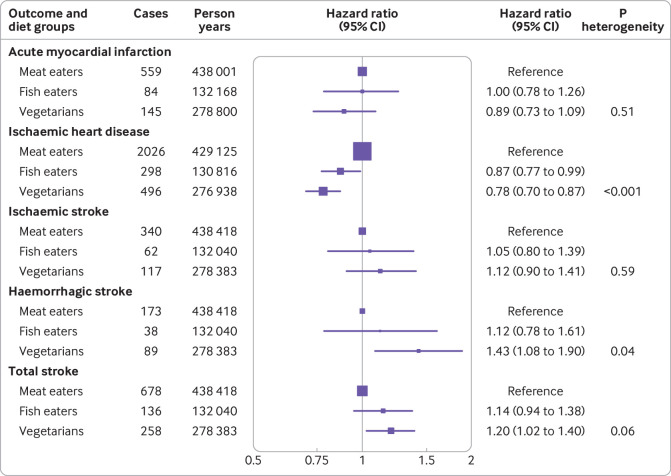
Over 18.1 years of follow-up, 2820 cases of ischaemic heart disease and 1072 cases of total stroke (519 ischaemic stroke and 300 haemorrhagic stroke) were recorded. After adjusting for sociodemographic and lifestyle confounders, fish eaters and vegetarians had 13% (hazard ratio 0.87, 95% confidence interval 0.77 to 0.99) and 22% (0.78, 0.70 to 0.87) lower rates of ischaemic heart disease than meat eaters, respectively (P<0.001 for heterogeneity). This difference was equivalent to 10 fewer cases of ischaemic heart disease (95% confidence interval 6.7 to 13.1 fewer) in vegetarians than in meat eaters per 1000 population over 10 years. The associations for ischaemic heart disease were partly attenuated after adjustment for self reported high blood cholesterol, high blood pressure, diabetes, and body mass index (hazard ratio 0.90, 95% confidence interval 0.81 to 1.00 in vegetarians with all adjustments). By contrast, vegetarians had 20% higher rates of total stroke (hazard ratio 1.20, 95% confidence interval 1.02 to 1.40) than meat eaters, equivalent to three more cases of total stroke (95% confidence interval 0.8 to 5.4 more) per 1000 population over 10 years, mostly due to a higher rate of haemorrhagic stroke. The associations for stroke did not attenuate after further adjustment of disease risk factors.
In this prospective cohort in the UK, fish eaters and vegetarians had lower rates of ischaemic heart disease than meat eaters, although vegetarians had higher rates of haemorrhagic and total stroke.
探讨素食与缺血性心脏病和中风风险的关联。
前瞻性队列研究。
英国的 EPIC-Oxford 研究,这是一个在全国范围内招募的队列,其中有很大一部分非肉食者,招募时间在 1993 年至 2001 年之间。
48188 名无缺血性心脏病、中风或心绞痛(或心血管疾病)病史的参与者,根据基线时收集的饮食信息,分为三组:肉食者(食用肉的参与者,无论是否食用鱼、奶制品或蛋类;n=24428)、食鱼者(食用鱼但不食用肉;n=7506)和素食者(包括严格素食者;n=16254),随后在 2010 年左右(n=28364)再次进行调查。
通过记录链接直到 2016 年,缺血性心脏病和中风(包括缺血性和出血性类型)的发病情况。
在 18.1 年的随访中,记录到 2820 例缺血性心脏病和 1072 例总中风(519 例缺血性中风和 300 例出血性中风)。在调整了社会人口统计学和生活方式混杂因素后,食鱼者和素食者的缺血性心脏病发生率分别降低了 13%(风险比 0.87,95%置信区间 0.77 至 0.99)和 22%(0.78,0.70 至 0.87)(异质性 P<0.001)。这相当于素食者与肉食者相比,每 1000 人中有 10 例缺血性心脏病(95%置信区间为 6.7 至 13.1 例)减少。缺血性心脏病的相关性在调整自我报告的高胆固醇、高血压、糖尿病和体重指数后部分减弱(素食者的风险比为 0.90,95%置信区间为 0.81 至 1.00)。相比之下,素食者的总中风发生率高 20%(风险比 1.20,95%置信区间 1.02 至 1.40),这相当于在 10 年内每 1000 人中有 3 例以上的总中风(95%置信区间为 0.8 至 5.4 例),主要是由于出血性中风的发生率更高。进一步调整疾病风险因素后,中风的相关性并未减弱。
在英国的这项前瞻性队列研究中,食鱼者和素食者的缺血性心脏病发生率低于肉食者,但素食者的出血性和总中风发生率较高。