Molecular Immunity Unit, Department of Medicine, University of Cambridge, Cambridge CB2 0QH, United Kingdom.
Department of Medicine, University of Cambridge, Cambridge CB2 0QQ, United Kingdom.
Proc Natl Acad Sci U S A. 2019 Sep 17;116(38):19083-19089. doi: 10.1073/pnas.1905054116. Epub 2019 Sep 4.
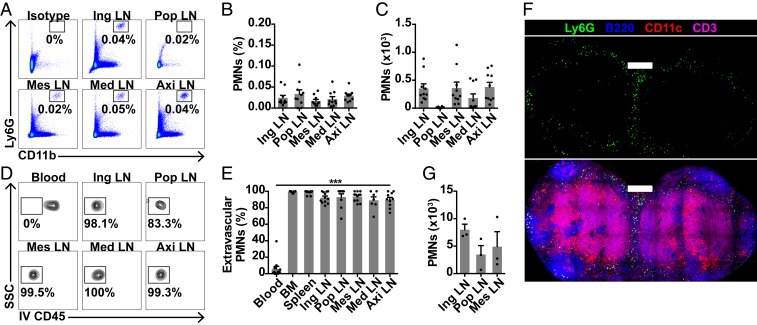
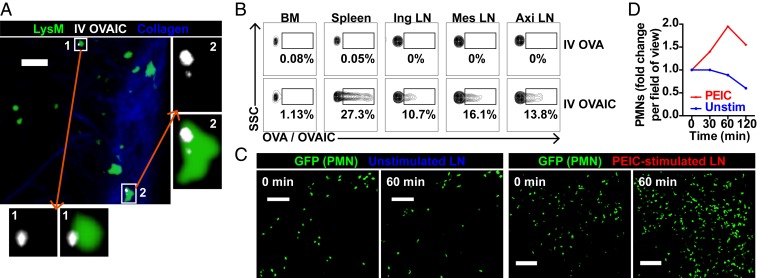
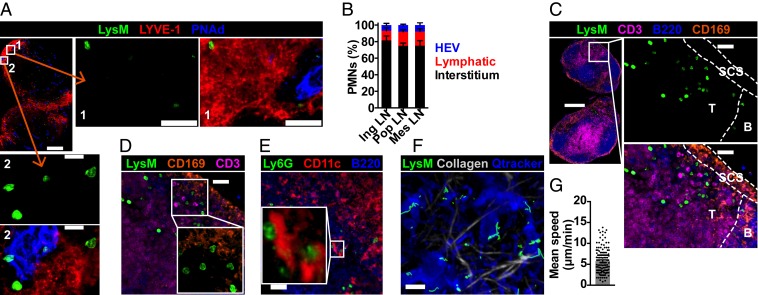
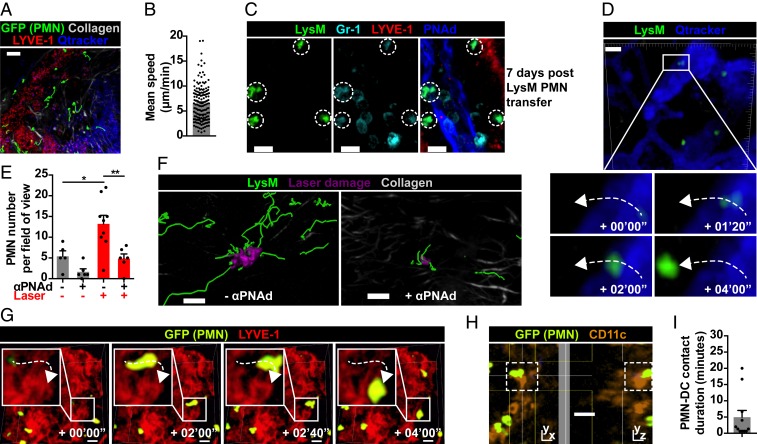
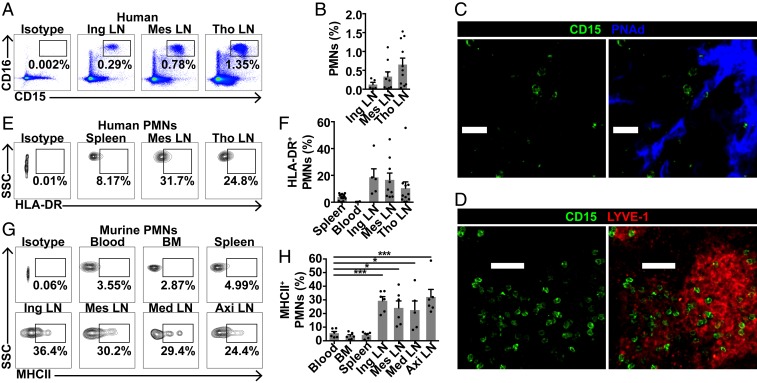
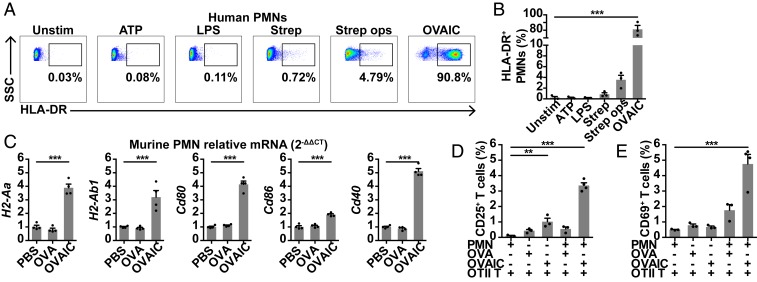
Neutrophils play a key role in innate immunity. As the dominant circulating phagocyte, they are rapidly recruited from the bloodstream to sites of infection or injury to internalize and destroy microbes. More recently, neutrophils have been identified in uninfected organs, challenging the classical view of their function. Here we show that neutrophils were present in lymph nodes (LNs) in homeostasis. Using flow cytometry and confocal imaging, we identified neutrophils within LNs in naive, unchallenged mice, including LNs draining the skin, lungs, and gastrointestinal tract. Neutrophils were enriched within specific anatomical regions, in the interfollicular zone, a site of T cell activation. Intravital two-photon microscopy demonstrated that LN neutrophils were motile, trafficked into LNs from both blood and tissues via high endothelial venules and afferent lymphatics, respectively, and formed interactions with dendritic cells in LNs. Murine and human LN neutrophils had a distinct phenotype compared with circulating neutrophils, with higher major histocompatibility complex II (MHCII) expression, suggesting a potential role in CD4 T cell activation. Upon ex vivo stimulation with IgG immune complex (IC), neutrophils up-regulated expression of MHCII and costimulatory molecules and increased T cell activation. In vivo, neutrophils were capable of delivering circulating IC to LNs, suggesting a broader functional remit. Overall, our data challenge the perception that neutrophil patrol is limited to the circulation in homeostasis, adding LNs to their routine surveillance territory.
中性粒细胞在先天免疫中发挥着关键作用。作为循环系统中占主导地位的吞噬细胞,它们可以从血液中迅速募集到感染或损伤部位,内化并破坏微生物。最近,人们发现中性粒细胞存在于未感染的器官中,这对其功能的传统观点提出了挑战。在这里,我们显示中性粒细胞在稳态下存在于淋巴结(LN)中。通过流式细胞术和共聚焦成像,我们在未受挑战的正常小鼠的 LN 中鉴定出了中性粒细胞,包括引流皮肤、肺部和胃肠道的 LN。中性粒细胞在特定的解剖区域富集,在滤泡间区,这是 T 细胞激活的部位。活体双光子显微镜显示,LN 中的中性粒细胞是运动的,可以通过高内皮静脉和输入淋巴管分别从血液和组织中进入 LN,并与 LN 中的树突状细胞形成相互作用。与循环中性粒细胞相比,鼠和人 LN 中性粒细胞具有独特的表型,其主要组织相容性复合物 II(MHCII)表达更高,提示其在 CD4 T 细胞激活中可能发挥作用。在体外用 IgG 免疫复合物(IC)刺激后,中性粒细胞上调 MHCII 和共刺激分子的表达,并增加 T 细胞激活。在体内,中性粒细胞能够将循环 IC 递送到 LN,这表明其具有更广泛的功能。总的来说,我们的数据挑战了中性粒细胞巡逻仅限于稳态下循环系统的观点,将 LN 纳入其常规监测领域。