Department of Oncology, Qingdao Municipal Hospital, School of Medicine, Qingdao University, Qingdao, Shandong 266071, P.R. China.
Department of Central Laboratory, The Affiliated Hospital of Qingdao University, Qingdao, Shandong 266003, P.R. China.
Mol Med Rep. 2019 Nov;20(5):4168-4174. doi: 10.3892/mmr.2019.10646. Epub 2019 Sep 3.
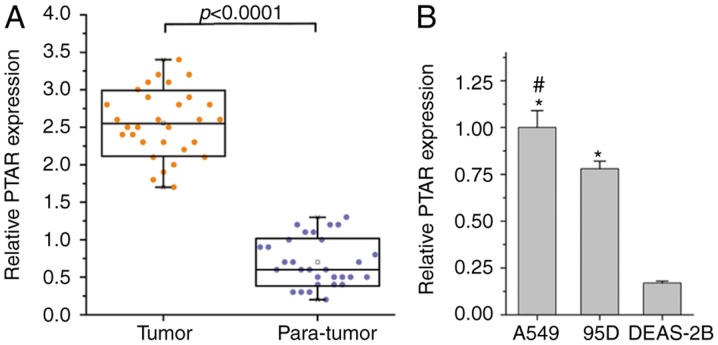
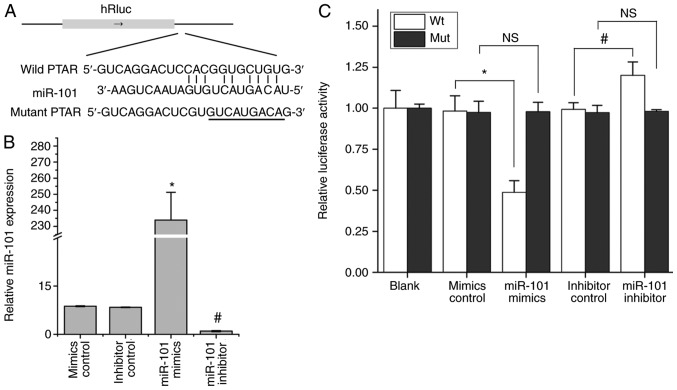
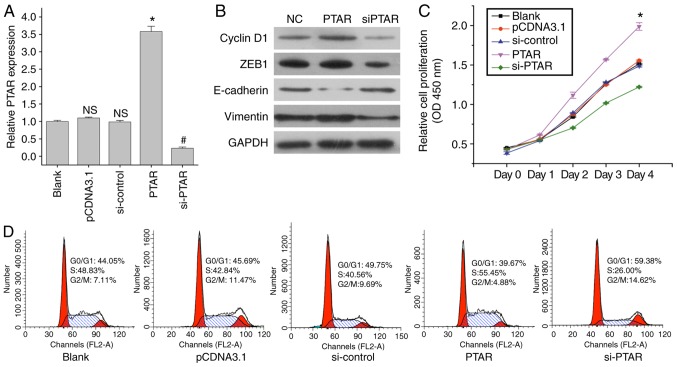
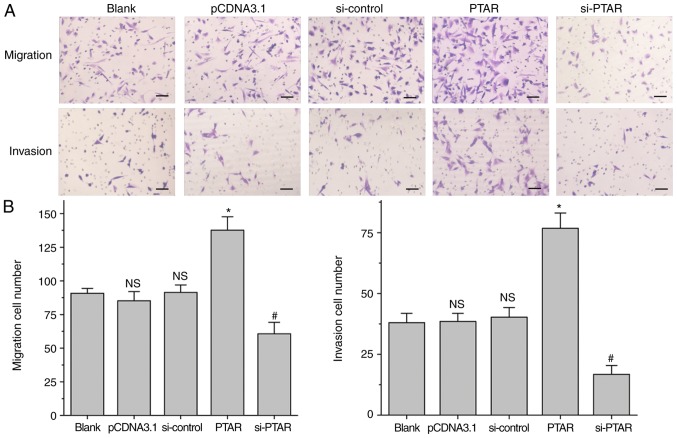
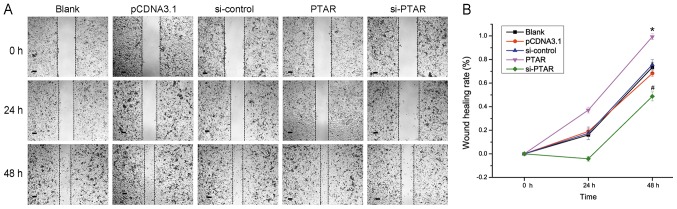
MicroRNA (miR)‑101 copy loss is an early event in the development of human lung cancer, and it occurs in 29% of all lung cancer incidences. In addition, miR‑101 expression in non‑small cell lung cancer (NSCLC) is known to be downregulated. The aim of the present study was to explore the roles and mechanisms of the long non‑coding (lnc)‑RNA pro‑transition associated RNA (PTAR) on NSCLC cell proliferation, migration and invasion in association with miR‑101. Reverse transcription‑quantitative PCR analysis was performed to detect the expression of lncRNA PTAR in 30 paired human NSCLC tissues and the corresponding para‑tumor tissues. PTAR was amplified and cloned into the expression vector pCDNA3.1. Then, PTAR‑overexpression plasmids or small interfering (si)‑RNA‑PTAR was transfected into A549 cells for 48 h, after which cell proliferation and the cell cycle distribution were evaluated. In addition, Transwell chamber and cell scratch‑wound assays were conducted to analyze A549 cell migration and invasion. A luciferase activity assay was evaluated to determine the interaction between PTAR and miR‑101. Furthermore, our results demonstrated that in human NSCLC tissues and cell lines, lncRNA PTAR expression was upregulated compared with normal lung tissues and cell lines, respectively. Additionally, PTAR transfection was observed to promote A549 cell proliferation, migration and invasion; opposing effects were observed with siRNA‑PTAR transfection. The luciferase activity assay revealed that PTAR could act as a sponge to bind miR‑101. Thus, miR‑101 plays a role in NSCLC tumorigenesis and progression. In conclusion, lncRNA PTAR was proposed to promote NSCLC cell growth through sponging and inactivating miR‑101, which may be a possible mechanism underlying miR‑101 copy loss in human NSCLC.
微小 RNA(miR)-101 拷贝丢失是人类肺癌发展的早期事件,它发生在所有肺癌病例的 29%中。此外,非小细胞肺癌(NSCLC)中的 miR-101 表达已知下调。本研究旨在探讨长链非编码(lnc)RNA 前过渡相关 RNA(PTAR)在与 miR-101 相关的 NSCLC 细胞增殖、迁移和侵袭中的作用和机制。采用逆转录定量 PCR 分析检测 30 对人 NSCLC 组织及其相应癌旁组织中 lncRNA PTAR 的表达。扩增并克隆 PTAR 到表达载体 pCDNA3.1。然后,将 PTAR 过表达质粒或小干扰(si)-RNA-PTAR 转染至 A549 细胞 48 小时,评估细胞增殖和细胞周期分布。此外,通过 Transwell 室和细胞划痕实验分析 A549 细胞迁移和侵袭。通过荧光素酶活性测定评估 PTAR 与 miR-101 之间的相互作用。此外,我们的结果表明,在人 NSCLC 组织和细胞系中,lncRNA PTAR 的表达高于正常肺组织和细胞系。此外,PTAR 转染观察到促进 A549 细胞增殖、迁移和侵袭;与 siRNA-PTAR 转染相反。荧光素酶活性测定表明,PTAR 可以作为海绵结合 miR-101。因此,miR-101 在 NSCLC 肿瘤发生和进展中发挥作用。综上所述,lncRNA PTAR 通过海绵吸附和失活 miR-101 促进 NSCLC 细胞生长,这可能是人类 NSCLC 中 miR-101 拷贝丢失的一种可能机制。