Department of Hematology and Oncology, Zhongda Hospital Southeast University, Nanjing, Jiangsu 210009, P.R. China.
Department of Cardiology, Jiangsu Province Hospital, Nanjing, Jiangsu 210009, P.R. China.
Mol Med Rep. 2019 Oct;20(4):3679-3690. doi: 10.3892/mmr.2019.10627. Epub 2019 Aug 29.
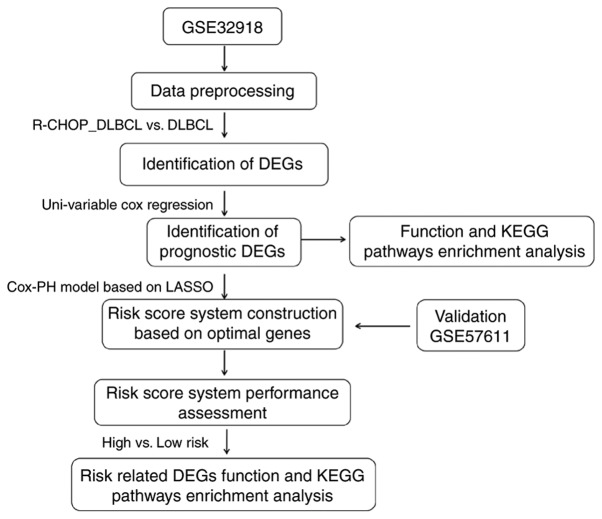
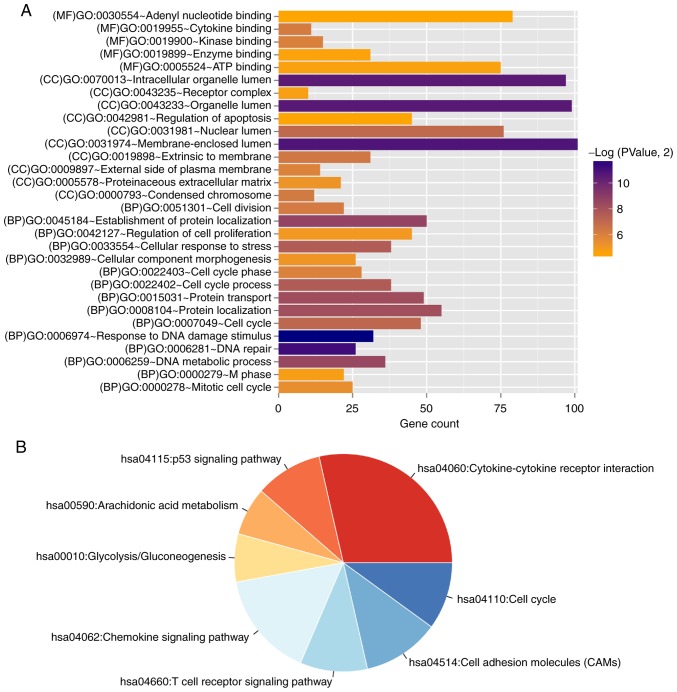
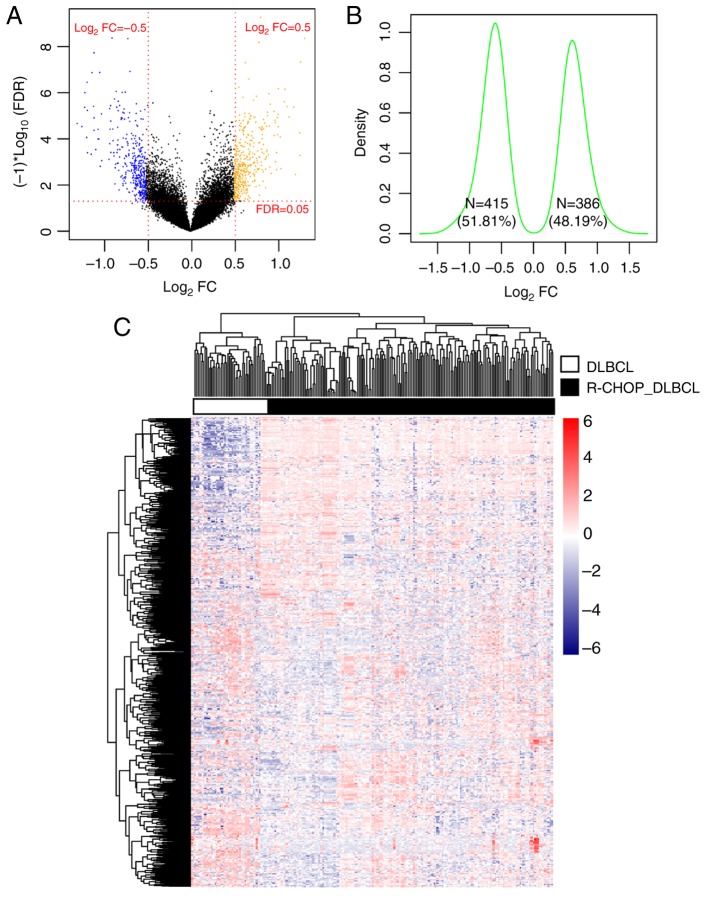
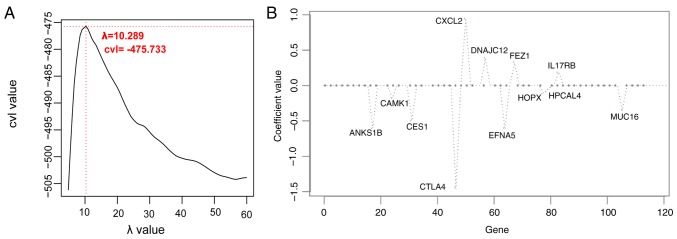
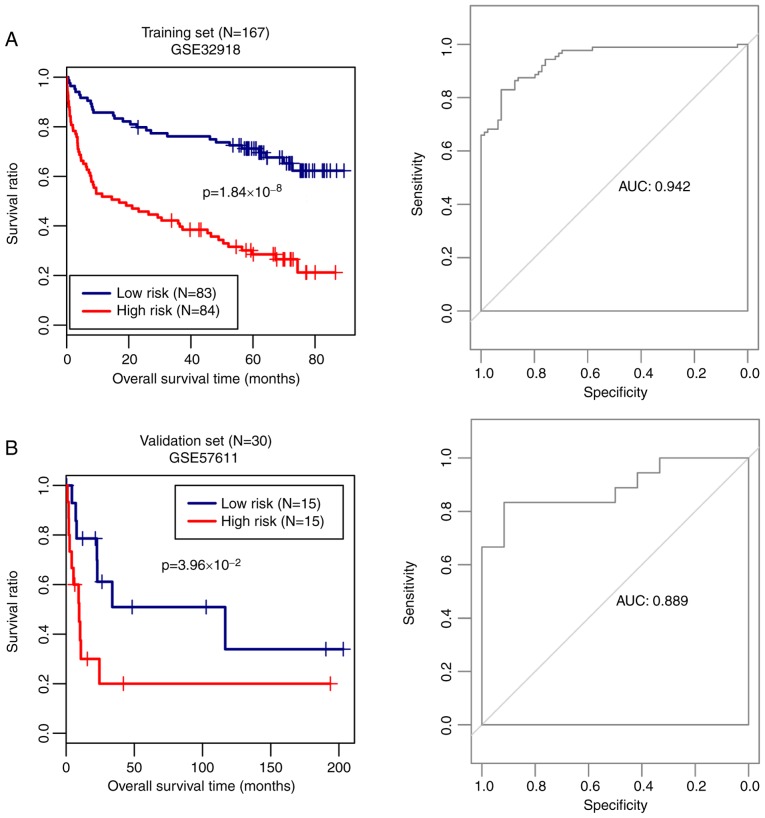
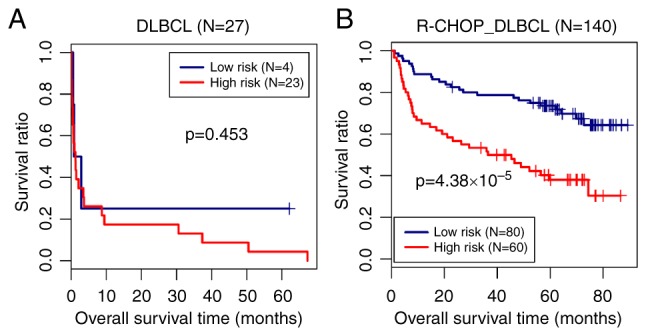
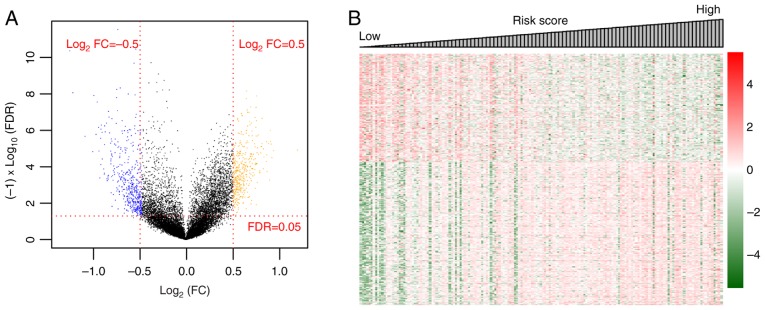
Diffuse large B‑cell lymphoma (DLBCL) is a common subtype of non‑Hodgkin lymphoma, which is curable in the majority of patients treated with rituximab plus cyclophosphamide, doxorubicin, vincristine and prednisone (R‑CHOP) immunochemotherapy. However, the therapeutic mechanism of R‑CHOP has not been elucidated. The GSE32918 and GSE57611 datasets were retrieved from The Gene Expression Omnibus database. The differentially expressed genes (DEGs) associated with R‑CHOP therapy were identified using limma. Combined with prognostic information in GSE32918, DEGs found to be significantly associated with prognosis were selected using univariate Cox regression analysis and a risk prediction model was constructed. Based on this model, the samples in the training set (GSE32918) were divided into high and low risk score groups according to the median risk score. A total of 801 DEGs were identified between the R‑CHOP treated DLBCL and primary DLBCL samples, from this 116 prognosis‑associated genes were selected. Using Cox proportional hazards model, an optimal combination of 12 genes [including calcium/calmodulin dependent protein kinase I (CAMK1), hippocalcin like 4 (HPCAL4) and ephrin A5 (EFNA5)] was selected, and the sample risk score prediction model was constructed and validated. The DEGs between high risk score and low risk score groups were significantly enriched in functions associated with 'response to DNA damage stimulus', and pathways including 'cytokine‑cytokine receptor interaction' and 'cell cycle'. The optimal combination of the 12 genes, including CAMK1, HPCAL4 and EFNA5, was found to be useful in predicting the prognosis of patients with DLBCL after R‑CHOP treatment. Therefore, these genes may be affected by R‑CHOP in DLBCL.
弥漫性大 B 细胞淋巴瘤(DLBCL)是非霍奇金淋巴瘤的常见亚型,在接受利妥昔单抗联合环磷酰胺、多柔比星、长春新碱和泼尼松(R-CHOP)免疫化疗的大多数患者中可治愈。然而,R-CHOP 的治疗机制尚未阐明。从基因表达综合数据库中检索 GSE32918 和 GSE57611 数据集。使用 limma 鉴定与 R-CHOP 治疗相关的差异表达基因(DEGs)。结合 GSE32918 中的预后信息,使用单变量 Cox 回归分析选择与预后显著相关的 DEGs,并构建风险预测模型。基于该模型,根据中位风险评分将训练集(GSE32918)中的样本分为高风险评分组和低风险评分组。在 R-CHOP 治疗的 DLBCL 和原发性 DLBCL 样本之间共鉴定到 801 个 DEGs,从中选择了 116 个与预后相关的基因。使用 Cox 比例风险模型,选择了 12 个基因的最佳组合[包括钙/钙调蛋白依赖性蛋白激酶 I(CAMK1)、钙调蛋白样蛋白 4(HPCAL4)和 Ephrin A5(EFNA5)],构建并验证了样本风险评分预测模型。高风险评分组和低风险评分组之间的 DEGs 在与“对 DNA 损伤刺激的反应”相关的功能以及包括“细胞因子-细胞因子受体相互作用”和“细胞周期”在内的途径中显著富集。CAMK1、HPCAL4 和 EFNA5 等 12 个基因的最佳组合被发现可用于预测接受 R-CHOP 治疗后 DLBCL 患者的预后。因此,这些基因可能受 R-CHOP 影响在 DLBCL 中。