Center for Outcomes Research and Economic Evaluation for Health (C2H), National Institute of Public Health, 2-3-6 Minami, Wako, Saitama, 351-0197, Japan.
Department of Health and Welfare Services, National Institute of Public Health, 2-3-6 Minami, Wako, Saitama, 351-0197, Japan.
Qual Life Res. 2020 Jan;29(1):253-263. doi: 10.1007/s11136-019-02287-6. Epub 2019 Sep 4.
In developed countries, progressive rapid aging is increasing the need for social care. This study aimed to determine Japanese utility weights for the Adult Social Care Outcomes Toolkit (ASCOT) four-level self-completion questionnaire (SCT4).
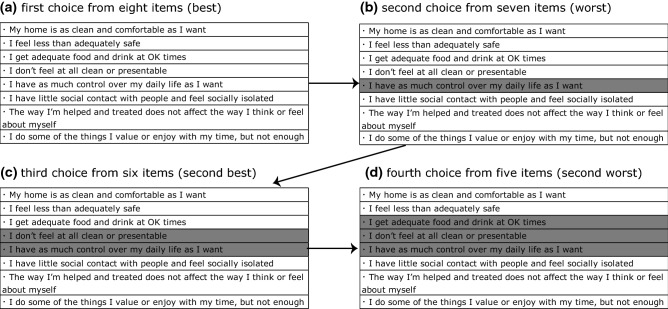
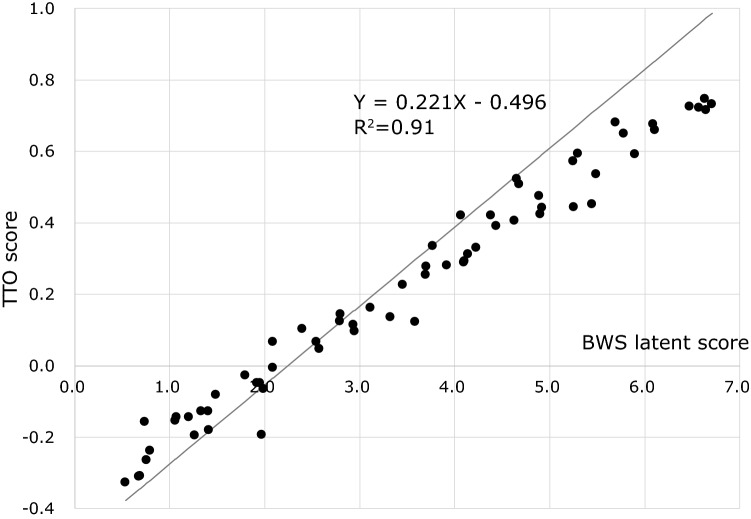
We recruited 1050 Japanese respondents from the general population, stratified by sex and age, from five major cities. In the best-worst scaling (BWS) phase, respondents ranked various social care-related quality of life (SCRQoL) states as "best," "worst," "second-best," or "second-worst," as per the ASCOT. Then, respondents were asked to evaluate eight different SCRQOL states by composite time-trade off (cTTO). A mixed logit model was used to analyze BWS data. The association between cTTO and latent BWS scores was used to estimate a scoring formula that would convert BWS scores to SC-QALY (social care quality-adjusted life year) scores.
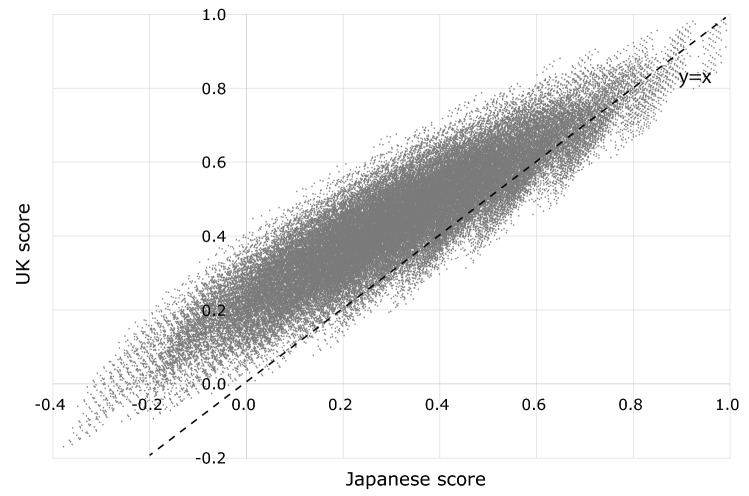
Japanese BWS weightings for ASCOT-SCT4 were successfully estimated and found generally consistent with the UK utility weights. However, coefficients on level 3 of "Control over daily life" and "Occupation" domains differed markedly between Japan and the UK. The worst Japanese SCRQoL state was lower than that for the UK, as Japanese cTTO results showed more negative valuations. In general, Japanese SC-QALY score (for more than 90% of health states) was lower than that for the UK.
We successfully obtained Japanese utility weights for ASCOT SCT4. This will contribute to the measurement and understanding of social care outcomes.
在发达国家,人口快速老龄化使得对社会关怀的需求不断增加。本研究旨在确定日本对成人社会关怀结局工具包(ASCOT)四级自我完成问卷(SCT4)的效用权重。
我们从五个主要城市的一般人群中按性别和年龄分层招募了 1050 名日本受访者。在最佳最差评分(BWS)阶段,受访者根据 ASCOT 将各种与社会关怀相关的生活质量(SCRQoL)状态评为“最佳”、“最差”、“次佳”或“次差”。然后,受访者被要求通过综合时间权衡(cTTO)评估八种不同的 SCRQOL 状态。混合对数模型用于分析 BWS 数据。cTTO 与潜在 BWS 评分之间的关联用于估计一个评分公式,该公式将 BWS 评分转换为 SC-QALY(社会关怀质量调整生命年)评分。
成功估计了日本 ASCOT-SCT4 的 BWS 权重,发现与英国效用权重大致一致。然而,“日常生活控制”和“职业”领域第 3 级的系数在日本和英国之间存在显著差异。日本最差的 SCRQoL 状态低于英国,因为日本 cTTO 结果显示出更负面的评价。总体而言,日本 SC-QALY 评分(超过 90%的健康状态)低于英国。
我们成功获得了 ASCOT SCT4 的日本效用权重。这将有助于对社会关怀结局进行衡量和理解。