Environmental Laboratory, Engineer Research and Development Center, US Army, Vicksburg, MS, USA.
Bennett Aerospace, Cary, NC, USA.
Mol Ecol. 2019 Oct;28(19):4422-4438. doi: 10.1111/mec.15230. Epub 2019 Sep 26.
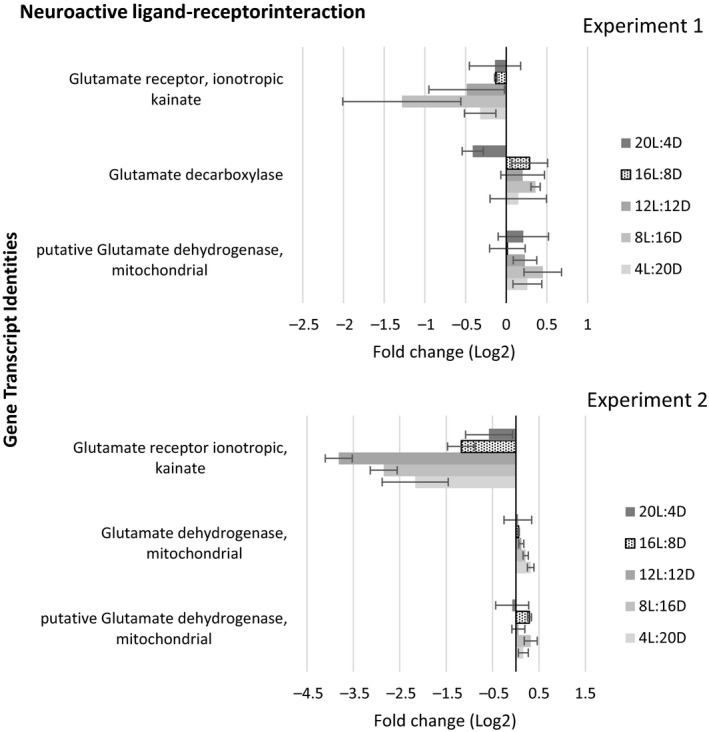
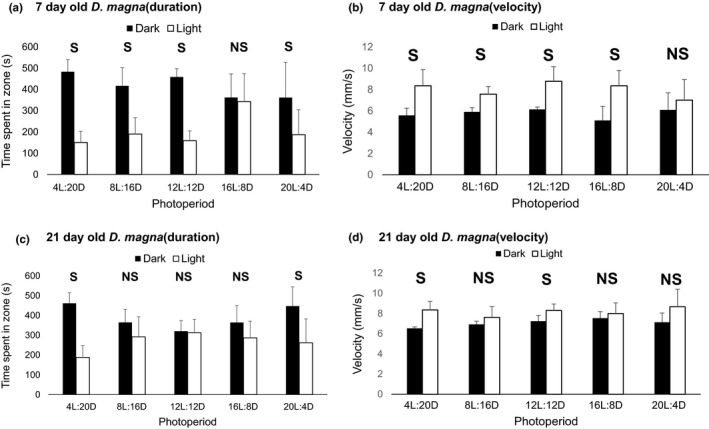
Nearly all animal species have utilized photoperiod to cue seasonal behaviours and life history traits. We investigated photoperiod responses in keystone species, Daphnia magna, to identify molecular processes underlying ecologically important behaviours and traits using functional transcriptomic analyses. Daphnia magna were photoperiod-entrained immediately posthatch to a standard control photoperiod of 16 light/ 8 dark hours (16L:8D) relative to shorter (4L:20D, 8L:16D, 12L:12L) and longer (20L:4D) day length photoperiods. Short-day photoperiods induced significantly increased light-avoidance behaviours relative to controls. Correspondingly, significant differential transcript expression for genes involved in glutamate signalling was observed, a critical signalling pathway in arthropod light-avoidance behaviour. Additionally, period circadian protein and proteins coding F-box/LRR-repeat domains were differentially expressed which are recognized to establish circadian rhythms in arthropods. Indicators of metabolic rate increased in short-day photoperiods which corresponded with broadscale changes in transcriptional expression across system-level energy metabolism pathways. The most striking observations included significantly decreased neonate production at the shortest day length photoperiod (4L:20D) and significantly increased male production across short-day and equinox photoperiods (4L:20D, 8L:16D and 12L:12D). Transcriptional expression consistent with putative mechanisms of male production was observed including photoperiod-dependent expression of transformer-2 sex-determining protein and small nuclear ribonucleoprotein particles (snRNPs) which control splice variant expression for genes like transformer. Finally, increased transcriptional expression of glutamate has also been shown to induce male production in Daphnia pulex via photoperiod-sensitive mechanisms. Overall, photoperiod entrainment affected molecular pathways that underpin critical behavioural and life history traits in D. magna providing fundamental insights into biological responses to this primary environmental cue.
几乎所有动物物种都利用光周期来提示季节性行为和生命史特征。我们研究了关键物种大型溞(Daphnia magna)对光周期的反应,以使用功能转录组分析来确定对生态重要的行为和特征的潜在分子过程。大型溞在孵化后立即被光周期驯化,适应标准对照光周期 16 光照/8 黑暗小时(16L:8D),相对于较短(4L:20D、8L:16D、12L:12L)和较长(20L:4D)的日长光周期。短日光周期诱导的避光行为明显高于对照。相应地,观察到参与谷氨酸信号的基因的显著差异转录表达,这是节肢动物避光行为的关键信号通路。此外,周期昼夜节律蛋白和编码 F 盒/LRR 重复结构域的蛋白质的表达也不同,这些蛋白质被认为在节肢动物中建立昼夜节律。在短日光周期下,代谢率的指标增加,这与系统水平能量代谢途径的广泛转录表达变化相对应。最引人注目的观察结果包括在最短的日长光周期(4L:20D)下,新生幼体的产生明显减少,以及在短日和昼夜平分点光周期(4L:20D、8L:16D 和 12L:12D)下雄性产生明显增加。观察到与雄性产生的假定机制一致的转录表达,包括光周期依赖的性别决定蛋白 transformer-2 和小核核糖核蛋白颗粒(snRNPs)的表达,它们控制像 transformer 这样的基因的剪接变体表达。最后,谷氨酸的转录表达增加也被证明可以通过光周期敏感机制诱导大型溞的雄性产生。总之,光周期驯化影响了大型溞关键行为和生命史特征的分子途径,为研究生物对这种主要环境线索的反应提供了基础。