State Key Laboratory of Infectious Disease Prevention and Control, National Institute for Communicable Disease Control and Prevention, Chinese Center for Disease Control and Prevention, Changping, Beijing, China.
Shandong Center for Disease Control and Prevention, Jinan, Shandong Province, China.
BMC Microbiol. 2019 Sep 5;19(1):213. doi: 10.1186/s12866-019-1582-8.
Shiga toxin-producing Escherichia coli (STEC) are emerging foodborne pathogens that are public health concern. Cattle have been identified as the major STEC reservoir. In the present study, we investigated the prevalence and characteristics of STEC strains in beef cattle from a commercial farm in Sichuan province, China.
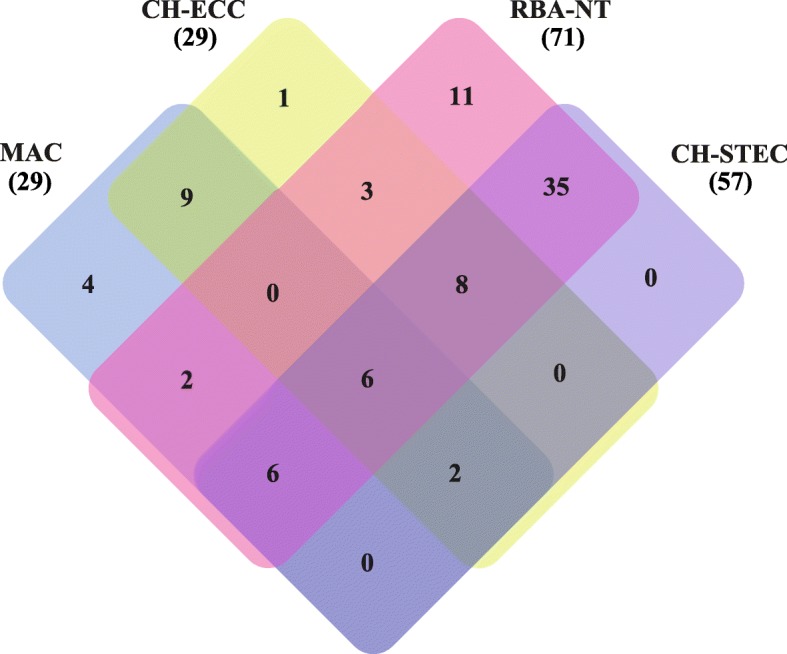
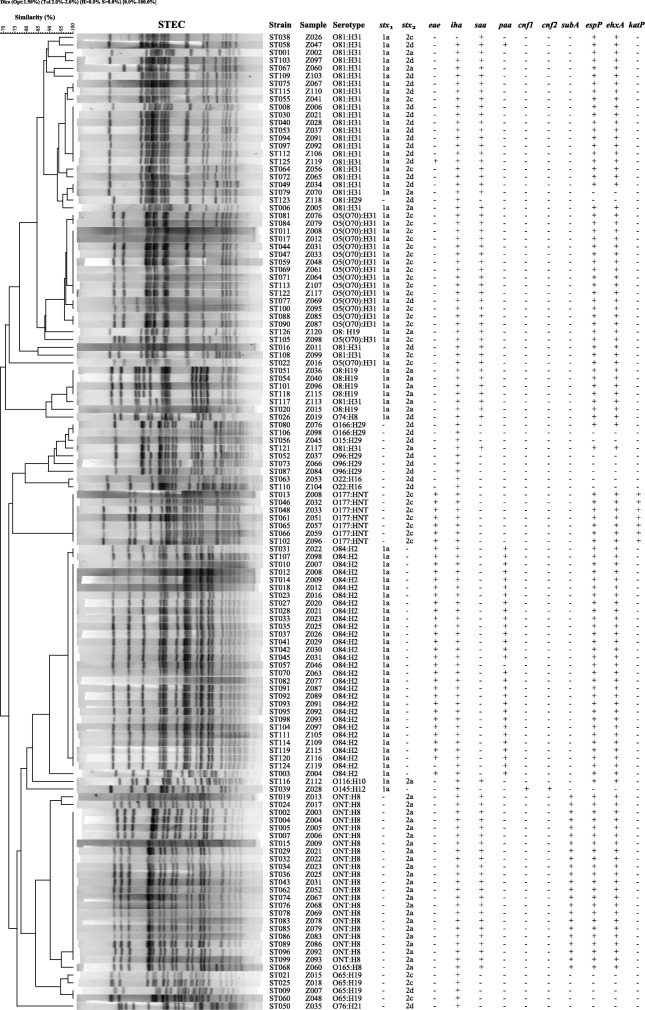
Among 120 beef cattle fecal samples, stx genes were positive in 90% of samples, as assessed using TaqMan real-time PCR, and 87 (72.5%) samples were confirmed to yield at least one STEC isolate by culture using four selective agars, MacConkey, CHROMagar™ ECC, modified Rainbow® Agar O157, and CHROMagar™ STEC, from which 31, 32, 91, and 73 STEC strains were recovered, respectively. A total of 126 STEC isolates were selected and further characterized. Seventeen different O:H serotypes were identified, all of which belonged to the non-O157 serotypes. One stx subtype (stx) and three stx subtypes (stx, stx, and stx) were present among these isolates. The intimin encoding gene eae, and other adherence-associated genes (iha, saa, and paa) were present in 37, 125, 74, and 30 STEC isolates, respectively. Twenty-three isolates carried the virulence gene subA, and only one harbored both cnf1 and cnf2 genes. Three plasmid-origin virulence genes (ehxA, espP, and katP) were present in 111, 111, and 7 isolates, respectively. The 126 STEC isolates were divided into 49 pulsed-field gel electrophoresis (PFGE) patterns.
Our study showed that the joint use of the selective MacConkey and modified Rainbow® Agar O157 agars increased the recovery frequency of non-O157 STEC strains in animal feces, which could be applied to other samples and in regular STEC surveillance. Moreover, the results revealed high genetic diversity of non-O157 STEC strains in beef cattle, some of which might have the potential to cause human diseases.
产志贺毒素大肠杆菌(STEC)是一种新兴的食源性病原体,引起了公众健康关注。牛已被确定为 STEC 的主要储存库。本研究调查了中国四川省一个商业农场肉牛中 STEC 菌株的流行情况和特征。
使用 TaqMan 实时 PCR 评估,在 120 份牛肉粪便样本中,stx 基因阳性率为 90%,通过使用四种选择性琼脂(MacConkey、CHROMagar™ ECC、改良 Rainbow® Agar O157 和 CHROMagar™ STEC)培养,确认 87(72.5%)份样本至少产生了一株 STEC 分离株,从这些样本中分别回收了 31、32、91 和 73 株 STEC 菌株。共选择了 126 株 STEC 分离株并进一步进行了特征分析。鉴定出 17 种不同的 O:H 血清型,均属于非 O157 血清型。这些分离株中存在 1 种 stx 亚型(stx)和 3 种 stx 亚型(stx、stx 和 stx)。37、125、74 和 30 株 STEC 分离株分别携带编码 intimin 的基因 eae 和其他粘附相关基因(iha、saa 和 paa)。23 株分离株携带毒力基因 subA,只有 1 株携带 cnf1 和 cnf2 基因。111、111 和 7 株分离株分别携带 3 种质粒来源的毒力基因 ehxA、espP 和 katP。126 株 STEC 分离株分为 49 种脉冲场凝胶电泳(PFGE)图谱。
本研究表明,联合使用选择性 MacConkey 和改良 Rainbow® Agar O157 琼脂可提高动物粪便中非 O157 STEC 菌株的回收率,可应用于其他样本和常规 STEC 监测。此外,结果表明牛肉牛中非 O157 STEC 菌株具有很高的遗传多样性,其中一些菌株可能具有引起人类疾病的潜力。